
Editor's Notes: Media Consolidation Is More Dangerous Than Media Fragmentation
We need to strengthen truly liberal media institutions.
Great evils require effective remedies.

On the evening of July 4, 2025, a collection of activists and protesters arrived at the Prairieland ICE detention facility in Alvarado, Texas. They performed a "noise protest," among other things setting off fireworks, in an attempt to signal to the detainees that they were not alone. Some individuals also slashed car tires and spray-painted "Ice Pig" and "Fuck you Pigs" on a car and a guard hut. ICE agents inside the facility called the local police, who responded. After an altercation, one protester—Benjamin Hanil Song—fired an AR-15 in the direction of a police officer. A bullet struck the officer in the neck, but did not kill him. Song and fifteen other activists were ultimately arrested and charged. Six took plea deals, and in June 2026 nine were convicted by a jury of their peers of multiple charges, including material support of terrorism. Song was sentenced to 100 years in prison.
Much has been written about these events, whether about the morality of the activists' actions, the absurdity of referring to antifa as an "organization" let alone a terrorist one, or the strikingly long sentences handed down. The longest sentence handed down to any of the January 6 insurrectionists, for comparison, was 22 years.
This essay will not touch on any of those topics. Instead, I want to consider the idea encapsulated in the graffiti that forms this article's header image: "Great evils require great remedies." It's a good phrase. But it reflects a moralistic or even aesthetic way of thinking about practical problems. This essay takes a different tack: great evils require effective remedies.
Thus, this is not an essay about the morality or immorality of the events at Prairieland. This essay treats morality as irrelevant. It is a cynical essay, an exercise in cold-hearted strategic and tactical analysis. It asks: what did the Prairieland activists intend to achieve, and were the tactics they adopted successful to that end?
Cards on the table: they weren't successful. The events at Prairieland on July 4, 2025, resulted in a large number of activists arrested, no national upsurge in anti-ICE sentiment, and legal and propaganda victories for the government. A tactical analysis of Prairieland is a case study in mistakes. But negative examples are nevertheless useful for future organizing.
Did the Prairieland activists achieve their goals? There is always some interpretive difficulty in identifying the "theory of the case" of diffuse mass movements. Even relatively small groups, like the Prairieland activists, are not prone to hierarchical bureaucratic structures and clearly articulated statements of policy.
On the other hand, there are the zines—the reading material of the book club to which many of the Prairieland activists belonged, and which proved so relevant at their trial (a topic to which we will return). None of these were of course the official "doctrine" of anything like a "North Texas Antifa Cell." Nevertheless, some of them articulate ideas we can see at work in the events of July 4.
Consider War in the Streets: Tactical Lessons from the Global Civil War, vol. I, published in 2016. Per the preface (p. 4):
The idea for this zine was to collect a series of situated and intelligent reflections on black blocs, street clashes and related tactics of confrontation. Each of the texts collected here tries to spell out in concrete ways what seems like it has worked and what hasn't, while trying to be clear about how each tactic relates to the larger insurrectional process.
In "The Riot or the Attack," A. G. Schwarz sets out a series of reflections that directly bears on the connection between tactics and strategy. In particular, they write (p. 28):
There is nothing valuable in refusing to challenge the alliances of capital, to instead defiantly occupy a lonely moral high ground as the only enemy of the system.
To have the hope of seeing something different, there will need to be ten flyers for every flying brick, and many more of each.
In other words, the point of "attacks" is not merely to slash the tires of a random car—a meaningless act—but rather must be coupled with effective communication of ideology, with the aim of activating and recruiting larger numbers of people to the cause.
If the ultimate goal is to end the mass deportation regime, then this requires some form of national political change, whether that comes in the form of a general strike or a general election. The goal of individual "attacks," therefore, is to activate large numbers of people to engage in the cause.
The "noise demonstration," aka the setting-off of fireworks, served the additional goal of communicating to detainees that they are not alone: that there is someone out there who cares about them and is willing to fight for them. Of course, this may also have the effect of activating larger numbers of people to the cause.
We must therefore ask two questions: first, did the Prairieland activists achieve these goals? Second, how did the government successfully spin their actions into "material support of terrorism"?
The short answer is "no" and "easily." Whether you think their actions were villainous or heroic is not my concern. What is true is that their actions ensured that they struggled to achieve sympathetic media coverage outside of a few left-wing outlets, struggled to attract material or legal support (the ACLU, for instance, refused to touch the case), and failed to achieve positive virality in the larger culture. In other words, their tactics failed to connect with their larger goals.
Let us start with the single most important failure at Prairieland, the event that transformed July 4 from unruly protest into "material support for terrorism": Song shot a cop.
According to Song, he was firing warning shots—aimed at the ground—and it was simply a bad ricochet that led to the cop getting struck. Maybe this is true—but it hardly matters. There is a certain aura of fate about the entire affair—a few inches in one direction, and Song would have hit nothing; a few inches in the other, and the bullet severs the officer's spine and he's dead at the scene. Strange circumstances: but they reflect the fundamental truth that adding violence to a situation inherently creates unpredictability. Song fired an AR-15 in the direction of a police officer; once you do that, the results are not exactly under your control.
What events led to this outcome? The activists were worried about the presence of armed counterprotesters—viz., white supremacists with guns. They therefore came equipped with a small arsenal of their own, including handguns, longarms, body armor, and first aid kits with gunshot trauma materials.
As the old Texan saying goes, "an armed society is a polite society." The idea was that the presence of armed activists would deter armed counterprotesters from causing trouble. In the event, no counterprotesters appeared, armed or otherwise. Most activists therefore left their weapons in a nearby van. Song, however, kept his rifle "just in case."
And, when police arrived—as, frankly, the activists very much expected them to—and one of them drew his sidearm, Song fired his rifle and struck a police officer.
It might be tempting at this point to shift to a moral framework that simply blames Song for being a hothead. But that would be a mistake. Rather, Song's actions are an unsurprising result of culture and doctrine among the Prarieland activists. This isn't particularly complicated. Prior to July 4, Song himself talked about using longarms to intimidate police officers.
Per one of the activists, Susan Kent:
Autumn Hill asked Song whether the plan was for them to bring guns. "Yes," Song replied. "I'm not getting arrested."
And when police officers arrived, someone shouts "Get to the rifles," at least according to prosecutors. Song's actions flowed out of a deliberate strategy of using firearms to intimidate other armed parties. And as Song's actions demonstrate, once you commit yourself to such a strategy, you have inherently admitted the possibility of shooting, injuring, and killing the other party.
Of course, right-wing groups bring guns to protests all the time. On the other hand, right-wing activists often have the active support of police officers. They are not planning to commit property crimes and get into fights with cops. As Katherine Cross has emphasized, they understand that they want to have the cops on their side, and cops are often willing to oblige. Perhaps this is unfair, but that hardly matters: activists must take account of realities.
It is also worth noting here that the use of violence no longer appears to inherently discredit left-wing activism. Luigi Mangione's killing of UnitedHealthcare CEO Brian Thompson created a—to this author—distressing degree of online support. Tyler Robinson's (alleged) killing of right-wing media activist Charlie Kirk likewise created no clear groundswell of support for pro-MAGA ideas, despite enormous efforts by the administration and right-wing media to turn Kirk into a martyr.
But none of this entails that all violence is equally effective. The directionless violence of "public disorder," from smashed shop windows to burning dumpsters to "that guy on the subway is being weird and rowdy," reliably turns normie publics in reactionary directions. This is, on some level, quite understandable. The average American is not worried about getting assassinated for billionaire crimes. But perhaps their window might get smashed: what then??
The Prairieland activists failed to incorporate their tactical doctrine into an effective strategy. The net result is that the material action—shooting a cop—combined with the aesthetics (vandalism, graffiti, disorder, guys in ski masks running around shouting about smashing the state)—together meant that it was easy for the government to paint them as terrorists, and difficult for them to present themselves to a mass audience as sympathetic protesters.
The events at Prairieland also demonstrate the limits of "opsec." The use of encrypted chats such as Signal, or the practice of not taking your phone to a protest, may provide a certain limited protection from routine surveillance. But if you shoot a cop in the neck, the gaze of the state will fall upon you like a hammer.
The essay "How Is It To Be Fun?" from the War in the Streets zine presents itself as a guidebook for engaging in black bloc activity, by which its author means a set of tactics for engaging in and getting away with illegal activity at protests, such as vandalism (p. 6). These tactics include rooting out or avoiding police informants (p. 12), getting into and out of all-black "party clothes" (p. 13) in order to make identification difficult, development of "affinity groups" of three to eight people to be your partners in crime (p. 7), and so on.
That essay represents an extreme example, in its explicit endorsement of illegal activities, but nevertheless, "security culture" or "opsec" has become a basic aspect of organizing in the modern age. Even relatively normie groups now communicate via encrypted messaging apps with self-deleting messages. And the practice is pervasive in corridors of power, from Silicon Valley to the White House.
The Prairieland activists embraced a number of aspects of security culture. They surveyed the Prairieland site ahead of time, noted the locations of security cameras, parked their cars out of sight of the protest area, organized via private Signal chats rather than public posting, and left their phones away from the protest area, some in Faraday bags. Many of them arrived in black bloc costume, some with face masks.
Evaluated merely on a tactical level, these kinds of measures can function to make it difficult for police to identify and charge individuals for various petty crimes. However, what Prairieland demonstrates is that security culture becomes a trap once certain lines are crossed. To again quote "How Is It To Be Fun?": "The second most basic element of security culture is staying off [the police's] radar" (p. 7). If you break a store window in Coraopolis, the FBI is unlikely to bend all its resources to find you. If you shoot a cop in the neck while attacking an ICE facility, multiple federal agencies are going to come looking for you.
You need to adjust your security culture to your threat model. As James Mickens so memorably put it in a rather different context, if the Mossad wants to get you, the Mossad is going to get you. The trick therefore is to avoid getting on the Mossad's radar—or, in this case, the FBI's.
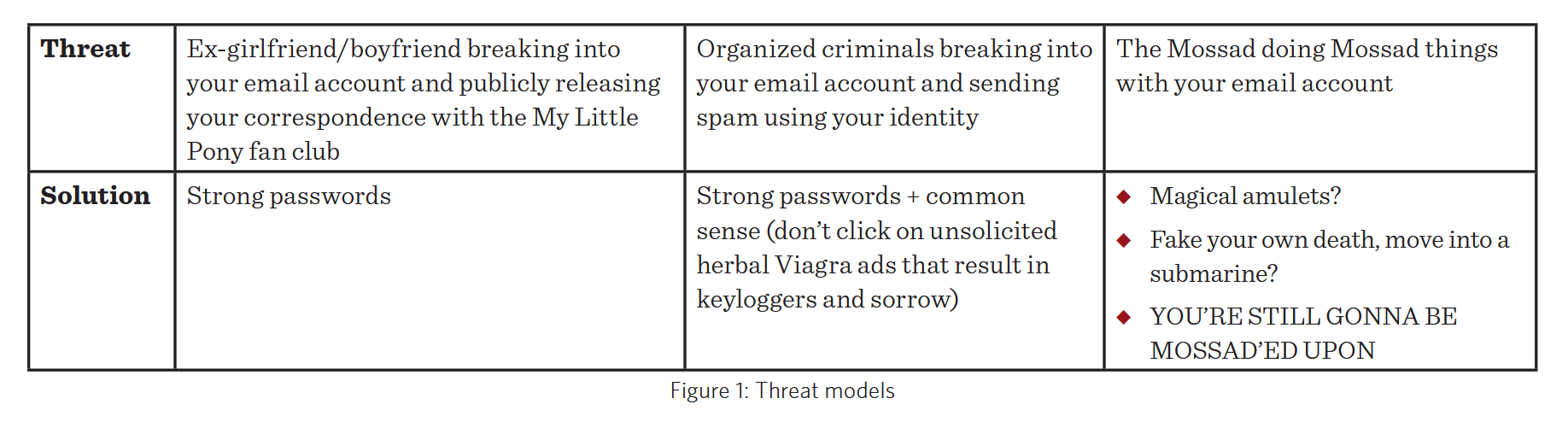
Once you are on their radar, as a result of having committed a serious crime like (e.g.) shooting a cop and then leveraging your affinity group to attempt to get away with it, security culture becomes a trap. The level of federal scrutiny that landed on the Prairieland protests made it inevitable that the activists involved would be identified and arrested. And the actions they took to obscure their identities beforehand—and to escape and hide evidence afterwards, from giving each other rides to deleting Signal chats to removing boxes of anarchist literature—themselves became evidence of crimes like obstructing justice, tampering with evidence, conspiracy, and material support of terrorism.
At least some authors have argued that it was just "snitches" who ruined everything. But it is a mistake to blame outcomes on individual character. It is simply impossible to prevent at least some people from talking to the police once the crowd size passes a certain point, and even more so if someone has shot a cop. No amount of security culture is going to prevent this.
At least some commentators have framed the Prairieland case as an attack on free speech in general, largely because of the importance of the zines to the government's case. Many of the defendants were in a book club together; some of that club's reading material was radical zines.
It is important to be precise here. Sophie Lewis' "The Satanic Death Cult Is Real" is in fact just a long-form reflection on the horror movies "Hereditary" and "Midsommar." Other book-club readings, such as War in the Streets, which I have quoted from repeatedly, "Organising for Attack! Insurrectionary Anarchy," and "If We Go, We Go on Fire: On Grief and Social War" quite explicitly advocate for engaging in illegal activity and provide tactics and justifications for doing so. At trial, the government made a great deal of hay out of these readings. We are told that the Prairieland case therefore represents an assault on the First Amendment.
Yet you can read all those zines right now. You can order physical copies from the internet right now, or you can easily search their titles and find electronic copies freely available. It is not illegal to possess, read, or distribute these texts. Perhaps you should.
Rather, Prairieland is a case study for activists in the limits of the First Amendment. Freedom of speech is a powerful tool for activists, but it is equally important to understand the limits of that tool.
Consider another incendiary essay, Nicholas Decker's "When Must We Kill Them?" While this essay earned Decker a visit from the Secret Service, he was never charged with anything, and the essay remains freely available online.
Now consider the following hypothetical. I arrange a reading group with my friends, in which we read Decker's essay. Afterwards we all agree that we should, in fact, kill them. And then we go out and do so. After having done so, at least one of us attempts to destroy evidence that she had ever read the essay. In such case the government might reasonably both use our possession of the essay as evidence of our intent, and portray our later removal of the essay as an attempt to cover up evidence.
The First Amendment, in other words, provides extremely powerful protections for free speech, far more so than in most comparable Western countries. But these protections are not absolute. As @InternetHippo so memorably put it,
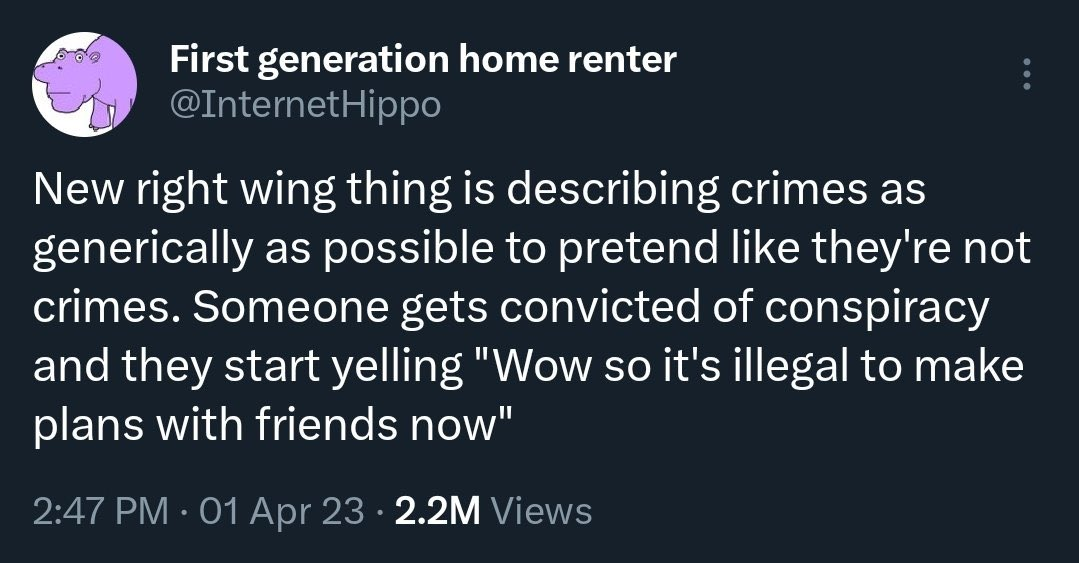
Consider Maricela Rueda. After her arrest, from jail, Rueda called her mother; her mother called Daniel Sanchez Estrada (Rueda's husband), and told him that he should go to Rueda's house and take some things from it. One of the things he took was a box of radical zines. Was he convicted of "moving a box of zines"?
No. He was convicted of tampering with evidence, because he was tampering with evidence. The sentence—30 years—is absurd. But while the continual cry that Estrada was convicted for "moving a box of zines" is perhaps effective propaganda, it remains bad tactical analysis. The First Amendment will not protect you if you are attempting to hide evidence! You, activist, should not expect it to!
It is worth emphasizing, again, that in previous cases—like the cases against the DisruptJ20 protesters or the Stop Cop City protests—prosecutors attempted to leverage such evidence against activists to demonstrate that, e.g., everyone wearing black was engaged in a conspiracy against the state. In those cases they failed, but also the DisruptJ20 activists did not shoot a cop. One must be purely cynical about such things: juries are inclined to let defendants off when they think the charges are bullshit. When there's a cop on the stand with a big scar on his neck from a 5.56 round, juries are less sympathetic.
Tactical errors often flow from deeper cultural dysfunctions. Once again, A. G. Schwarz provides a useful summary (p. 27):
Smashing windows can become and is becoming the signifier of belonging to yet another clique, little different from organizing Food Not Bombs or riding bicycles or holding mycology workshops.
This dynamic was comprehensively analyzed by longtime activist Jonathan Smucker in his Hegemony How-To. Smucker recalls having a certain epiphany while preparing for the Washington A16, 2000 anti-IMF protests. He saw his fellow activists engaged in activities that were nominally about recruiting outsiders and normies—about building a mass movement—and yet at the same moment these actions were almost perfectly calibrated to alienate outsiders (p. 30). Smucker understood that these actions, despite their superficial appearance, were in truth aimed at insiders—aimed at proving one's radical bona fides within the movement, and therefore securing one's social standing. Per Marxist theory, this is an instance of the general tension between maintaining one's status within a group and improving the status of the group in wider society.
We might therefore call this behavior radicalism for radicalism's sake. It gives the appearance of being aimed at stopping some great social wrong, such as the mass deportation machine. But achieving that goal almost definitionally requires activating a mass national movement. And the actions of the Prairieland activists were not well-calibrated to that end. They failed to impact the national attention cycle, achieving at best notoriety among a small set of left-wing activists and media.
Once stated, one can see how this phenomenon pervaded the events at Prairieland—the obsession with assault rifles and armed standoffs, the black clothes and ski masks, the opsec cult—signifiers of radicalism calculated to alienate normies while elevating one's status with a fringe clique. Mere tactics disconnected from real strategy.
It is worth noting again that charges not unlike the Prairieland charges failed to stick against DisruptJ20 or Stop Cop City activists. Yet they have stuck against the Prairieland activists. It is not exactly a mystery why. Sara van Horn interviewed Xavier de Janon, a lawyer for a Prairieland defendant:
According to de Janon, the fact that there was a gun present and that the black bloc participants did not conform to certain standards of respectable activism made this case seem unsavory or too risky to support.
If this were a soccer match, whining about unfairness might be reasonable. But in fact this is a desperate struggle for the future of the republic. What is necessary is to win.
Of course the prosecutions are politically motivated. Of course the administration's rhetoric is wildly overheated. Of course the judges are Republican hacks who spend the rest of their time screaming about the trans menace.
In other cases, activists and indeed ordinary Americans have understood that it is possible to turn these apparent strengths into weaknesses. The government overcharges, prosecutors act unlawfully before grand juries, the grand juries laugh them out of the room. Larry Bushart was arrested for posting a dumb meme about Charlie Kirk; he sued the government and won, ultimately receiving a $835,000 settlement.
The Prairieland events, by contrast, met the administration on exactly the terrain the administration wished to be met on. Since Trump's inauguration, the administration has been desperately attempting to get a "do-over" on the George Floyd protests of 2020. They wish to manufacture images of steely-eyed soldiers facing off against violent un-American riots. These images are intended to leverage support for increased state powers and expanded authoritarianism.
The Prairieland activists decided to meet the administration on the field the administration picked and deliver them the fight the administration wanted. By contrast the ordinary citizens of Minneapolis, and their resolute nonviolence, even in the face of brutal murders committed by agents of the state, have done far more to change national opinion on the mass deportation machine. They chose not to give the administration the fight it wanted. They met physical force with soul force, as Dr. King put it. Forget about the morality. The tactic was effective.
Whether you think the Prairieland activists are victims or heroes is left to you, reader. This is a cynical essay. And this cynic notes that there seems to be an advantage to wrapping yourself in the flag and declaring that your goal is to save America, as opposed to dressing all in black and explaining how your goal is to destroy it.
In 1989, a wave of massive protests broke out across the authoritarian communist regimes of the Eastern Bloc. The security apparatuses of the Soviet Union were still in place, waiting for orders to suppress the crowds: but the orders never came. The East German regime anticipated violence to which they might respond with force, but no violence came, not a molotov cocktail nor a broken shop window. The following passage, from Steven Kotkin's Uncivil Society (p. 59), is a propos here.
Later, one Stasi officer recalled that, although they had been told to anticipate a mob, ‘we saw that they were entirely normal people shouting “Wir Sind das Volk [We are the people],”’ adding ‘and we belonged to them too.’
Featured image credit author, 2026.

We need to strengthen truly liberal media institutions.

Accountability and court reform must be zealously pursued once Trump is out of power.

Get a copy of The Reconstruction Papers while inventory lasts, and reserve a copy of next year’s issue.

Drawing on and improving the model pioneered during the New Deal.
Sign up for the newsletter and get our latest stories delivered straight to your inbox.