
The Communist and the Caricature: the Missed Opportunity in August Nimtz and Kyle Edwards' "The Communist and the Revolutionary Liberal in the Second American Revolution"
Nimtz and Edwards offer caricatures where a fascinating and nuanced reality was available.

Socialism is alien to America, and hostile to American values.
Such is taken for granted not only in rightwing American politics, but in the mainstream political discourse. Even with the advent of Bernie Sanders, democratic socialism is at most a fringe phenomenon that arouses suspicion from most of the Democratic Party.
It’s curious to learn, then, that Karl Marx had a deep connection to America in his lifetime. Though Marx never visited America, he was a regular correspondent for Horace Greeley’s New York Daily Tribune, which at the time had the largest subscriber base in the world (200,000 in 1855). Marx wrote nearly 500 articles for the paper (some of these were written by Friedrich Engels) from the years 1853 to 1861, when Marx lost his position due to cost cutting related to the Civil War.
In these pages Marx argued forcefully for the abolition of slavery, which he saw as a moral imperative in and of itself, but also as critical for the unification and empowering of the American proletariat. After the defeat of the 1848 revolutions in Europe, Marx saw America as the next great hope for the working class. Marx translated these ideas into political action, advocating for the Republican Party and the election of Abraham Lincoln in the pivotal 1860 election.
More importantly, Marx was not alone. After the failed 1848 revolutions, thousands of German radicals fled Prussian oppression and found new lives in America. These “Forty-Eighters” carried on their radical left politics in their new home, spreading the ideas of Marx and Engels by forming clubs (like the New York Communist Club), publishing pamphlets and newspapers, and ultimately by campaigning for Lincoln and the Republicans and volunteering for the war effort on the Union side.
Marx’s greatest lieutenant in America was the Forty-Eighter Joseph Weydemeyer, who had befriended Marx and Engels back in Prussia, and had served as an editor of Marx’s socialist periodical Neue Rheinische Zeitung. In America before the war, Weydemeyer was responsible for publishing (in German) Marx’s famous essay, the Eighteenth Brumaire of Louis Napoleon. In the Civil War itself, Weydemeyer rallied the sizable German American community to support Lincoln and the war effort and served under General John C Frémont. Unlike much of the Republican Party, including Lincoln himself in the early stages of the war, Weydemeyer and the German Americans conceived of the war in explicitly abolitionist terms. The Forty-Eighters fought the Slave Power not to preserve the Union, but to eradicate slavery from America.
Karl Marx and the radical left were with America in her moment of greatest peril and highest triumph.
I learned these details of Marx’s championing of a free America and the German immigrant communist radicals who aided in this effort from a remarkable book, The Communist and the Revolutionary Liberal in the Second American Revolution: Comparing Karl Marx and Frederick Douglass in Real-Time. Authors August Nimtz and Kyle Edwards take advantage of the fact that the titular subjects were almost exact contemporaries—Marx and Douglass were both born in 1818, though Marx died a little over a decade before Douglass—who both left enormous written corpuses with significant topical overlap.
The value of this approach is clear enough. When thinking about two ideologies, it’s so easy to get bogged down in fraught comparisons between ideal theory versus the complicated actions of historical actors, or between figures in wildly different contexts and times. Why not compare the celebrated revolutionary liberal, Frederick Douglass, with the iconic theorist of communism in a kind of natural ideological experiment on the issues they both discussed at length on record? Why not indeed.
Marx versus Douglass
The picture of Frederick Douglass that emerges is one of a hapless liberal, hidebound to a Providence-based episteme and a natural rights political framework, whose naïve legal grasp of the American Constitution and lack of organizational acumen limited his influence to giving speeches and penning books and newspaper columns. Douglass was a passionate abolitionist, however, and for a brief period before and during the war, the liberal pacifist scales fell from his eyes, and he endorsed revolutionary violence. Douglass ultimately disappointed even here, because his only goal was to free the chattel slaves, rather than liberate all workers from the bondage of private property. His “voting fetishism” and “parliamentary cretinism” lowered and occluded his sights.
Karl Marx, by contrast, learned the hard lessons of 1848 that real progress could only be achieved at the barricades and on the battlefields. His scientific historical materialism informed him that it was virtually impossible for the North to lose the war. Marx’s keen judgment of character and political savvy brought him to support Abraham Lincoln in the 1860 election and throughout the war, despite Lincoln’s failure to commit to ending slavery and reluctance to prosecute the war as an abolitionist revolution rather than a constitutional war of preserving the Union. And, of course, Marx’s communist principles made obvious the need to expropriate the enslavers and redistribute their plantations amongst the freed blacks. Marx’s party-building and savvy networking allowed him to extend his reach across the Atlantic, as his loyal lieutenants organized the German Americans into action, in politics and in war.
I began reading this book as an avid fan of Douglass and as someone who appreciates Marx, even if critically. So I was prepared for an immersion into the complexities of two of the nineteenth century’s most renowned activists and innovative thinkers. Instead, I read the caricatures above.
I should back up and attend to a few specific criticisms. Consider the assertion that Douglass held fast to a belief that Providence must prevail in the end and vanquish slavery.
Unlike Douglass, Marx was no inevitablist about the progress of human emancipation. If so, then why the need for the Manifesto? … For Douglass, at that moment in his career, Providence and natural law were most decisive in the unfolding of the history of society, whereas for Marx the conscious intervention of human beings (shaped by circumstances beyond their control) was most decisive in this unfolding. This marked the fundamental epistemological difference between the two protagonists. (81)
It’s pretty remarkable to claim that Douglass—who escaped slavery, founded and edited abolitionist and antiracist newspapers, conducted fugitives from bondage along the Underground Railroad, personally lobbied the President of the United States to levy blacks in the Union Army to turn the war into one of emancipation, and then rallied black volunteers to enlist when Lincoln finally acquiesced—to claim that such a man rested comfortably waiting for Providence to carry the day. Nimtz and Edwards (NE) fail to even mention Douglass’s involvement with the Underground Railroad, where Douglass risked his life aiding fugitives.
There is quite some irony in making this claim about Douglass and Providence and then going on to praise Marx for his prophetic confidence that the North must win the war based on the “scientific” principles of historical materialism.
“I am firmly of the opinion, [Marx] wrote, “now as before, that the North will win in the end.” Yes, along the way there would be all kinds of twists and turns but for the South to be victorious it would require “the RECONSTRUCTION of the United States on the basis demanded by the South,” namely, on the basis of slavery. “But that is impossible and won’t happen.” … Then Marx’s bottom line: “For all that, I’m prepared”—informed by his historical materialist perspective—”to bet my life on it that these [Southern] fellows will come off worst.” It’s hard to imagine Douglass saying the same. (198)
Another bizarre angle NE take is emphasizing Douglass’s stated view that the Constitution was an abolitionist document. They argue that this was a marginal view among constitutional scholars and that Marx had the better understanding of the Constitution as a document that affirmed slavery.
For Douglass, the Constitution was an abolitionist document, near sacrosanct—again, a position that few abolitionists other than he adhered to. This was why, therefore, Douglass could proclaim, as he did in July 1863, ‘not a sentence or syllable of the Constitution need be altered.’ For Marx, on the other hand, Lincoln’s adherence to the document had been an obstacle for the defeat of the slavocracy. (193)
Douglass’s abolitionist constitutionalism is not so marginal as NE claim. But that is almost beside the point. NE act on a number of occasions in the book as if Douglass was primarily concerned with legal interpretation, rather than changing—abolishing—the fact of slavery on the ground. One might even say that Douglass was concerned less with interpreting the world and more with changing it.
NE do discuss some real and interesting differences. Two interesting cases are the protagonists’ divergent reactions to the political unrest in Europe in 1848 and the Paris Commune in 1871. The authors skewer Douglass for condemning the peaceful Chartist march on Parliament in London in April, 1848. Douglass evidently thought this was an assembly intent on violence, and pointed to the progress liberal radicals in Britain had made on a number of social justice causes by peaceful, democratic means. NE are on target to suggest Douglass was overwrought in his denunciation of the Chartists, and betrayed a cause he was sympathetic to.
Douglass had been inspired by the February revolution that ushered in a republican government in France, but condemned the “wild and wicked means of anarchy and bloodshed” of what would come to be known as the June Days uprising. Unlike the example of the Chartists in England, this was real political violence, spurred by the closure of the national workshops the republican government had opened up to provide employment for the masses. Douglass, again, wanted to defend republican government. NE point to this as just another example of Douglass’s naïveté—his “parliamentary cretinism” that prevented him from seeing that real political change came from the barricades and battlefields. Douglass does little to assuage his 21st century critics when he blames “the communists of Paris … for this last confused scene of human slaughter.” Yet it’s worth noting that Douglass also allowed that the rebellious workers evidently believed they were fighting for their rights, and he issued a warning to the statesmen of Europe: the people will not idly suffer oppression and injustice if they believe they have it in their means to throw it off.
NE level similar criticism of Douglass’s condemnation two decades later of the Paris Commune in 1871. Douglass sided again with national republicans—who had negotiated a peace with the Prussians and secured relatively favorable terms for Paris—against radical leftists. As leftist radicals themselves, it makes sense that NE would side with the Communards. Yet from the perspective of pragmatic politics of the kind our authors argued Marx excelled at in the case of Lincoln and the Republican Party, the Paris Commune was doomed from the start. If this is the case, it’s hard to blame Douglass for condemning “radicalism … run mad.” Or perhaps Marx and his 21st century protégés believe the better analogy to the Commune would be John Brown’s always dubious yet nevertheless inspiring raid on Harpers Ferry.
One well targeted criticism of Douglass is his refusal to back the expropriation of plantations from slave owners and to redistribute it to the emancipated blacks after the war. As NE graciously acknowledge, Douglass didn't argue against such a seizure, but neither did he advocate it, a notable neglect for an unshy newspaperman. Much later in life, Douglass himself regretted this. For Marx and his communist worldview, this policy was obvious.
Marx versus Douglass?
From a Marxist perspective, there is plenty to criticize in Douglass. After all, he was a liberal and not a communist. But our authors ignore or downplay points of convergence and potentially fruitful exchange between Douglass and Marx, owing to their presentation of Douglass as an uncomplicated and unreflective thinker who had no agenda beyond the abolition of slavery and the establishment of republican institutions.
Marx, or at least his modern day interpreters, might dismiss Douglass's lifelong dedication to women's suffrage and equal access to political office and representation as "voting fetishism" but there are deeper resonances here. Douglass's feminism wasn't a bland assertion of ethereal "natural rights," but an assertion of human fullness of being, of granting woman "the fullest opportunity to exercise all the powers inherent in her individual personality, and allow her to do it as she herself shall elect to exercise them. Her right to be and to do is as full, complete and perfect as the right of any man on earth." This was just the application to women of Douglass's oft-repeated vision of human brotherhood as "all for each, and each for all," a phrase bearing more than passing resemblance to Marx's own famous "free development of each is the condition for the free development of all."
One might think that economic inequality would be a natural topic for a comparison between the communist Marx and the liberal Douglass. NE do mention Matthew Karp's exhumation in Jacobin of Douglass's arguments against wealth inequality. But they dismiss this intervention in the space of a single paragraph in their conclusion. Only the abolition of property and full communism, it seems, are acceptable responses to wealth inequality. This is unfortunate because in this antebellum piece (1856) Douglass sets out an argument not only that "wealth has ever been the tool of the tyrant, the readiest means by which liberty is overthrown," and that "poverty [is] the natural consequence of wealth unduly accumulated," but argues from class interest and systemic perspectives. In the Douglass view, tyrants cling to their power by colluding with capital and duping the working poor into serving the interests of the wealthy. Like Marx, Douglass thought capitalism was not simply the tyranny of evil men, but that "the rush and crash of the mighty machine of society compels them, in self-defence, to join in the rush for wealth."
Douglass's attention to inequality merited a passing, if irritated and perfunctory, reference in the main text of the volume. Douglass's commentaries, repeated in different versions across three decades, on "the labor question" are pushed to a short discussion in an appendix. This is a puzzling marginalization from a communist investigation, even if their ultimate conclusion is to denounce Douglass as hopelessly bourgeois. But there is much a Marxist might appreciate in Douglass, who averred “the labor of a country is the source of its wealth; without the colored laborer to-day the South would be a howling wilderness, given up to bats, owls, wolves and bears.” For Douglass,
The happiness of man must be the primal condition on which any form of society alone can found a title to existence. … That society is a failure in which the large majority of its members, without any direct fault of their own, would, if any accidental circumstances deprived them for a month of the opportunity of earning regular wages, be dependent upon private or public charity for daily bread. Yet such is the actual condition of even favored American labor.
NE are fair to say that Douglass’s prescriptions are less impressive than his normative assessments. Douglass struggled with what exactly to do about the “labor question.” Yet Douglass felt that labor must ultimately win in the contest with capital for the sake of humanity. This seems like an obvious point of fruitful exchange between socialists and Douglass-inspired liberals, if not coalition.
There’s some irony in one issue that was ignored entirely by NE: the question of free trade. The irony is that Marx favored free trade—the liberal position—while Douglass supported protectionism. Add a wrinkle: Douglass’s protectionism explicitly appealed to the interests of American labor.
This points to a final commonality between Marx and Douglass, and one that goes largely untouched by NE. Both our protagonists were steadfast cosmopolitans. Douglass advanced both a black internationalism that centered Haiti and other black populations, as well as an American “composite nationality.” He pressed the case for open borders for men and women of all races from all parts of the world. This, again, pairs well with Marx’s own admirable cosmopolitanism that urged the workers of the world to break their chains and unite against the common capitalist enemy.
There is so much that liberals can learn from Karl Marx, in both his philosophical work and his political activism. Liberals have been blind to the value of Marxian thought because of the Cold War and the genuinely antiliberal nature of the dominant strands of Marxism in the 20th century. Nimtz and Edwards have done us all a service by beginning a conversation about how Marx can relate to liberalism by doing a real-time comparison between Marx and Douglass.
Unfortunately, Nimtz and Edwards undercut their case by caricaturing Douglass and, arguably, Marx. This serves no one. A Marxist reading this text will see little of the radicalism and complexity of Douglass's fugitive liberalism. A liberal encountering the doctrinaire and incurious Marxism presented here will miss much of the liberal-adjacent pragmatism of Marx, let alone the wide diversity of later Marxism. More open-minded investigations without predetermined conclusions will prove more fruitful for liberals and socialists both.
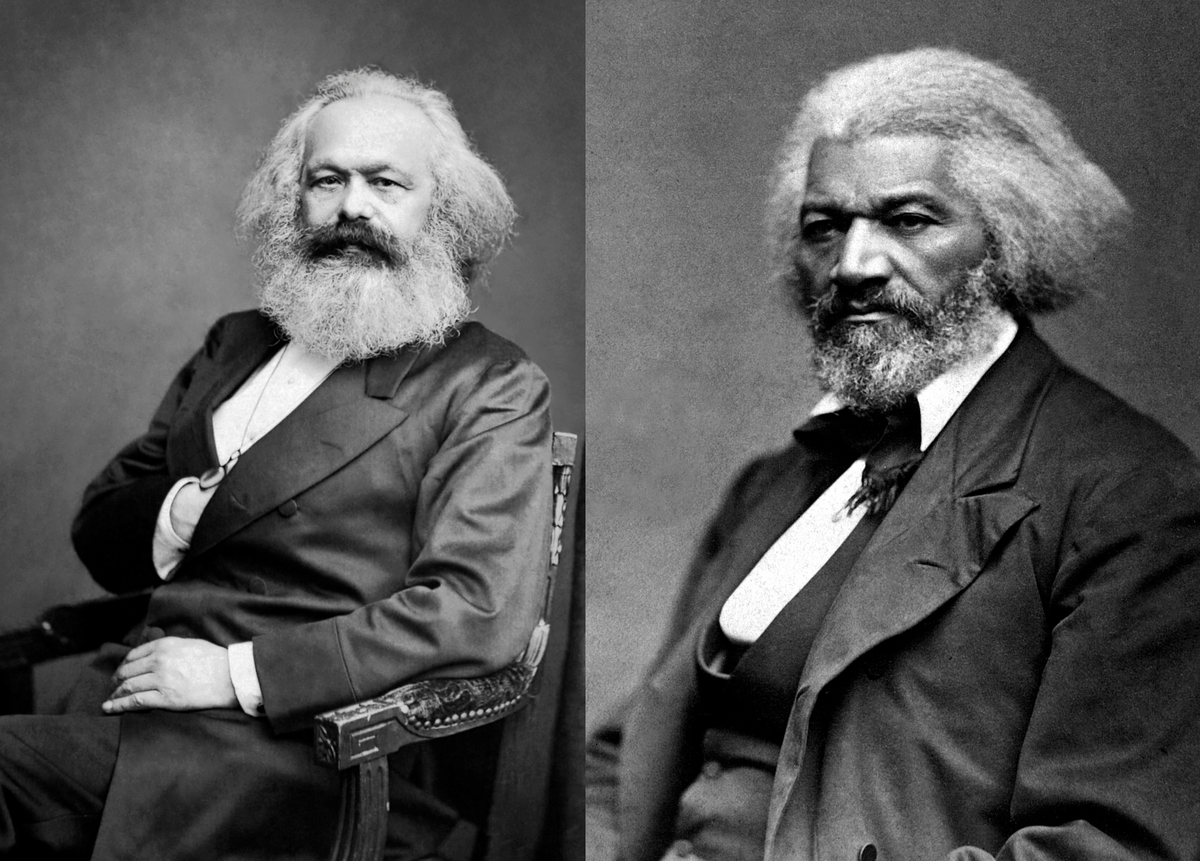
Featured image is Karl Marx and Frederick Douglass


.png?ref=liberalcurrents.com)
_(cropped).jpg?ref=liberalcurrents.com)