
Concede Nothing
Trans people are who we say we are, and we will fight and organize on those grounds.
It's never just one minority.

In the space of a few years, the UK has moved from a broadly inclusive status quo to being the most aggressively anti-trans developed democracy in the world. Though pushed by a minuscule number of people, the assault has been full-spectrum—government, courts, press, the health system, radicalised internet groups, and violent vigilantes—all working simultaneously towards the same goal.
Precisely because this has taken place across multiple domains (and often in quite convoluted ways, with poor press coverage) the speed and scale of our transformation is often lost on people. But when considered together, it’s staggering.
In the 2017 general election, all the major parties ran on making the country more trans-inclusive. The then governing Tory Party abandoned these commitments in 2020. Later that year, the High Court ruled that gender affirming care for trans people under 16 (puberty blockers) needed court approval. This would be overturned a year later, but restrictions the National Health Service (NHS) adopted following the ruling would remain. In 2023, scenes of utter derangement—including anti-trans campaigners exposing themselves in parliament—acompanied the Scottish government passing minor reforms to make gender transition easier. The national Tory government (who had run on these same policies a mere 5 years before) caused a constitutional crisis by intervening in Scotland's affair to block the bill, the first time such a veto had occurred since devolution.
The next year, the NHS ended all prescriptions of puberty blockers to under 18s. The Tavistock Centre—England’s only youth gender clinic—was closed. An aggressive campaign from the national press alleged that at least 1,000 families were planning to sue the centre for rushing their children into transition. It was later revealed that, over 10 years and 12,000 users, the clinic had actually only received 8 complaints about care.
Seeking healthcare elsewhere was also ruled out. In May of 2024 the government used emergency powers to criminalize the supply of puberty blockers from private providers. They would be voted out of office 2 months later, but the incoming Labour government quickly formalised the emergency prohibition into a permanent legal ban. This mass denial of care (and, in many cases, forceable detransition) was accompanied, predictably, by an explosion in the suicide rate amoung trans young people. Deaths linked to gender or sexual identity more than doubled in 24/25, and trans young people are now estimated to be taking their own lives at 7 times the rate of their peers. Campaigners for trans inclusion describe regularly hearing from parents who are sleeping at the bottom of their children’s beds, terrified of what they might do.
A year ago, The UK supreme court ruled that the 2010 Equality Act should be interpreted in line with sex recorded at birth (or “biological sex” as it is generally called by our press and politicians). What this meant practically was unclear, but our press immediately interpreted it as mandating a national ban on trans inclusion in public bathrooms. As did the Equality and Human Rights Commission (EHRC) which attempted to unilaterally enforce an aggressive prohibition on any trans person entering any single-sex space—either those that matched their gender identity, or those that matched their sex at birth. What followed was a year of confused back and forths in which it has been functionally unknowable which toilets—if any—trans people are legally permitted to use.
Meanwhile, the effective end of healthcare has expanded from teenagers to adults. Between 2016 and 2025 the average wait time for a first appointment at an (adult) gender clinic increased from 9 months to 25 years.
On Thursday (the 21st), the final version of the EHRC’s statutory code of practice was revealed. This is toned down somewhat from earlier drafts, but the thrust is clear: trans people must be excluded from the single-sex spaces of their gender (trans women cannot be allowed to use women’s toilets), and may be excluded from single sex spaces of their assigned sex at birth (a trans man can be barred from a women’s toilet or changing room) on a case by case basis. This is to be enforced by challenges based on an individual’s “physique or physical appearance.” It also includes what functionally amounts to a complete ban on trans people competing in sports.
All of this has been accompanied by a rise in harassment, intimidation, and violence. Since the supreme court ruling last year, both trans people, queer people, and those with a presentation that does not match gender stereotypes have reported a marked increase in hostility and challenges. Many of the leading voices of the anti-trans movement have taken to overtly calling for violence against trans women using the “wrong” toilets. When noted anti-trans fanatic Graham Lineham was arrested for (even by their standards) blatant incitement, it became a cause célèbre with the entire gender critical movement rushing to defend him, including Labour ministers like Wes Streeting (one of the architects of the banning of youth healthcare). The government then announced an overhaul of online hate incident rules to ensure such accountability would never happen again.
Many trans people are making plans to leave the UK. Alice, an anaesthetist working in England told the Guardian “It’s been made abundantly clear that I’m not welcome . . . I will not be a second-class citizen in my own country.” Additionally, the suicide hotline Samaritans has reported a 40% increase in calls from the trans community over the last year.
Taken as a whole, this is the most profound rollback of the rights of a minority in my lifetime. And in this—both that it happened and how it happened—we have the answer to a question I have been asking for some time: with the UK under assault from the same forces that are destroying the US, when will our democratic backsliding start?
Some readers, I suspect, may feel I’m a bit late to the party on this one. After all, with the last ten years of Brexit, rolling PMs, corruption, scandals, and the hopelessly inept attempted cover ups of those scandals, it can hardly be said the British system has been firing on all cylinders. If you want to tell me we left meaningful democracy behind some time ago, I won’t fight you too hard on that.
I would say however, as someone who lived in America through much of their transition to competitive authoritarianism, that even progressive cynics are often caught off guard by how much worse things can get. Yes, things are very bad (and very stupid) indeed, but this should not blind us to how much worse they can get. However one conceptualises it or labels it, our sudden reversal on trans rights is a massive red flag for our political and social system.
And it’s one that I think is being missed by the vast majority of the public and politicians alike. Even those who disagree with trans exclusion seem to largely conceptualise it as both a minor issue and a separable one—unconnected to the rising tide of fascism across the globe.
One might ask: isn’t this, however bad, a normal tension within liberal democracies between the two words in that label? There will always be cases of majority will coming down against individual rights, isn’t this just that? Don’t you need to be more persuasive to the ordinary Brit, rather than crying foul?
Well, there are better and worse ways of thinking about that tension. For one, majority will requires at least a narrow set of rights in order to ensure everyone can have their voices heard. But we don’t need to go too much into the theory of it however, because that is not at all what happened here. Unlike, say, Brexit which had rights implications but could point to democratic inputs (however flawed), nothing in the story I told above was backed by any democratic input of any kind. In fact, all of it was elites acting in explicit defiance of the democratic inputs they did receive.
The Tory 2017 manifesto was, as noted, moderately pro-trans rights. The 2019 one dropped the specific commitment to reforming the 2004 Gender Recognition Act (GRA), but still included some vague language about supporting LGBT individuals. The 2024 Labour manifesto was also moderately pro-trans and retained a GRA reform commitment. Nothing they have done since taking office has any democratic authorisation. I want to stress this: if Labour broke their commitment to maintaining Tory tax and spending rules it would be treated as a major scandal, that they broke their commitment to trans rights is not even remarked upon.
The 2025 Supreme Court ruling was obviously made by unelected officials. More than that though, the Labour government did not have to defer to the court, or accept the ECHR's interpretation of the ruling. Parliament is sovereign. At any point the government (especially one with a massive majority, elected on a pro trans rights manifesto just a year before) could have amended the 2010 equality act to clarify its definition of gender was trans-inclusive. Or they could have instructed the EHRC to update their guidance in a more liberal way. They chose to do all of this.
And how they chose to do it was also profoundly anti-democratic: The bathroom ban is a sweeping legal change, but it has occurred without passing new legislation. Instead, elites across a number of bodies are aggressively reinterpreting existing legislation (namely the 2010 Equality Act). What this means is that the mechanism through which the bathroom ban will become official is a ‘Statutory Instrument’ meaning that it will not receive parliamentary oversight or a vote—a core part of democratic functioning. (See here for Ian Dunt’s full breakdown of how this works). Now that it has been ‘laid’, MP’s have 40 days to object, but a majority of them would have to agree to a virtually never used procedure, something nobody expects to happen at this point.
Finally, the way this radical reinterpretation has been messaged is also troubling. It’s not that we’ve reinterpreted it, you see. Instead, it’s insisted that’s what it’s always meant. Harriet Harman, who put forward the Equality Bill that became the 2010 Equality Act, has endorsed this revisionist history claiming that “the Supreme Court [had] clarified what we said all along in the 2010 act”.
In fairness to Harman, she personally seems to favour a softer ‘can exclude’ position, rather than the harder ‘must exclude’ one that has emerged. But even with that qualifier, I’m sorry, this is preposterous. The story we’re expected to believe is that at the very end of the Brown government, ministers drafted an aggressive bathroom ban, utterly at odds with both our international commitments, EU caselaw, and the trans inclusive GRA they had passed 6 years previously. Unfortunately, no one else noticed that’s what the law said. And because they never bothered to point it out, it remained unenforced for a decade and a half. During which time the British government would issue travel advisories to American states who have passed similar bans and Labour MPs would declare them “malicious” and confidently state that such a thing would “never be passed in the UK.” Then, in the year of our lord 2025, our Supreme Court uncovered the truth: we had in fact had such a ban on the books the whole time!
I’ve been writing for about a year and a half about modern authoritarianism and I’ve managed to avoid the term ‘Orwellian’ up to this point. It’s just a bit cliche. But then authoritarianism is cliche. There’s something so tired and stupid, yet also inescapably sinister, about this way of doing things. So, sometimes, a tired term does the job. This national collective agreement to forget recent history is Orwellian. Oceania had always been at war with Eurasia. The Equality Act had always been a bathroom ban.
Liberal democracy is not just majority decisions bounded by rights. It’s also about the care with which decisions are made, the scrutiny to which they are subjected. The system should hear from different groups, evaluate evidence, and deliberate in a reasoned way.
Needless to say, none of that happened here either.
In the case of medical care for trans youth, we have seen a consistent pattern of starting with the conclusion (to deny it) and working evidence around that. The NHS recently moved to ban hormone replacement therapy (HRT) for under 18s, citing evidence reviews that showed a lack of effectiveness. The reviews had ignored 97% of the studies done on this subject, claimed there weren't enough studies done, and banned care on that basis. (Seriously, read this breakdown of their process, it’s astounding).
Liberal democracies should care about truth. Even the best of them will get things wrong of course, but there’s something authoritarian about reshaping our entire legal and social order on the basis of blatant falsehoods. Especially when the function of that reshaping is to demonize and marginalise an already vulnerable minority.
And there is one lie that has sat at the centre of this entire “debate,” unchallenged by mainstream politicians or press; namely that trans women—either in general, or specifically their presence in ‘women’s spaces’—constitute a physical and sexual threat to cis women.
This is not true. Every attempt to actually empirically study this has found no relationship between trans-inclusivity and bathroom crime. Anti-trans campaigners cannot even offer anecdotal evidence, usually relying on insinuation, hypotheticals, and vague handwaving towards “common sense.”
Nevertheless, it is taken almost as an axiom. Harriet Harman (mentioned above), in attempting to take a ‘both sides’ position, said she didn’t want to see trans people discriminated against, but “if you're dealing with women who've been traumatised by male violence, it might be that actually a trans woman there prevents them feeling they can be comfortable in a refuge or in a counselling session." Note the immediate jump to fears of male violence, the focus on specific cases that centre this (a refuge), then the reasoning from those cases to more mundane ones (which toilet to use at the pub). Neither Harman or her interviewer thought to ask if fears specifically of trans women correspond to the data we have. Much less why such fears are now endlessly invoked to create the perception of danger in situations not previously presented as a threat.
Finally, note how the fear is just lazily cast onto all cis women (or perhaps all vulnerable cis women, or survivors of male violence). Many, perhaps most, don’t feel this way. Public opinion is more than a bit fuzzy (most I suspect don’t have considered views); it really depends how you ask the question. But I’ll note that the EHRC itself in 2020 (just before anti-trans reactionary Kishwer Falkner was appointed to lead it) commissioned a study that found most Brits (and women more than men—66% vs 58%) were fine with trans people using the toilet of their gender. Even in the case of a women’s refuge, by a 2:1 margin (51-24%), Brits said they were comfortable with trans inclusion.
Again, a democracy is supposed to absorb data like this in decision making. It is supposed to listen to all points of view. Not only have trans voices been thoroughly excluded, but the (arguably majority) of cis women who support trans-inclusion have too.
In all this we have to mention the role of the press. The failings I am flagging here, of democratic legitimacy and process, of basic factual errors, should have been raised by them. A well functioning media is one of the most important safeguards against elites within a democracy conspiring, as they have here, to subvert the rights of a minority. A non-formalised safeguard, but a clear and essential part of the system.
Obviously that has not happened, but it’s much worse than that. Words can’t really do justice to how pathological our press has become on this, and how total that has been. After all, the history I’m covering here is only the last 10 years (with most of the significant changes happening in the last 5). Trans people existed before that and, while there was certainly prejudice, this was not considered a major political issue.
In 2012, in a case that is well known in the trans community, but virtually unheard of outside of it, The Daily Mail published a story by columnist Richard Littlejohn attacking a 32 year old trans woman called Lucy Meadows. The substance of his complaint, such as it was, was that she was a teacher. This was expressed in highly unpleasant and demanding language. Other writers and media jumped on, as well as aggressively covering her complaints about the treatment.
Within a year, Meadows took her own life. At the inquest, the coroner ruled she had done so because of the "ridicule and humiliation” of the national newspapers. He turned to the press gallery, speaking directly to the gathered media and said "And to you the press, I say shame, shame on all of you."
A morally and emotionally normal person might be somewhat chastened by being told, to their face, in an official hearing, that they had caused a young woman’s death. Not so the British press. This, for them, was only the start. Littlejohn’s story was one of 60 directly relating to trans people in 2012. Over the next decade this would increase to as much as 1,000 a month, the vast majority highly negative.
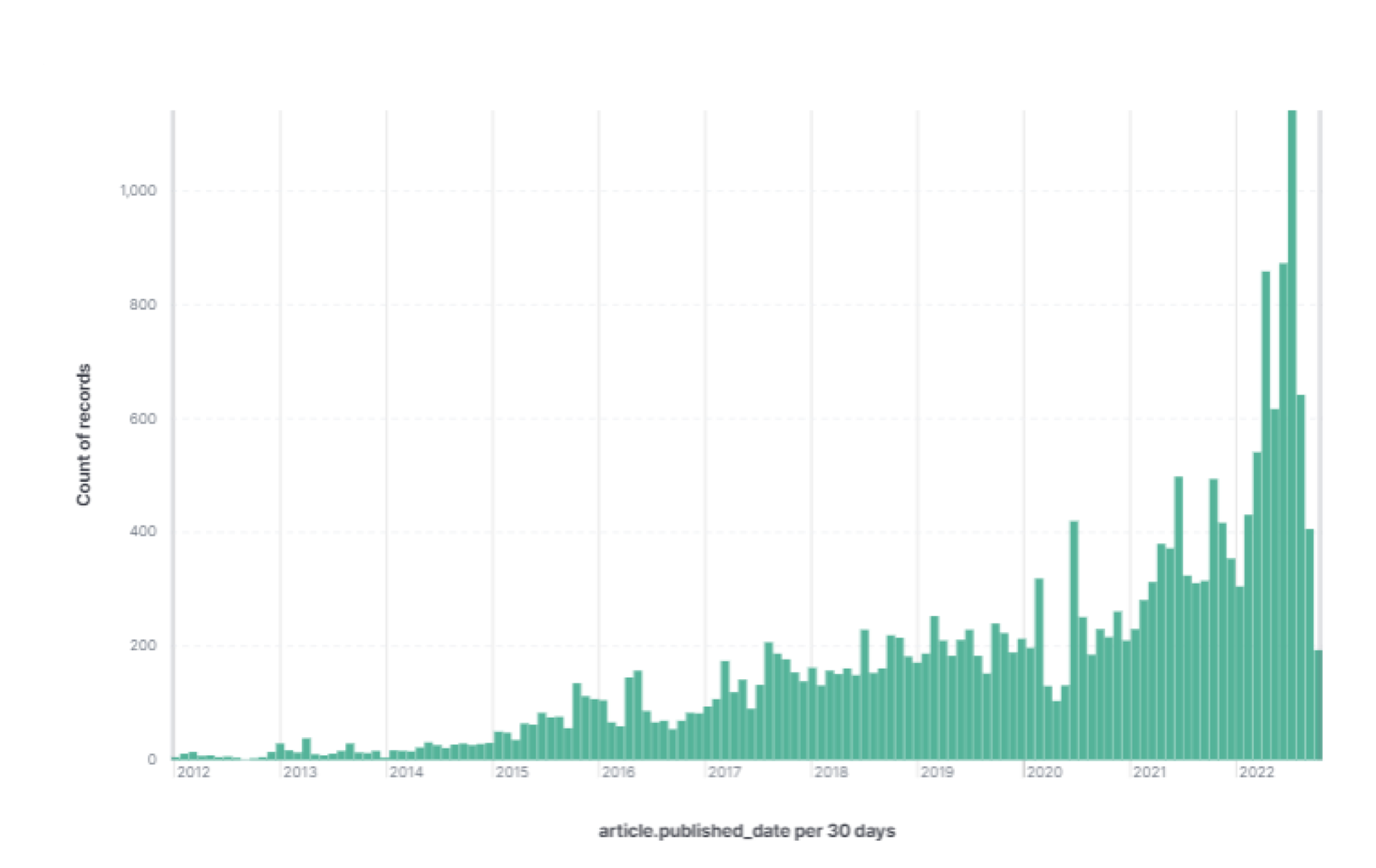
And it was across the spectrum. “There will always be a right wing media”, someone might say. Or “people are allowed to disagree with you on social issues, even be bigots, that’s free speech." Sure. But this isn’t that.
Following Meadows' death, 100,000 people signed a petition calling for Littlejohn to be fired. A fairly minimal act of accountability one might think. Instead, the British media closed ranks to defend him. Including the purportedly liberal media—the Guardian’s Media Editor urged people not to “rush to judgment.” Since then, the supposedly progressive paper has published article after article attacking trans people in the most visceral language.
And now any sort of concerted opposition seems to have faded away altogether. Observant readers will note I am writing an article about British politics, and directing my arguments to a British audience, in an American publication. In the months leading up to the Code of Practice (bathroom ban) being unveiled, the right wing press lobbied hard for trans exclusion (and are celebrating now), but unless I have missed something, I don’t think there’s been a single unequivocally pro-trans opinion piece in a mainstream media. Straight news reporting will ‘both sides’ it, including quotes for and against (see the BBC’s write up or the Independent’s), and there has been some reporting that quotes trans people on the impact this has had on them, but no major newspaper or outlet has a pro-trans opinion line.
Again, this is a clear symptom of democratic failing. It took Orban in Hungary over a decade of hard work to get such uniformity in the press on social issues. Trump and the American fascist movement have enthusiastically and brutishly gone after media freedoms and have achieved nothing close to this.The British media have just done it to themselves.
Yes, this hasn’t been because of a government crack down, but the result is functionally the same. The vast majority of people will never hear the other side of the story, the factually correct side of the story, the morally decent side of the story. The side of the story that was the overwhelming consensus among politicians and the public a mere 6-7 years previously.
So total is their control that this recent history is now unmentionable.
Some, but they too have failed. Unlike the US, the UK is famously minimal on institutional guardrails, what with our unwritten constitution and aforementioned parliamentary supremacy.
In theory, we’re still supposed to be bound by international law. We’re still signatory to the European Convention of Human rights and the Human Rights Act says we have to interpret all law in accordance with it. EU caselaw is clear that trans people cannot be treated as a ‘third sex’ (IE confined to gender neutral or disabled toilets), and EU commissioners have warned that our actions are likely violations, but this has been brushed off.
The bathroom ban has been challenged in court by the Good Law Project on the grounds that it mandated service providers (i.e. the bars, restaurants, gyms, shopping centers and schools who would be tasked with excluding trans people from toilets) violate existing law. The result was honestly a bit farcical. The EHRC’s defense, to simplify a bunch of legalese (see here for my full breakdown), was that the plain meaning of their guidance (mandatory trans exclusion) was not actually what they said. The High Court agreed that current law did not mandate trans exclusion (“I consider there would, in principle, be scope for a strong argument that a rule or practice that permitted trans women to use the ‘female’ lavatory”), but also agreed with the EHRC’s bizarre claim that they had not in fact said that, ruling with them. A few months later the final Code of conduct—which very, very explicitly does mandate trans exclusion—was unveiled. The ruling will be appealed.
The immediate upshot however is that the bathroom ban will go into force without the judiciary having examined it within any human rights framework. Along with democratic inputs, parliamentary scrutiny, press scrutiny, informed debate, and a parliamentary vote, that’s another core mechanism of liberal democratic functioning that has simply been circumvented.
This is being pushed by a very small group of people, but the British elite is very small. Apparently, we’re now at a point where a few well placed reactionaries really can exert full control over all our lives whenever they feel like it. Heck, even the collapse of the government hasn’t slowed them down: We all know Starmer is done as PM and we’re just waiting to see if Andy Burnham can win his by-election to challenge him (and if not, someone else will). The bathroom ban has dropped right in the middle of this strange little interregnum. You’d think we might have waited for a new leader before making such a massive change, but no.
That’s actually a final process point: They waited until after the May elections to unveil the final text of the ban (presumably so it wouldn’t become a rallying point for the Greens), then did so at 4:30 on Thursday, half an hour before MP’s were due to go on recess. Every single detail of this story is just so anti-democratic in spirit.
There’s always hope. American progressives saw their country get to a worse point than this and have managed to rally in a massive way. Their ‘resistance’ should be a source of inspiration to us—but also a caution that such pushback won’t just happen, we have to work for it.
And the efforts of those individuals and organisations attempting to fight this have not been for nothing. The bathroom ban was delayed and some of the worst parts toned down or removed.
Specifically, the insane idea that we would be asking people for birth certificates to use toilets has now been dropped (13.179). Not because, I feel the need to note, this is prima facie crackers, but on the pragmatic grounds that “There is no type of official record or document in the UK which provides reliable evidence of sex.” The ban also no longer applies to clubs and voluntary associations—your women’s knitting circle need not expel trans members.
Overall though, and without in any way wanting to diminish the heroic work that has gone into opposing it, this is still very bad. My read is the government basically acquiesced to giving the right wing press what they want, but tried to do so in as gentle and non-provocative a way as possible.
But there is no nice way to do this. Having read both the consultation draft and the final code, the primary differences are often stylistic. Things that it took Falkner’s EHRC a sentence to communicate, now take several paragraphs. It’s both more waffly and a bit more professional sounding, but it says much the same thing.
That trans people must be prohibited from single-sex spaces matching their gender remains. That’s the one thing the code is unequivocal on. Does this mean trans men using the women’s toilets? Not necessarily, that can also be prohibited: “a trans man might be excluded from the women-only service if the service provider decides that, because he presents as a man, other service users could reasonably object to his presence, and excluding him is a proportionate means of achieving a legitimate aim,” (13.156). Likewise, a trans man might also be excluded from a women’s counseling group because “he is likely to be perceived as a man,” (13.150).
What generally seems to be imagined is that trans people will use gender neutral toilets, disabled toilets, or whatever is available (other than single-sex ones). The code gives the example of a community group who “extends the use of the accessible toilet with baby changing facility so it can also be used as a mixed-sex toilet for anybody who does not wish to use the toilet for their sex,” (13.124). What this means functionally is that trans people will be expected to continually out themselves to ask which facilities they may use.
What about situations where no such 3rd space is available? Most British bars, pubs, and restaurants only have male and female toilets. Likewise, most gyms and leisure centres only have male and female changing rooms. Just making everything gender neutral is not an option as this is likely to amount to indirect gender discrimination against women to not provide them with a separate space. But financial constraints (or simply the layout of the building), may prohibit the creation of a 3rd space.
Here the code does offer clarity that the draft did not: for services everyone must use (like toilets) trans people should not be left in a position where there is no option for them (13.148-9). The example of a trans man in a gym is given (13.151), if the owner is to exclude him from the women’s changing rooms (it is clear he may not use the mens) then he should provide a 3rd space for him to use. Failure to do so may amount to discrimination.
What seems to be being said—and to be clear, I am imposing a clarity on the code that the text itself does not possess—is that trans people must be excluded from single-sex spaces of their chosen gender. If an establishment additionally wishes to exclude them from single-sex spaces of their sex at birth, it may do so, but for essential services like toilets it must then provide a 3rd space. Really anything will do, but if nothing is available, then it’s just governed by sex at birth. (The code doesn’t quite bite the bullet on the last point, but that seems to be what is being said).
It’s good that we got the explicit guidance that trans people should not be left without any options. But this will still be severely detrimental to dignity and privacy in practice. Moreover, while the code is clearly written to avoid the charge that it represents a prohibition on trans people existing in public, I worry that its functional impact will be that nonetheless.
Put it this way: if you are a cis man who generally presents in a traditionally masculine way, would you feel comfortable walking into a women’s changing room? Even if it were legal and the rules were on your side, you’d feel incredibly awkward, you’d worry about upsetting people, you . . . just wouldn’t do it, right? Likewise, if you’re a cis woman, would you want to use the men’s toilets? OK, well, trans people feel the same.
In my first essay on this I quoted a trans woman who had attempted to use the male toilets at a shopping centre, believing this is what she had to do following the supreme court ruling. She described shaking with fear and being confronted by a male security guard and two other users of the toilet: “Now that he infers I am trans, he starts sniggering at me. The other men in the room join him in laughing at me. I tell him that it isn’t funny and please stop laughing at me. He doesn’t stop . . . He tells me he doesn’t care what I have to say . . . I felt deeply unsafe, humiliated, hopeless - like nobody cares, violated.”
This (open mockery from an employee) would likely still constitute discrimination on the shopping centre’s part, but incidents like this are inevitable if we are going to be forcing trans women into mens rooms and trans men into womens rooms. Especially when you consider that all this is happening in tandem with rising rates of harassment and calls from leading anti-trans campaigners to use violence to “protect” women’s toilets.
Given that, again, most of the hospitality sector in the UK only has male and female options, the response from many trans people may be to just . . . not. Not go out to establishment’s they’re not familiar with, limit their access to the world, plan their excursions around toilets known to be safe.
The result of all of this, in its totality, is that we have pushed a minority group firmly outside of the circle of moral consideration and rights protections. This has reversed, and very quickly reversed, a political and social consensus for toleration.
That directionality matters. In response to my claim that this represents a clear sign of democratic backsliding it might be argued that liberal democracy has never been perfect, some groups have always been excluded.
I would bite the bullet on that the other way: Full liberal democracies are a comparatively recent thing (and even then, imperfectly realised). However one defines it, we might say that one of the functions of liberal democracies, one of the key positive things they do, is expand the circle of those considered worthy of inclusion, then ‘lock in’ those gains over time.
I am not naive about progress. I do not think there is some moral arc to the universe, or hold a whiggish notion that things always improve—very clearly they are not! With that said, we can use the directionality of inclusion and basic rights provisions as a health test for political systems. Democracy is not guaranteed to succeed, but if it is delivering more and more security, freedom, and prosperity to more and more of its members, we may say it is succeeding. Conversely, big rights reversals for minority groups are a sign that the system is failing.
Because it’s never just one minority.
Let us remind ourselves that free societies across the world are under attack, and in almost every case trans rights have been one of the first targets. It was in Orban’s Hungary, the forerunner of the modern far-right, it’s been a core part of MAGA propaganda. Heck, even Vladimir Putin rails incoherently about J K Rowling being “canceled”.
Yet British people, including many British liberals, are absolutely incapable of seeing our anti-trans turn in that context. But it is. We live in an interconnected world. The horrific ethnic cleansing proposals we’ve seen form the Tories and Reform owe a lot to American formulations, and the influence of figures like Elon Musk. The same goes for our attack on trans rights. A recent Amnesty International report found a massive increase in anti-trans groups and funding with “the biggest spenders [being] UK branches of US groups”. The EHRC’s new chair in Scotland, Alasdair Henderson, was just revealed to have tied to US ‘dark money’ anti-abortion groups. This is not just influenced, but directly funded by, American fascists.
You know the Martin Niemöller poem that starts “first they came for”? Again, something of an anti-authoritarian cliche perhaps, but we are now at the point where these start to be directly relevant. We are our first minority in, and the majority of us have done nothing.
So who’s next? The government is already proposing radical reforms that would functionally end our commitment to take in refugees and reduce many legal immigrants to poverty and insecurity. The Tories recently floated deporting 4-7% of the total legal population of the United Kingdom. Seriously. You thought I was exaggerating calling their plans ethnic cleansing? I was not.
If the spread of fascism here matches our international peers, we should likely expect other LGBT identities to be targeted soon, perhaps moral panic about women in the workplace or various other forms of once unthinkable misogyny. I’ll throw in my prediction—I think we might start seeing eliminationalist rhetoric towards neurodivergent people. American officials are now taking eugenicist stances towards autism, and the British press has previously shown itself capable of a mass ‘autism and vaccines' panic.
Regardless of the target, what would stop them? A very small group of very well connected people, funded by international fascism, have decided that trans identity is, at best, a delusion that has been tolerated for far too long. In the space of a few years they have been able to reorder our society and politics to effectively segregate them. What would stop them next time?
Say it was Sikhs. They’re about the same percentage of the population as trans people (just under one percent). Say the right wing press went on an absolute crusade against them. This could be driven by a very small number of people. Would the centrist or liberal press aggressively oppose this? Given their pathetically weak and non-existent response to anti-immigrant and anti-trans propaganda respectively, we’d have to assume not.
If they geared up and started publishing close to 8,000 articles a year—or 22 a day—on how dangerous Sikhs are, if they latched onto some (insane and unworkable) plan to surveil and segregate them, would our politicians cave or stand firm. We already know they’d cave. Enthusiastically in Reform’s case, awkwardly and abjectly in Labour’s.
Would the British people vote for it? That’s the best part! It doesn’t matter. In this respect we’re arguably in a worse position than America; however flawed the electoral system, their democratic inputs still matter. If democrats won a trifecta in 28/9 they wouldn’t enact a national bathroom ban. If they held at least part of it, they would act as a veto on one.
Because the UK’s main centre left party is so captured by reactionary centrists, that’s not the case for us. If well-connected reactionaries went after Sikhs next we could elect a government with a historic majority on a manifesto pledge to protect Sikhs and they’d start stripping their rights anyway. Would international law, our justice system, or parliamentary scrutiny offer any checks? Nope, nope, and nope.
There’s probably some gradations here. If the 1% they decided to go after next was Oxbridge grads or something, I assume the system would manage a bit more resistance. But almost all of us have at least one identity you can imagine a moral panic fixating on. Unless you are at the very top of all formal and informal hierarchies, you are not safe.
This will all feel for many, I suspect, like a distant hypothetical. I’ve found from having this discussion many, many times during America’s democratic backsliding that you can’t reason people into intuitively Getting It. People can accept the logic of what you’re saying and it still won’t feel real. At a certain point, those of us who warn must make our peace with that. We can’t alert everyone, even if it's in their interest.
But for those who might feel somewhat on the fence, let me leave you with this: democratic backsliding isn’t just about what happens to other people, or what may happen to you in some hypothetical. You are less free now because of what has happened.
Imagine you’re a young Victorian woman, recently married (I take this example from Philip Pettit). Your husband is affluent, and a decent enough man by the standards of the time. He buys you jewelry, if you want to go out to plays and such, he will let you. It could be worse. Many of your friends married neglectful men, cruel men, abusive men, and simply have to bear it. Divorce is impossible, marital rape legal, men control the finances, you are dependent on them and they can make your life hell. But your husband, thankfully, isn’t like that. All things told, you’ve done about as well as is possible under the circumstances.
But are you free?
Just intuitively, no, right? Yes, your standard of living is good, but you are utterly dependent on the whim of another. Should your husband become cruel you have absolutely no recourse. You are in a gilded cage, but a cage nonetheless. And this will show in your interactions, how you talk, how you carry yourself. You will try and stay on your husband's good side not because you want to, but because you need to. You are comfortable, but profoundly unfree.
A society that lacks this type of freedom—freedom as non-domination as philosophers call it—will become small, weak, and abject. When an elite has the ability to destroy your livelihood, or take away your rights whenever they feel like it they become arrogant. They demand deference, expect toadies, take joy in humiliating those below them. The rest of us cannot walk with our heads held high, cannot talk without feeling fear or currying favour.
And that is the type of society we are fast becoming. For many of course they were already there. Victorian marriage is gone, but there are many forms of domination that remain. Many feel like they live at the mercy of another. But for arrogant, entitled, and increasingly fascistic elites that’s not enough. It has to be all of us. They want to pick off minority groups at will with no possible challenge. In their swift destruction of trans rights they have taken a massive stride towards that.
This is not a hypothetical. You are less free now. Your security, dignity, and safety is in the hands of nasty, petty, monumentally stupid bigots. They can take it from you at a whim.
And that should bother you.
Featured image is People taking part in Trans Pride in London 2023, by Jwslubbock

The white male supremacists of the Texas GOP embody what the national party has become.

Get a copy of The Reconstruction Papers while inventory lasts, and reserve a copy of next year’s issue.

Liberalism's problem isn't structural. Liberalism's problem is that we got out-hustled.

Anton Jäger’s "Hyperpolitics" is, at its best, late marginalia for "The End of History and the Last Man." At its worst, Jäger, like Fukuyama, is a prisoner of his political pieties.
Sign up for the newsletter and get our latest stories delivered straight to your inbox.
