The Republic and Its Enemies
There can be no compromise on our founding principles of freedom, equality, and fellowship.

The anti-Trump coalition in the United States is broad, spanning the political spectrum from establishment conservatives and libertarians to social democrats, progressives, liberals, and those who prefer to avoid politics altogether. The breadth of this coalition is both its strength and its weakness. A coalition against the current president and administration has the numbers to win any national election, just so long as everyone votes together. But the same coalition can be easily divided over policy: over tax rates, over how to rein in ICE, over policies to address racial inequality, and anything else.
In other words, the anti-Trump coalition is a negative coalition, defined by what it opposes rather than what it supports. A negative coalition can be an effective source of resistance. Anger and outrage against the current administration is mobilizing Americans in collective defense of their neighbors, as in cities like Minneapolis and Los Angeles and in countless small towns across the country. Anger and outrage are also drawing Americans to the polls, which Democrats see as an optimistic sign for elections in November.
But a negative coalition cannot be the foundation for a durable political order that will outlast the current moment. The Biden-Harris administration exemplified the problem of holding together a coalition defined by what it opposes. Despite its message of national unity, and Biden and Harris’s sincere belief that the United States is stronger when Americans solve problems together, their administration quickly succumbed to disagreements over policies and priorities. Such policy disagreements are inevitable in any democratic system. But when facing an immediate authoritarian threat, democracy’s defenders need a strategy to manage these disagreements without opening the door for malicious actors who exploit them to tear down the American constitutional order.
The solution is to turn the negative coalition into a positive coalition, defined by what it stands for rather than what it stands against. This requires a positive vision for a political order that unites Americans around shared principles—and names the enemy of those principles. On the eve of the 250th anniversary of the Declaration of Independence, it is a fitting moment to look back on how the Founders created such a coalition for American independence, and the lessons for the current moment.
The Founders did not declare independence because they agreed on what America’s future should hold. The Declaration of Independence was, instead, a declaration of values that united the Founders and the principles for which they were willing to fight and die. Three such principles are freedom, equality, and fellowship. The Declaration of Independence turned a negative coalition against the British Crown into a positive coalition of thirteen united states. These principles can be mobilized again, in this new time of trial, to do so once more.
Freedom. Freedom is both the premise and the demand of the Declaration of Independence. The people of the colonies were free people because all people, by their nature, are free. Freedom is every person’s birthright, their endowment from their creator. Freedom means that every person may live as they please, make their way through life on their own terms, truck and barter, argue and compromise, make great things, be different, protest, and believe. Freedom is the right to be left alone.
The absence of freedom from Trump’s discourse is striking. Despite campaigning on Project 2025, a think tank document littered with references to economic freedom and educational freedom and religious freedom, the president and his supporters simply are not interested in freedom as they make their case to the American people. They govern through a language of control and submission, of strength and greatness through the exercise of power. Americans should remember that their freedom is not something that the Constitution creates, it is what the Constitution affirms. Federal officers who execute warrantless searches and secret police who murder protestors violate more than just their oath to the Constitution. They violate the proper order of a free people.
Equality. The Declaration of Independence declares that all men are created equal. Equality does not imply uniformity, nor does it imply that the government can or should create equality (although some may wish for this). The Founders’ principle of equality is forward-looking: it means that all people have the same rights and responsibilities, the same possibilities and the same privileges, regardless of their background or circumstance. There is no person whose rights are different than anyone else’s. Differences in heritage, status, wealth, ability, and belief are natural and inevitable, but none of these differences imply a hierarchy of rights.
The principle of equality as articulated in the Declaration of Independence rings hollow when we remember that it was written by a minority of white men, many of whom owned slaves and who treated their own children as property to be sold. Today, the president and his administration appeal to the Founders, perverting the principle of equality rather than upholding it. The American people in 2026 know better than this. To stand for equality is to stand in defense of the principle that the Founders failed to themselves enact: that all are truly created equal. The American people should not tolerate any government who treats some people as having more rights than others, for every government derives its legitimacy from the consent of the free and equal people.
Fellowship. The Declaration of Independence concludes by binding the principles of freedom and equality to the principle of fellowship: we mutually pledge to each other our Lives, our Fortunes and our sacred Honor. Fellowship invites Americans to come together to do good works and lift one another up, but it also recognizes the value and purpose of being one with our neighbors in the everyday sense. Many Americans embrace the traditions of Christian fellowship, and fellowship and community can be found at the synagogue, the mosque, the temple, the meeting, and any place where people come together. The core point is that fellowship itself is what matters, not any particular version of it; the Founders’ notion of fellowship rejects a homogenous conception of the community and affirms the right of all people to gather and commune on their own volition. Fellowship thus understood is what keeps freedom from degenerating into mere individualism, and equality into sameness. Christians and Jews are united not in their own fellowship, but by their mutual affirmation of fellowship itself as the glue that binds a people together.
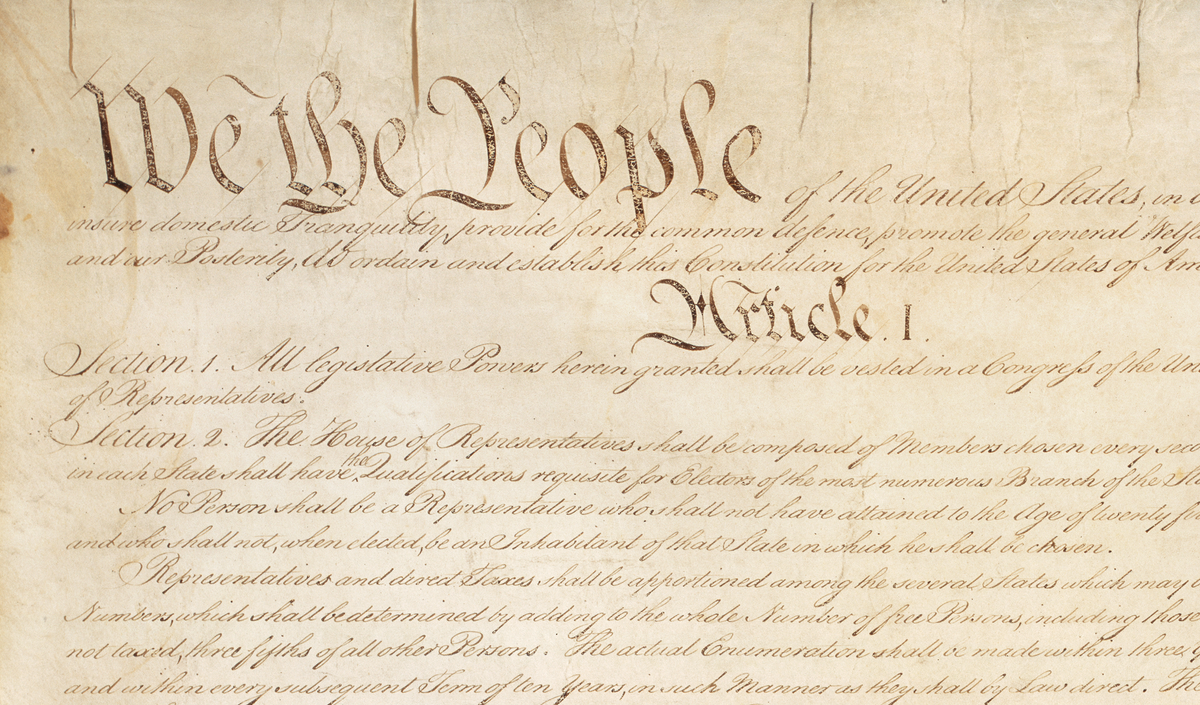
Freethinkers, social democrats, and libertarians share the same conviction in fellowship. To help one’s neighbors, to stand up for the Bill of Rights, and to demand that our government follow the law is to insist that principles of freedom and equality—the natural rights of every individual—can only be achieved collectively. The principle of fellowship is how a plural society manages conflict in defense of its common purpose.. And the U.S. Constitution opens with an invocation of this common purpose: to form a more perfect union, establish justice, insure domestic tranquility, provide for the common defence, promote the general welfare, and secure the blessings of liberty to ourselves and our posterity.
From Principles to Politics. Freedom, equality, and fellowship are principles of the republican tradition, in the U.S. and globally. Echoes can be found in liberté, egalité, fraternité ou mort (liberty, equality, and fraternity or death) in revolutionary France, in the revolutionary leader Simon Bolivar’s Letter from Jamaica, and in countless constitutions across the world. These are universal values, and they are also quintessentially American.
The Trump administration’s perversion of these American values explains why his second administration is so unpopular. But its opponents must not repeat the errors of the Biden-Harris administration, which activated a negative coalition to win the presidency in 2020 but failed to secure a durable settlement thereafter. The Biden-Harris administration’s fundamental error was refusing to confront the enemy of freedom, equality, and fellowship as the enemy. Biden and Harris knew exactly the stakes; they warned Americans of what the Trump administration would do if returned to office in 2025. Yet they believed that normal politics was possible, and hoped to turn the other cheek, to bless those who cursed them. “The fever will break,” Biden had been predicting since Obama’s reelection in 2012.
The Nazi propagandist Carl Schmitt was right to identify liberal democracy’s weakness: reducing political conflict to disagreement over economic policy or cultural values. But when the procedures of liberal democracy have been distorted by antidemocratic forces, the liberal’s response to these distortions must be unequivocal. Every liberal—republican, conservative, socialist, Christian, or any other—must draw the line when confronted with lawlessness, corruption, and perfidy by those who abandon freedom, equality, and fellowship for their personal ends. There can be no compromise on these principles.
Millions of Americans today have stood together in the spirit of the Declaration of Independence. They want leaders who will do the same, who are proud not to compromise on principles, and who will show our rulers that the American people in 2026 preserve the spirit of 1776. No libertarian believes that some people are less equal than others. No socialist allows their government to dictate that some workers are not citizens. No Christian closes their church to a stranger based on his or her passport. No American can accept the mendacity, antisemitism, Islamophobia, or the gutter racism that the current administration has unleashed. In the past months, Americans have given their lives in defense of the principles of our founding, and it is time for our country’s politicians to build the positive coalition that unites Americans around them once again.
Featured image is "Constitution of the United States, page 1"