Too Great For Any One Man
Since the founding generation, there has been a consistent and rational fear that the office of president was too powerful to be constrained by democratic institutions.
‘‘Of late most Wars have been declar’d from the Mouths of Canons, before any formal Declaration.’’ Were he alive today, Sir Robert Walpole might wince at the latest instance of this enduring fashion. In 2020, President Trump authorized the assasination of Iranian general Qasem Soleimani. According to Gene Healy, a senior policy expert at the Cato Institute, this attack ‘‘marked the first time an American president publicly ordered the assasination of a top government official of a country we were not legally at war with. It was also a major usurpation of congressional power.’’(The Cult of the Presidency, xiii) The Trump administration has now raised the ante with the outright elimination of the Iranian leadership, including Supreme Leader Ayatollah Ali Khamenei, Defense Minister Amir Nasirzadeh, and Revolutionary Guards Commander Mohammed Pakpour. No discernible principle of restraint can be found in these drastic actions, save personal ambition: ‘‘My own morality. My own mind. It’s the only thing that can stop me,’’ says the president. While the president acts, in good royal fashion, according to his own pleasure, top military officers are propelled by religious fervor. According to a report by The Guardian newspaper, military officers have been told that the Iran plan is ‘‘all part of God’s divine plan’’ to usher in ‘‘the imminent return of Jesus Christ’’ and the ‘‘End Times’’.
It has become customary to lament the paranoiac elements of American politics. All kinds of cranks episodically capture the attention and fascination of the American public with grand, frightful, tales of a secret cabal of ultra-rich subversives bent on enslaving the masses and subjugating them to their dehumanizing vision of world order. Richard Hofstadter famously described this ‘‘heated exaggeration, suspiciousness, and conspiratorial fantasy’’ as paranoid in style (The Paranoid Style in American Politics, p.3). This intemperate way of going about the business of politics has rightly been sanctioned by the liberal intelligentsia, but to the detriment of other more healthful forms of public neurotism.
As Gordon Wood notes in his classic study of the American Revolution, the cause of liberty was activated and nurtured by a ‘‘heightened language of intense liberalism and paranoiac mistrust of power.’’ (The Creation of the American Republic, p.17) The framers of the constitution were raised in a culture where every ‘‘accumulation of political power, however tiny and piecemeal, was seen as frighteningly tyrannical, viewed as some sinister plot to upset the delicately maintained relationships of power and jealousy.’’(The Creation of the American Republic, p.16)
A reading of the Federalist papers and other political tracts of the time make it amply clear that the winners of the continental war brought this cultural paranoia to the ratification debates. Everywhere they looked, the revolutionaries saw tyranny and the abuse of power on the horizon. It would not be excessive to suggest that one can trace the birth of the American constitutional system to this well-considered fear of political usurpation. Yet, far from being irrational, the first generation of American politicians saw themselves as the depositories of human wisdom. They were taught by enlightenment philosophers like Baruch Spinoza that government must aim at men not as theorists ‘‘would like them to be,’’ but as they are (The Passions and the Interests, p.13) They learned from the Bible and the commentaries of St.Augustine, John Milton, and the Puritan professors of their youth that ‘‘the human heart is desperately wicked.’’(Jeremiah 17:9) Such is ‘‘the depravity of mankind,’’ wrote Samuel Adams, ‘‘that ambition and lust of power above the law are…the predominant passions in the breasts of most men.’’(The Ideological Origins of the American Revolution, p.60) As such, when forming government, as David Hume advised, ‘‘every man ought to be supposed a knave,’’ the kind of person that would have ‘‘no other end in all his actions but private interest.’’(The Cult of the Presidency, p.26)
The founders did just that: rather than suppose men angels, they operated under the assumption that both the people in government and outside of it might try to undermine its fragile equipoise for entirely selfish reasons. The annoying checks and balances of the system were, as Madison said, a reflection of human nature: if only ‘‘men were angels, no government would be necessary.’’ (If Men Were Angels, p.173-174) As it stands, ‘‘Wherever power is lodged,’’ noted the New Hampshire Convention of 1781, ‘‘there is a constant propensity to enlarge its boundaries.’’ (The Creation of the American Republic, p.447) This meant that no site of coercive power, whether the legislature, the judiciary, the executive, or even the people, could be left unchecked. It was Thomas Jefferson’s conviction that power ‘‘must be so divided and guarded as to prevent those given’’ to one form of power play ‘‘from being engrossed by the other.’’ (The Creation of the American Republic, p.449) The result of all of this careful reflection was a marvel of the enlightenment age: an almost mathematical balancing of the passions and interests of humanity in the service of good government. Richard K. Matthews describes the geometricity of the Madisonian system using the metaphor of a seesaw:
‘‘…government (with its powers) sits on one side, individuals (with their rights) on the other; and reason provides the fulcrum that keeps both sides in the air. Since equilibrium, balance, and stability (rather than play) are the goals of Madison’s seesaw, he must shift his political weight from side to side, back and forth, as changes in the sociopolitical environment require. He must do so to keep either side from gaining sufficient gravity to crash to the earth, toss the other off the seesaw, and thereby create either tyranny or anarchy and ruin that delicate balance he strove to create and maintain.’’(If Men Were Angels, 24)
The delicacy of this arrangement speaks to the diligence of the constitutional framers. No one can accuse the founding generation of having been lax in their search for potential sources of corruption. Indeed, ‘‘If we know anything about the public discussions of 1787-1788,’’ says Karl Rove, ‘‘it was that when it came to identifying potential sources of tyranny and misrule in the Constitution’s numerous clauses, Anti-Federalists wrote with promiscuous abandon.’’(The Cult of the Presidency, p.28) It was they (the Anti-Federalists) who forced already thorough examiners of the constitution to devote themselves to an even more scrupulous search for any possible constitutional design flaws that might condemn the nation to political dysfunction. The outcome of this extra work was the Bill of Rights and the enduring political system that we have today.
No King at war
Given this deeply embedded feeling of distrust—one which, as noted before, was not based on phobia, but on sound philosophy and cumulative experience—it is not surprising to discover that Madison and his colleagues placed little trust in the office of president. Rather, they sought at every turn to undermine any royal pretense in the U.S. government. This was especially the case in the realm of war and peace. One of the distinctive jobs of the eighteenth-century monarch was to direct foreign policy and wage war. Foreign policy was the métier des rois, that one area of politics they were expected to master and skillfully orchestrate. Some did a masterful job planning the advancement of their Kingdom in a hostile world, while others failed miserably. Military command could either make or break a royal empire, hence why monarchs jealously guarded the integrity of their craft and their right to dominate this province of politics. We do well to remember that one of the central points of contention between Louis XVI of France and the affronting Estates-General was over the exclusive right to direct foreign policy. When a 1790 territorial dispute between Spain and Britain over access to a trading station at Nootka Sound, off the Island of Vancouver, called for French involvement, the various deputies of the French Assembly bandied to deny the King the right to respond. They declared that ‘‘The Right to make peace and war belongs to the nation. War can only be declared by a decree of the legislative body, passed on the formal and necessary proposal of the king and subsequently sanctioned by His Majesty.’’ (The French Revolution, p.68)
This was a significant, and humiliating, reversal. Past kings had been described by learned jurists of the likes of William Blackstone as ‘‘generalissimo, or the first military command, within the kingdom.’’(The Cult of the Presidency, p.29) Now, under the supervision of ambitious politicians, the King of France had to yield this power to untrained novices. Unlike some of the French rebels, the American revolutionaries had no interest in denying the executive the opportunity to respond vigorously to foreign threats. They understood, as John Locke and other luminaries of that Glorious revolution also did, that the executive had to have some discretion in acting for the interest of the country. As John Locke wrote, ‘‘Many things there are, which the Law can by no means provide for, and those must necessarily be left to the discretion of him, that has the Executive Power in his hands, to be ordered by him, as the publik good and advantage shall require.’’(The President Who Would Not Be King, p.98) Being people of good sense, the American founders recognized that the executive position had to contain a modicum of flexibility, but were insistent that this necessity had to be detailed by the Constitution and regulated by Congress to ensure that this provision was not inadvertently ‘‘throwing into his hands the influence of a monarch.’’(The Cult of the Presidency, p.33)
Constitutionalists like James Madison were also eager to avoid plunging the country into a ruinous war. As Greg Weiner has demonstrated in his book Madison’s Metronome, Madison’s whole orientation was one of retardation. His sophisticated blocking mechanisms aimed at a timely delay of public debate for the sake of recalibration and rational refinement. One of the constitution’s primary functions, says Weiner, is to act as a metronome, a mechanical device regulating the tempo of American politics (Madison’s Metronome, p.4) So understood, the stoppage, gridlock, and torturous (or tortoise) progression of Congressional debate is not an accident, but intentionally baked into the system. The curtailing of the power of the executive, and the specification of terms for the exercise of war, was designed to guarantee that this ‘system’, as James Wilson called it, ‘‘will not hurry us into war; it is calculated to guard against it.’’ If respected, ‘‘It will not be in the power of a single man, or a single body of men, to involve us in such distress; for the important power in declaring war is vested in the legislature at large.’’ (The Cult of the Presidency, p.33)
When reflecting on the principal difference between the British and American constitutional system, Justice James Iredell of North Carolina noted that ‘‘The king of Britain is not only commander-in-chief of the land and naval forces, but has power, in time of war, to raise fleets and armies. He also has the power to declare war.’’ By contrast, ‘‘the President has not the power to declare war by his authority, nor that of raising fleets or armies. These powers are vested in other hands.’’(The President Who Would Not Be King, p.89) According to the American jurist Michael McConnell, Iredell’s exposition of the presidential powers ‘‘far surpasses anything in The Federalist’’ and is consistent with his own view of the restricted role of the executive in American political culture. In his opinion, ‘‘The principal device of the constitutional framers was to allocate large swathes of constitutional power to Congress, rather than the President, and to require advance congressional authorization and approval for many of the most significant powers of the state, such as taxation and coercion.’’ (The President Who Would Not Be King, p.351)
The reason for this procedure has once more to do with the ratifiers' intelligent fear that sinful men might seek self-aggrandizement over considerations directly related to national interest. Their review of the annals of history and the pages of newspapers revealed that it was not uncommon for monarchs to chase after what Federalist John Jay condemned as a ‘‘thirst for military glory, revenge for personal affronts, ambition, or private compacts to aggrandize or support their particular families or partisans.’’(The Cult of the Presidency, p.29)
Writing in 1793, James Madison asserted that this vainglory in war produced a political condition in which ‘‘the strongest passions and most dangerous weaknesses of the human breast; ambition, avarice, vanity, the honorable or genial love of fame, are all in conspiracy against the desire and duty for peace.’’(The Cult of the Presidency, p.30) Madison was not the first to observe that human passions often undermined political goods such as peace and freedom. Religiously-minded politicians such as Samuel Adams had noted that in all nations the selfish instincts of human beings had ‘‘combined the worst passions of the human heart and the worst projects of the human mind in league against the liberties of mankind.’’(The Ideological Origins of the American Revolution, p.60)
For a modern example of this theory at work one need look no further than the most sensational war actions of the Trump administration. The Supreme Court’s public rejection of the President’s emergency tariffs provided the psychological impetus to attack Iran. The initial success of Operation Epic Fury has also given the President more reason to force the collapse of the Cuban regime. As one White House insider told The Atlantic’s Vivian Salama, ‘‘The president is feeling like, ‘I’m on a roll’; like, ‘This is working.’’’ In other words, current foreign policy decisions are partly being directed by the executive’s outsized ego. When feeling publicly humiliated or defeated, the President tries to recover by overseeing a successful decapitation. The expressed gratitude of oppressed people and the accompanying praise of journalists further propel the executive toward another attempt at a historic regime change. While the immediate results of force may be positive, the entire enterprise remains not only unconstitutional, but also threatens to destroy the long-term prospect of peace in notoriously unstable regions of the world.
A president that can wage war against any country, without approval from Congress, is one that demonstrates a haughty disregard for the well-placed limits on his power and is as such a danger to the republic. What could reasonably stop such a person from taking equally audacious liberties with the peace and serenity of the American people? It was just this hazard that Madison had in mind when he asserted that ‘‘in no part of the constitution is more wisdom to be found, than in the clause which confides the question of war and peace to the legislature, and not to the executive department. Beside the objection to such a mixture of heterogenous powers: the trust and the temptation would be too great for any one man.’’(The Cult of the Presidency, p.30)
The public may have forgotten the teachings of the founding generation, or they may have perhaps moved on from the theological worldview of the Puritan world. Either way, what both the American nation and the world cannot afford to neglect, especially in an age where Congress and the United Nations are ineffectual, is the healthy paranoia that once motivated informed American citizens and their legislators to stringently and passionately object to any presidential démarche that too closely resembled the freedom of an absolutist monarch. With all this talk of a new age of ‘neo-royalism’ perhaps what the country needs is for liberal politics to grow more paranoid in style, not less.
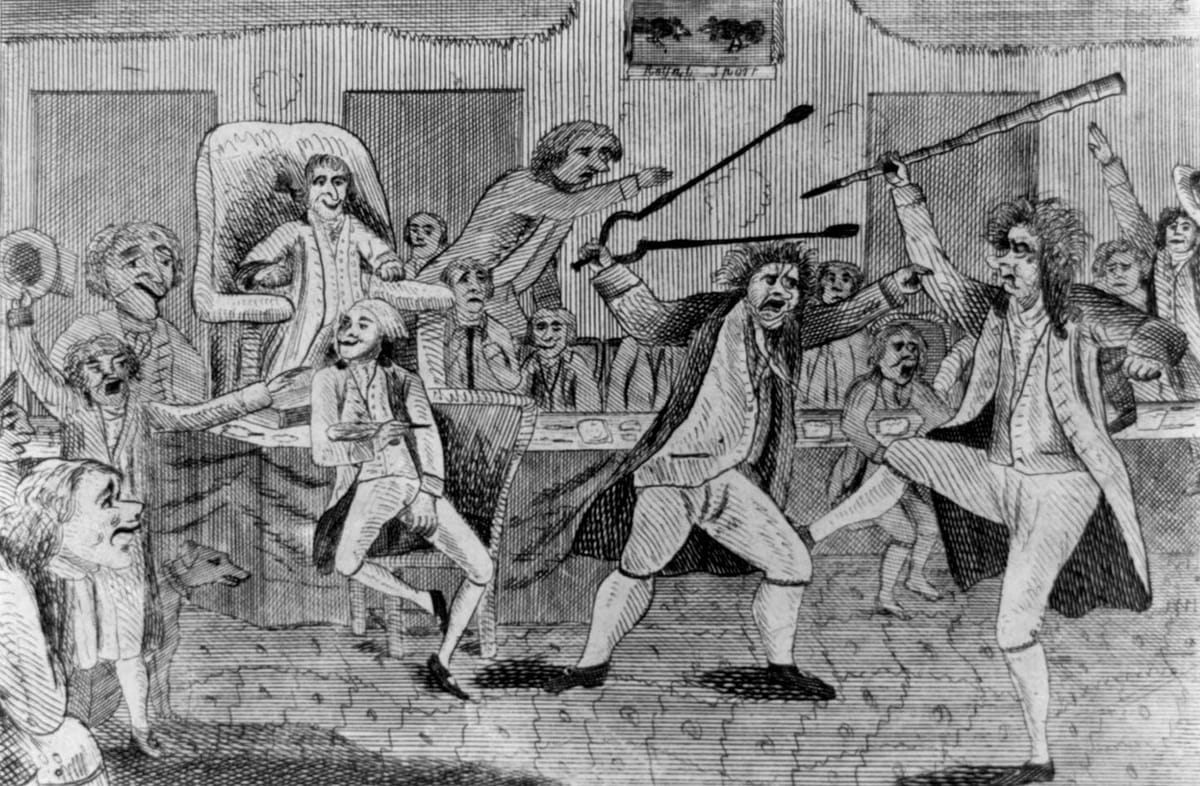
Featured image is a 1798 political cartoon depicting a fight over the alien and sedition acts