
Better Win a District: Virginia’s Sixth
Flipping this ruby red district would signal an "apocalypse for Republicans."

Why did JD Vance personally campaign for the former Hungarian prime minister, Viktor Orbán? Why did his comprehensive defeat by a former member of his own party, Péter Magyar, garner such attention from the American press?
Because, according to Greg Sargent, Orbán has for the last sixteen years served as the vanguard of the authoritarian internationale, leading and organizing would-be autocrats across the West. How did he lose, and what does that mean for the American struggle against authoritarianism?
Neon Liberalism can be heard on Spotify, on Apple, on YouTube, on Amazon, and elsewhere via its RSS feed.
Greg Sargent, staff writer at the New Republic and host of their Daily Blast podcast, and author of:
 Greg Sargent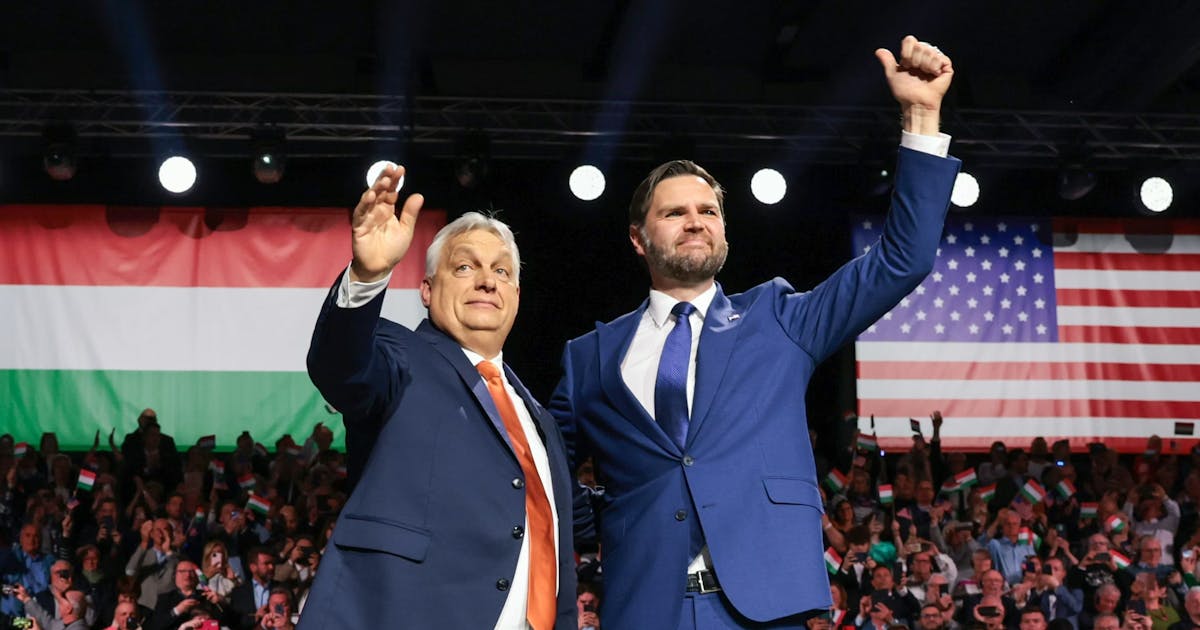
**Samantha Hancox-Li** [00:10]
Welcome back to Neon Liberalism. I am Samantha Hancox-Li. In the last few days, Peter Magyar defeated Viktor Orban in Hungary, in a major election. For those of you who are following along at home, or maybe for those who aren't, this is kind of like Donald Trump getting defeated by a man named Johnny America, and it seems to have political implications for America and for American politics. To try and understand why the elections in a relatively small Central European country attracted so much attention and seemed to have such implications for American politics, I'm really excited to have on Greg Sargent. Greg is a staff writer for The New Republic and the host of their Daily Blast podcast. So, yeah, Greg, thanks so much for coming on the podcast.
**Greg Sargent** [01:12]
Really great to be on. Thank you.
**Samantha Hancox-Li** [01:18]
All right, so I guess, first question, you just wrote a piece about Hungary, about the Hungarian elections — what's the capsule version of what happened there?
**Greg Sargent** [01:28]
Well, so Viktor Orban was in power for 16 years, and throughout those 16 years he did a number of authoritarian things that came to the attention of the American right, and over time became more and more a model of what the right should do in the United States to these people. CPAC, which is a conservative conference, was hosted in Hungary a couple times. Some prominent right-wing writers journeyed to Hungary almost on a pilgrimage to pay homage to Orban, and Tucker Carlson interviewed Orban very prominently. They were very, very all in on the Orbanism project, which is essentially authoritarian rule. It's what's been called illiberal authoritarianism or competitive authoritarianism, and that essentially goes out of its way to use state power to lock in the rule of the ruling party on the explicit understanding that it's doing that in a counter-majoritarian and illiberal way. In fact, Viktor Orban has given major speeches saying liberal democracy is dead and liberal democracy has failed. So for the American right he became the model for an American future, and Donald Trump is sort of the standard bearer of this American right, this component of the American right, and they see Trump as implementing Orbanism here. So the failure of Orbanism in Hungary, as evidenced by this major landslide loss, is to liberals a rebuke of that whole understanding of politics, that whole illiberal project, essentially.
**Samantha Hancox-Li** [03:10]
I guess I also kind of want to situate this, so this is something that affects the right — they put all their hopes in this guy, et cetera — but it also seems to have implications for us on the left, for progressives, because of how the new Prime Minister, the new party leader Peter Magyar, ran and what he did in order to defeat Orban. So if you could situate this a little bit also in terms of these debates in the Democratic Party about what we should stand for and how we should fight Trump.
**Greg Sargent** [03:48]
Right. Well, it bears stressing at the outset that the challenger who defeated Viktor Orban is not a liberal — he's a liberal in the small-L sense, in the sense of liberal democracy, but not a liberal in the kind of American progressive sense. He is a right-of-center politician, and he was not at all liberal in his campaigning on LGBTQ rights, or on immigration, or on other matters. But at the most fundamental level of all, he ran a candidacy that was centered on restoring real liberal democratic rule and the rule of law and an embrace of internationalist institutions. He vowed to reverse Orban's hostility to the EU and to NATO, for instance. So for liberals in the United States, this is kind of subject to appropriation in the somewhat limited sense that we saw a centrist politician who campaigned in favor of globalist institutions — to use the right's slur for them — and who campaigned on a willingness to hold corrupt actors in the government accountable, and who campaigned on a restoration of the rule of law. For us liberals, that's a sign that maybe the tide is turning against illiberal authoritarian right-wing rule, kind of in a global context. The argument I made in my piece is that MAGA and Donald Trump and Orban's imitators very much understand their movement as a global one, and we liberals need to think of our movement as a global one in response. That's sort of the case I made in my piece, is how we can start to think about how to do that.
**Samantha Hancox-Li** [05:54]
Yeah, I think that's right. I mean, I guess I always have to emphasize — Hungary is really not a big place, right? Hungary is about 10 million population. Their total GDP is something like $220 billion. The total GDP of Pittsburgh, where I live, the Pittsburgh metropolitan area, is about $190 billion, right? Hungary, in any kind of economic sense or big picture geopolitical sense, they are a tiny little player on the world stage. But it's become this proxy fight for this global struggle between forces of liberal democracy and more authoritarian forces.
**Greg Sargent** [06:12]
Right. Yeah, indeed.
**Greg Sargent** [06:58]
Right, and that I think is the reason that we need to think of this in global terms. Remember, Orban is an inspiring figure, not just to American rightists, but also to the global — I guess, MAGA movement. It's not quite the right phrase for it. I'd be interested in what you think is the right way to describe this. It's almost like a MAGA internationale — a kind of group of autocrats and far-right politicians who sort of have the same conception of how their own nations should be organized and yet they're allied with each other in a global struggle to export this to as many places as possible. Although Hungary is very limited in its power and GDP, and it's a small player, they kind of represent the global vanguard of this movement. That's why it's so important to both the right and the left in America, because Orban's defeat is actually the defeat of one of the leaders of a global movement. That's exactly why JD Vance went to Hungary in the closing days of the campaign in a desperate last-minute bid to try to put Orban over the top, and of course that seems to have backfired, which has inspired a great deal of mirth. As I argue in my piece, I think we need to look at what JD Vance actually said in Hungary about this global movement to understand how we can sort of globalize our version of the opposition. And by the way, I want to remind people, JD Vance is almost certainly going to be the 2028 Republican presidential nominee, so these big arguments over globalism versus right-wing authoritarianism are going to be extremely important going forward, and we'll have to engage them.
**Samantha Hancox-Li** [09:05]
Yeah, so I agree with all of that. Actually, well, I don't agree with all of that. I was about to say something completely wrong, because I'm not sure it's going to be Vance. I think Rubio is going to give him a run for his money. I think Vance is just not a very talented politician. But that's not really what I want to talk about today. I think a couple things — I think Vance is good at positioning himself as one of these kind of reactionary intellectuals. People who are really deep into that stuff kind of like him, but he's never really won a serious competitive election, basically ever, from what I understand. He doesn't really have a lot of charisma. And honestly, I think Trump, in three years, is going to be feted much more than he is, and I'm not convinced he even likes Vance that much, right? He sends Vance off to fail at negotiations in Pakistan, and then he goes to the UFC with Rubio, and he's hanging out with Rubio. I think he likes Rubio better. But you know, it's Trump, that stuff can change.
**Greg Sargent** [09:20]
Yeah, that's very interesting though. Can I just ask a question about — I mean, that would really be something if Rubio actually did it. It would really require Donald Trump being okay with it. I think it's a little hard for me to see how that unfolds. I wouldn't rule it out, but how do you see that unfolding? How does that sort of happen in Trump world?
**Samantha Hancox-Li** [10:05]
I don't want to talk about this, because I just find the speculation — we can speculate, but it's all speculation, this is still a long ways out. Anyways, what I was trying to say is, the stakes of the authoritarian — the phrase I like is the "authoritarian international," got that from Joe Stieb — but yeah, they don't really have a name for themselves. The boundaries can be a little fluid, but in Hungary, this was well understood, right? Some of the chants you would hear from the Hungarian opposition were like "Putin out," right? We have to choose Europe and not choose Russia, because in many ways that's who Orban was aligning himself with — Russia and Putin. So you say that Orban is the vanguard, but in many ways, I would see Russia as a very central center of gravity for this kind of movement.
But here's what's really interesting to me. These people feel oppressed by global liberal institutions. From their perspective, liberal internationalism is already here and it's everywhere and it's smothering our nation, and blah blah blah. And from our perspective, we're like, we barely have a liberal international to fight the authoritarian international. We're still trying to build that. To me, this speaks to the sense that on an institutional level, there is a liberal international order — there's all these institutions, there's the IMF, there's the UN, there's courts, there's NATO. But for the authoritarian international, they didn't really have these kinds of formal ties, these legal institutional ties, but they were effective at creating these associational ties between parties. Like Vance going to campaign for Orban, Rod Dreher and these other American intellectuals who go to Hungary and are supported by the Hungarian state. It turns out that CPAC, or at least some form of CPAC, was getting funding from the Hungarian state. So they were able to build these kinds of links below the legal level, at the political level, between their movements. I'm curious, what lessons do you think there are there for liberals in America?
**Greg Sargent** [13:23]
Well, I'd like to pick up on something you said, sort of halfway through that, to try to get to the answer to what you're saying, which is that they feel oppressed by international institutions, that they feel oppressed by the international order in some very large sense. I think it's really important to understand that what they are offering — what Orban was and I guess still is offering, what JD Vance and Donald Trump think they're offering — I don't think Donald Trump thinks about it that deeply, but JD Vance, who's a genuine intellectual of sorts, really does —
**Samantha Hancox-Li** [14:02]
Of sorts.
**Greg Sargent** [14:04]
Right. He fancies himself as an ambitious thinker. Let's put it that way. They actually think of themselves as offering their own version of freedom, and that's why I found JD Vance's speech in Budapest to be so interesting. Their version of freedom — it's convoluted, and as you mentioned earlier, there's some fluidity — but I think this is the general version of it. They think that democratic self-determination depends on peoples defined ethno-nationalistically, and in some cases by religion. They think for peoples to flourish they need to be free to essentially prevent the pollution of the polity or the pollution of the people by outside influences. And in essence they think that they can support each other in this sort of endeavor, right? JD Vance goes to Hungary to lend support to Orban's effort to prevent immigrants from polluting the ethno-nationalist essence of the people, and Orban speaks back to the American right about their effort to do that here. But it's a peculiar understanding of freedom and self-determination, but it is a vision, and that's the thing that I think we need as liberals to focus a little bit more on — to try to understand what their vision actually is and why ours is better. That's the argument I'm basically making.
**Samantha Hancox-Li** [15:20]
I was wondering actually if you could talk a little bit more about that vision. We've talked — okay, there's this kind of vaguely ethno-nationalist aspect to it, there's competitive authoritarianism, but Orban was in power for 16 years in Hungary. He came into power with enormous majorities and was able to rewrite the constitution, so we really got to see — he got as much power as you could want to try and reshape society according to his vision. What did he actually do with power in Hungary? What is the right-wing vision of the future?
**Greg Sargent** [15:52]
Well, the right-wing vision of the future is essentially — it's conservative in one limited sense — it's about putting the brakes on efforts by people like you and me to prevent the flourishing of ethno-nationalist blocs. Their vision is essentially closing societies against each other. What Orban essentially represents to the American right, and what Vance actually said during the speech in kind of various coded ways, is the international future that this authoritarian international imagines is one in which nations don't cede their authority to international institutions, they largely don't allow in immigrants, and they resist outside influences on their imagined cultural and ethno-nationalist identities. Now, they would reject the idea that those identities are imagined, but I think it's very clear that they are kind of manufactured almost out of nothing. So, clamping down on LGBTQ rights, using state power to encourage quote unquote traditional families, really slamming the brakes on immigration with an explicitly ethno-nationalist justification — a clear and unequivocal statement that the Hungarian people flourish when they are allowed to be their true ethno-nationalist essence. In their mind, because the liberal international is so powerful and is so bent on destroying the individual nation as they conceive of it, they are justified in using full-blown authoritarian rule to essentially impose their vision.
So, clamping down on LGBTQ rights, all sorts of gerrymandering schemes, capturing the media in all sorts of deeply corrupt ways. What we're doing in the United States, what we're living through in the United States, is sort of a shadow version of what Orban was actually able to do. That's why it required such an enormous popular wave to overcome. I like to joke that the election outcome in Hungary was actually too big to rig — like, it can be legitimately called too big to rig. That's the phrase that Donald Trump uses to describe his 2024 victory, but when he says that he's just lying, right? His victory was incredibly narrow, and the election wasn't rigged against him. If anything, it was rigged in his favor by our own counter-majoritarian features of our system. But to overcome what Orban was able to lock in, it did actually require a turnout and a performance that was too big to rig.
**Samantha Hancox-Li** [19:50]
I mean, I think this isn't just a jab at Trump, but this is an important lesson for us for the future, right? Just because there's a competitive authoritarian in power doesn't mean they are always going to win. They can be beaten. Could we talk about the Budapest Pride from two years ago, which was totally officially banned, and they showed up anyway by the hundreds of thousands? You can beat these people no matter what they say.
But I don't want to talk about that. I want to talk about, first of all, this vision — trying to understand how they sold themselves to the Hungarian people, and why the Hungarian people turfed them out in the end. The way I kind of see it — you talked about these big things. They're going to be anti-immigrant, they're going to be anti-EU, anti-queer, and pro-natalist is kind of the euphemism for it, but "traditional families." And to me, there's this kind of biopolitical vision of the national body as defined by a kind of biological unity, and we need to keep out these corrupting influences, these people who aren't producing the right kind of children, and women need to be put in the right kind of place to produce more children. So that's one level, and the other level, as you say, is the political level — competitive authoritarianism.
I think Singapore is a really interesting model for this, just to try and understand how it works. It's like, yeah, there are elections — they always have elections, and the elections are always quite fair, right? They count all the votes. But the rigging happens outside of — it's not like they're stuffing ballot boxes exactly, but there's media control, there's prosecution of opposition figures, not for political crimes, but they're like, "Oh, you committed tax evasion, and we're going to prosecute you for 10 years, we're just going to ruin you," right? You're going to ruin your life, even if you win in the end, and maybe you won't, because they've kind of captured the courts.
And then there's the corruption that turned out to be endemic in Hungary. What Orban did with power is — okay, there's all this stuff that he's selling people on, but actually he's just making himself rich, he's making his friends rich, he's trading favors. And one of the things that I think is actually most interesting about this whole process is that Peter Magyar, the guy who's now going to be the leader of Hungary, used to be a member of Orban's party. Until recently he was a member of Orban's party, and he leaves over the Novak pardon scandal — which, it turns out, is another great little parallel between them and us — about child sex abuse and about government cover-ups of child sex abuse, where they are handing out pardons to people who enabled the sexual abuse of children. This is the moment that Magyar and many others actually kind of break off from Fidesz.
So there's just this buildup of frustration with corruption, with abuse, with these other aspects of the system that are all kind of downstream of this larger authoritarian project. I think that's really interesting, and I'm curious what you think that teaches us about beating Trump in America.
They put out a whole slew of these things, yeah. There's — I mean, it's so much, because they are rich texts, as they say. There's the intense use of imagery — they were using Halo imagery for a while, like imagery from the Halo video game, but also these whole montages of clips from the '70s and '80s, as if that was the time we really wanted to get back to, which might have surprised people in the '70s a little bit, that we thought that was the golden age. But anyways.
**Greg Sargent** [23:32]
Well, I want to pick up on your use of the word "endemic," because it seems to me that one aspect of this that's been missing from the discussion largely is that the sort of corruption you're talking about that Orban engaged in, and that Donald Trump engages in here, isn't incidental to their politics. It's not incidental to right-wing populism. It's intrinsic to it, I think, on a really deep theoretical level. Now, you guys are the political theorists, but I'll have a stab at trying to explain this as best I understand it, which is that once your project divides the polity into the friend and the enemy — everybody's commented on the Schmittian nature of Trumpism and the Schmittian nature of Orbanism — once you've essentially said, okay, there's a certain type of person who has the right type of baby, is the right ethnicity, is the right religion, once you've sort of said that this mystical nation is made up of only those people, then you're automatically saying that all these other people are, of course, outsiders who are subject to exclusion.
I'll bring in here the famous or infamous tweet from the Department of Homeland Security's Twitter feed, which said "100 million deportations" and had a picture of a paradise island. Remember that?
**Samantha Hancox-Li** [25:05]
That's amazing. You could write doctoral theses about the Department of Homeland Security Twitter feed. I mean that. I'm not being glib, but you really could.
**Greg Sargent** [25:15]
Well, back to the DHS tweet — 100 million deportations would, of course, go far beyond removing the 14 million estimated undocumented immigrants in this country. It would remove many legal immigrants and many Americans who are in some sense connected to immigrant families. And by the way, when we had the horrific execution of Renee Nicole Good and Alex Preddy, who were killed in Minneapolis precisely for the crime of siding with immigrants — if you looked closely at the way people like JD Vance and Donald Trump, and the various incel Twitter feeds and so forth, talked about this, they really did conceive of those people, Renee Nicole Good and Alex Preddy, as enemies of the people in this kind of Schmittian right-wing sense. They were collaborators in the project of polluting the mystical people, as they understand it.
But so, back to corruption. Once you've decided that this is what constitutes the nation, then anyone who is on the side of that vision is entitled to the spoils that are taken from those who do not side with that vision. You can just go through so many different ways that this understanding of things manifests itself. Think about this one — Donald Trump threatening to deny disaster aid to blue areas. Now, there's a lot of buffoonery there, because he actually recently said he was going to cut off aid to Western Maryland. Maryland's a blue state, but anyone who knows Western Maryland, as I do, knows that it's in Appalachia, and those western counties are very Trumpy. I think Jamelle Bouie had a very good line about this, where he said that there's this bizarre, balkanized, simplistic understanding of the electoral map which just groups entire states into friend and enemy status, when of course demographic reality is a million times more complex.
But you see where I'm going with this — the corruption and the doling out of state favors to friends of the regime, that is intrinsic to this friend-enemy politics, is basically how I understand it. And so finally, when it starts to have this horrific impact on the local level to people, they reject that. And I think we saw something similar in Minneapolis — this enormous outpouring was against this sort of friend-enemy politics and the treatment of Americans as enemies within.
**Samantha Hancox-Li** [28:52]
Yeah, I think that's right. Once you start saying, "Well, there's the underclass over there, and we're going to exploit them, but don't worry, you're on the good side," that boundary always gets a little squiffy. And I think also, as they start to — there's a long story, but the short version is, yeah, power corrupts, right? As you start to say, "Well, I need to have all this power, the rule of law is just getting in my way. Democracy and elections, they're just stupid. I should just rule forever." That kind of unaccountability inherently breeds corruption, breeds bribery, breeds various kinds of horse trading, breeds abuse, frankly.
I think we're already seeing this with Trump. I talked about this a little bit with Joey Politano last week, but the whole tariff circus show has really been a corruption bonanza. The example that I keep coming back to, because it's so petty and it's so stupid, is that Trump tore down part of the White House and he's building his giant stupid ballroom there, and they are building it with foreign steel. Turns out they are building it with steel from a company called ArcelorMittal, which is Europe's largest steelmaker, which donated $43 million of steel and pretty much immediately got a bit of tariff relief. And we've seen various American companies do basically the same thing. This is what happened in Hungary, this is happening in America.
And here's my take on this, to kind of go back to where we started — one of the questions I asked at the start is, how does this play in terms of democratic politics in America? I think there was this real strain in the Democratic Party, especially after Trump was just elected, where they're like, "Oh God, Joe Biden ran on democracy, on the rule of law, and Harris lost, and that didn't work. Biden gave this big speech in Philadelphia about fascism and the rule of law, and we lost anyways, so that didn't work. We have to talk about groceries. Why aren't we talking about the price of eggs?" So they pivot from every insane thing that Trump does immediately back to, "And what about the price of groceries?"
I think that can be a little bit frustrating, because it feels like they're just changing the topic or they're running away. And I think what Magyar shows us in Hungary is that there's a way to tie these things together, and that lens is corruption. What's going on at the elite levels of our government right now is Trump and his friends and a bunch of rich bastards are just looting from the public as hard as they can. I think that's, for me anyways, a powerful message going forward.
**Greg Sargent** [32:02]
Right, it's a little perilous to try to create a direct parallel, but point 100% taken. And especially about the Democrats, it's almost comical — actually, it's kind of comical — the way they pivot back to the price of eggs. I saw a missive, and this goes for the war as well, which is just astounding — I'm paraphrasing here, but I swear there was a Democratic email that went out just a few days ago that essentially said something like, "The war is unpopular because it's driving up costs." And it's like, that's the reason, the only reason it's unpopular? You really can't say that threatening to destroy a whole civilization, threatening to wipe out tens of millions of lives, as Trump did when he threatened to obliterate Iranian civilization — you can't even say that that's unpopular?
But to your point, there absolutely is a way to tie all these things together, which is: the ethno-nationalist favoritism screws over ordinary people. This right-wing authoritarian contempt for international institutions and contempt for our alliances also has terrible effects in the real world. You can see it all in the tariffs, because the imposition of the tariffs was itself a tremendous abuse of power. Trump essentially arrogated for himself the power to impose taxes on imports from all over the world, even though Congress is supposed to be the ones who do that. So right there you've got a direct link between the authoritarianism — which is claiming the power to tax imports without Congress — and the nationalism, the hyper-nationalism, which is just show contempt for our alliances and screw over our allies in every way possible. There's an easy way to say, these tariffs are an abuse of power, they have contempt for our allies, and that's fucking us at home. I mean, that should be pretty easy to say.
**Samantha Hancox-Li** [35:00]
You would think. I would say some of our elected Democrats are not exactly social media natives and struggle ever so slightly with doing that in a natural and compelling way. But enough about that.
**Greg Sargent** [35:08]
Yeah, no, it's absolutely true. As frustrating as — and by the way, you raised an important aspect of it, which is that it comes across as insincere. That to me is the real kill shot here — they're trying to connect with voters, they're saying here's how you connect with voters, by exclusively talking about their material concerns, but then the result is something so ridiculously canned and workshopped and focus-grouped that it just sounds like a machine talking half the time. It doesn't connect with anybody, and it just throws away this opportunity to make big and powerful arguments about what we think the world should look like.
**Samantha Hancox-Li** [35:50]
No, I think that's right. I mean, I think you can see — like him or not, like his policies or not — you have to agree, Mamdani is a very effective communicator. One of the ways he does that is he seems to believe it, right? When he says, "I'm out here" — they just started moving for a new tax on unoccupied luxury units in New York City. We can talk about that on a policy level, but when he says we want the rich to pay their fair share, you get the sense that he means it. You don't get the sense that someone handed him a script from a focus group that says you've got to mention those egg prices, and they're reading whatever — they would have read anything, right? And he has that level of sincerity that I think certain Democrats could learn to cultivate.
**Greg Sargent** [36:55]
Can I throw in a point about Mamdani there, if you don't mind? I think another reason that he comes across as authentic, and this kind of serves our larger point here — and I'm not the first to say this, I don't remember who said this first, so I apologize to that person in advance — but one of the things about the way Mamdani talks about very technocratic stuff, right, like how to regulate vendor carts, halal vendor carts, how should we regulate those? What should we do with traffic on 14th Street? Very technocratic stuff, but the way he talks about it, it seems like he's essentially embodying the idea that a better world is possible in some big way. That is the essence of what we're talking about. JD Vance goes to Hungary, he talks about Western civilization — a lot of liberals hear a bunch of buzzwords, right-wing buzzwords — but he's talking to people about the better future that he thinks is possible. And we don't do that enough. That, I think, is why Mamdani broke through in many ways. He was essentially saying, this isn't just about traffic on 14th Street, this isn't just about how to keep a halal meal from a food cart down to $8 — it's we can take charge of things, we can collectively make decisions on how to have a better world and a better life.
**Samantha Hancox-Li** [38:30]
Yeah, go right ahead. No, I think that's right, and I kind of want to ask you about what I think might be a tension here, or what some people see as a tension, where they hear, "Well, we should talk bigger, we should dream bigger, we should have a vision," but how the hell are we going to do that when we are as big and diverse a party as we are? And the events in Hungary — because we have too many visions, right? You have a vision from Hasan Piker, who thinks that the Soviet Union should still be around and that would be better, and the dictatorship of the proletariat — and it's like, how are you going to fit that into the same kind of party where you could get a vision from somebody like Abigail Spanberger or JB Pritzker, who have very different politics, let's say, than the dictatorship of the proletariat?
And Hungary shows us why this can be difficult. Part of why Magyar was able to win was that the opposition to Orban was united, and they were united by opposing Orban and restoring accountability and the rule of law, anti-corruption. That means that quite literally, I believe the Socialist Party, some of their candidates could have won elections, could have won seats, and they stood down and let Magyar's party win because the only thing that mattered was beating Orban. So how do you see a tension there between the popular front, the broad front of resisting Trump, and this more aspirational vision of the future?
**Greg Sargent** [40:15]
So I think Hasan Piker is a sort of a tough case here because he's really quite marginal compared to what the Democratic mainstream thinks, and I think what you said there perfectly captured that basic fact. But if you look at Mamdani and Abigail Spanberger, who you also brought up, you can actually see the seeds of this sort of center-left broad coalition. I wrote a piece about this as well, right after the elections, in which Abigail Spanberger vastly outperformed — she won the governorship of Virginia by 15 points, which is a tremendous win. Obviously, Mamdani was also able to win. There was actually a connecting thread between them, which was a certain type of optimism about what we can do together.
I think people misread Abigail Spanberger as purely a centrist, because there's a bit of a dodgy tendency within center-left politics to really deliberately exaggerate factional disputes and to essentially try to put people into different factional boxes, because that's the way to build power bases. Let's just be real, that's what a lot of these groups are doing a lot of the time, centrist groups very much included.
**Samantha Hancox-Li** [41:40]
Yeah, I mean — Third Way. This whole Piker discourse starts because Third Way tries to take them out, and they're just groups — I'm sorry.
**Greg Sargent** [41:49]
Can we just talk about what bullshit this is for one second? Third Way knows full well that if they say that, they will get attention from reporters, and then they can go to their donors — well, I shouldn't say this about Third Way, but as a general matter, centrist groups know that they can go to their donors if they've picked a fight with the left and say, "Look, we're taking on the real problem." So there's just — that's why I would advise people to just sidestep those debates a lot of the time and focus on the commonalities.
But back to Spanberger for a second. I think Simon Rosenberg, the Democratic strategist, has a very good way of talking about this. He says Spanberger didn't really run as a centrist, she ran as a patriot. She has national security experience, she's a suburban woman, she's concerned about the direction of the country under fascism. She wouldn't use that word — I mean, maybe the umbrella here that we should really be looking at is anti-fascism. That's what really unites Mamdani and Spanberger, in a sense. Even if Spanberger wouldn't use the word fascism, it's still what unites them, it's still the common thread.
**Samantha Hancox-Li** [43:20]
I think I really like a point you made there, where there are people who are just maneuvering to keep their little club in the tent, and that's Third Way, that's Piker — everyone has their own little boogeyman of somebody they don't like. But in terms of people who are actually getting elected, I've really been struck by the ideological convergence among the broadly speaking center-left. You have market liberals and you have democratic socialists, and the democratic socialists will say stuff like, "Yeah, we need to build more housing, and that includes market-rate housing." Mamdani has embraced a lot of YIMBY points about housing in New York City. And then you'll have the market liberals being like, "Yeah, I support the government doing X, Y, and Z, because it just turns out it's an efficient service provider in this area." So many of the things that used to be these bright ideological lines about markets versus government — it just turned out it was a pragmatic question, and we can all be pragmatists together about it, in ways that I find really heartening. I think that's a step on the road towards what you're talking about, towards having a vision of the future.
And I guess, yeah, it's time for me to ask — what's your vision of the future? What should Democrats be talking about?
**Greg Sargent** [44:34]
Well, I think they should be talking a lot more about how international institutions can actually be made to succeed. The only conceivable way forward that I can see, at least, is that international cooperation is brought to bear on problems like climate change, rampant inequality, the global super-rich and their corruption and kleptocracy, and migration problems. I'd like to see more cross-border cooperation on immigration. This is something that certain immigration theorists have talked about, but we're looking at a future where it's at least plausible that continued climate change makes migration problems even more pressing.
In the ethno-nationalist vision — which, by the way, is also about fossil supremacy, that's a whole big topic we could talk about — they see fossil supremacy as linked to ethno-nationalism. In their vision, we're not going to do anything about climate change, it's going to get worse, there's going to be more desperation in what they call the Third World, with the global poor, and they will just militarize borders more to deal with that. That's the future they envision — much more suffering among the global poor, higher walls, machine gun turrets on the top of those walls to take out immigrants who are desperately trying to flee conditions that we had a very big hand in creating.
I think we should grab this in hand and say we need to have more international cooperation on both climate change and migration. We need to talk about international compacts of certain types that would essentially create agreed-upon standards for dealing with the future of climate migration. If we're going to have increased poverty in some of these places because of us, because of what we contribute to climate change, we have to talk as a group of nations about what we're going to do for those people.
That's a very limited set of ideas, but that's kind of what I'm hoping Democrats can start addressing a little more forthrightly and directly. And then of course, more freedom at home for besieged groups like trans people and gay people, and less natalism. I know there's a whole case for a progressive case for being pro-natalist, and I don't want to get into that, but broadly speaking, I think we need to make a much more robust case for the kind of egalitarian liberalism that we think would make a better world. Does that make any sense?
**Samantha Hancox-Li** [46:55]
Yeah, there's a lot there. I kind of got fixated on the immigration question, because there's some parts of that I really agree with. I mean, you just look at the modeling, and climate refugees seem like that's going to be a very real thing. It's maybe already starting to be a real thing. It's going to be a very real thing. We kind of saw already how the Syrian refugee crisis reshaped European politics. The scale of climate migration could be substantially larger. So there's the aspect of mitigation, where it's like, yeah, we really do need to get climate change under control. There are things we can do, both to decrease warming, to increase resilience to climate change in various areas. But we're still probably going to see various kinds of population shifts, even population shifts within the United States, as certain parts of the country just become really, really quite hot, unbearably hot, possibly.
I'm curious, but so there's still going to be some kind of migration pressure domestically, internationally. What do you think we should do about it?
**Greg Sargent** [49:04]
Well, look, I want to preface this by saying that I get that immigration is a hard problem, politically. Joe Biden — and I think his record is actually very broadly misunderstood, which is another topic — but Joe Biden was horrifically unpopular on the issue, and that's because his border was perceived as out of control, and it's frankly true that the current asylum system is probably unworkable. So I think we need to come up with some sort of new combination of a more secure border, plus a reformed asylum system, which unfortunately does entail more restrictions on asylum seeking by people who cross the border illegally, but in exchange for that, I would pair that with broader legal pathways — more options for people to immigrate to the United States lawfully and orderly.
Look, the next Democratic president is going to have a bunch of immediate practical problems to deal with. There's going to be these enormous prison camps full of people. There's going to be a segment of the party, probably led by Third Way, saying essentially we can't change a thing about what Trump did to asylum. There's going to be parts of the party who don't want to restore the humanitarian pathways that Donald Trump cut off. I think we're going to have to bite the bullet and show a little courage and get out there and say we are going to restore those humanitarian pathways, and we are going to create a path to getting right with the law for many of the undocumented immigrants in this country. We're going to create new ways that people can come here, both for humanitarian purposes but also for economic ones. We're going to make that easier rather than harder. Bite the bullet and essentially say we can do this.
The big challenge for the future is going to be, can we show that a humane immigration system can actually be managed in the national interest? That to me is a big component of any future vision for liberals. It's got to be: we think this can be done, here's how we would do it.
**Samantha Hancox-Li** [51:30]
I think there are some parts of that that I agree with. We look — if we're going to be the party of government, we have to prove that government works. If we're going to be the party of egalitarian liberalism, we have to prove that it works. And I think American voters really don't like immigration chaos, the perception of immigration chaos. As someone who has had some personal experience with the immigration system, it's just goofy. It's like, wait, you mean I have to wait a year, a year and a half for my application to be processed? Part of the reason that Trump has been able to do all this stuff is that there are all these weird executive discretionary carve-outs — temporary — like, what is Temporary Protected Status? Did we let you in or not? We have to be able to answer that question for people quickly and efficiently — to be like, yes, welcome to America, here's your green card, you'll be a citizen in X years, take this test, congratulations, here's your little flag. And in the background, by the way, that is the little flag that my partner got at his naturalization ceremony.
**Greg Sargent** [52:45]
And yeah, and here's your work permit — critical point — here's your work permit.
**Samantha Hancox-Li** [52:52]
Right, and here's your work permit. Like, we do these things where we're like, "Hey, you're going to be here, you're an asylum seeker, you can't work." And also, "It's going to take us — we'll get back to you in a year or two or five about whether you're actually going to be allowed to stay here." This is crazy. This is not a system that works. We can cast blame on this or that person and be like, "Oh, Republicans deliberately sabotaged it," but American voters don't really care who sabotaged it, they want it to work. So I think on some level, I believe in immigration, I believe that we can make immigration work, we have to actually do it right, and we have to sell people on that vision of a future where liberalism works basically.
**Greg Sargent** [53:30]
Right, and that's going to entail some steps, like intermediate steps, like doing away with the filibuster. I think Democrats will not listen to this, I guarantee you, but I think that they should just say straight out, if we take power, we will eliminate the filibuster immediately, put the millions and millions of people who are here on an undocumented basis on a path to legal status. There will be, of course, vetting and all that. We will create much more legible — and "legible" is important for the reasons you said — we will create much more legible and orderly and user-friendly pathways for people to get here. I think Democrats should make a central part of their message the idea that one of the reasons that immigration is so screwed up is what you identify, which is that it's really fucking hard to get here, and it's really hard to get here on the right side of the law, and Democrats should say that.
**Samantha Hancox-Li** [54:20]
Yeah, no. I mean, doing this would also take the pressure off of illegal immigration, right? Nobody wants to hike through the desert to get to America. That's no one's first choice — to cross through the Darien Gap, or whatever, on some long pilgrimage from South America to the American border. They do it because there's no other way, and because being in America is really good. We should let people who want to come here and become Americans become Americans in a straightforward and easy way. And some people — like, I'm sorry, you killed 20 people back home, we're not going to let you in, whatever. That's just an example. Sure, there's going to be some kind of process where we say maybe not everybody, but a lot of people. But we have to actually make it work. I think a better world is possible. Yeah, go right ahead.
**Greg Sargent** [55:34]
Can I just throw something out there about that? One really good example of the absurdity of what you just identified is President Biden having these secret talks with the Mexican government about how they can prevent migrants from getting from the south end of Mexico to the north end of Mexico. Can they please use their military to stop these people from walking across the entire country of Mexico to get here, because those border numbers are really bad for me. And then of course Trump doing a lot of the same stuff. All these barriers to people getting here are just so ridiculous. We just have to make the system usable for people — they have to be able to get here on a sane and orderly basis.
And again, I just want to stress this: Democrats need to say very clearly, a big problem with our system is that legal immigration is too hard. Now, that's going to drive the consultants crazy, but fuck that. They have to say that. You just have to explain this basic fact to people, because it's the central fact about immigration politics and policy, and it's certainly not well understood.
Let me just do a thought experiment. Imagine if a large majority of voters understood how hard it is to get here legally. It would be a different political environment completely. Everybody was surprised when Joe Rogan came out against the ICE deportation of grandmas and kids, and there was one line he used that I think always deserved more attention. He said something like, "God, there has to be a better way." And he doesn't know that one party is heavily committed to making it as hard as possible to get here. If he understood that fact, he wouldn't have endorsed Trump.
**Samantha Hancox-Li** [57:32]
No, I think that's — I'm not going to talk about Rogan, but I do kind of want to bring this back to Hungary as we wrap up here. Magyar, in many ways — a lot of people made compromises in order to get Magyar over the finish line. We talked about some of those. He was not a woke blue-haired progressive, or whatever. He wasn't some social radical; he's in some ways a center-right politician. So there's some level of compromise, but there's principle there. There were principles that voters could identify and understand, and that he communicated to them clearly. It wasn't like, "I just need to read more focus groups about the price of goulash," or whatever the Hungarian egg equivalent is — maybe it's just eggs, I don't know, not an expert on that aspect of things.
But there was a principle — a principle of anti-corruption, the rule of law, accountability for the many crimes committed by the regime. I think that's what we call leadership, what we call political leadership. And I think it is possible still. I think we are starting to see a new crop of Democrats who believe in it. Any concluding remarks before we wrap up here?
**Greg Sargent** [58:56]
Well, an essential component of that message was that a sane attitude towards international institutions and our alliances is good for us. Just to go back to the Spanberger-Mamdani connection — they both, and this is something that eluded a lot of people — it wasn't just affordability, it was democracy. They both had a very pro-democracy message, and they both had a very pro-immigrant message: immigration good, democracy good, international alliances generally good, international institutions generally good, corruption bad, mindless absurd hostility to our allies and to international institutions bad.
This is where Democrats can go. It's sort of a sweet spot, I think, and there's a very broad coalition in favor of all of those things. Now, we're going to have fights with Hasan Piker, or whatever, but if you just start with this broad set of things — democracy, anti-corruption, affordability, let's get affordability, eggs can be in there, we don't have to leave out the price of eggs — tariffs are a mistake because they're just a fuck-you to our allies for no reason. There's just a very broad set of basic principles here — self-rule — that can unite Mamdani and Spanberger, and dare I say it, even Third Way.
**Samantha Hancox-Li** [1:00:39]
Yeah, maybe even Hasan Piker. I guess we'll find out, maybe. So, yeah, Greg, thanks so much for coming on the podcast and talking about all this stuff.
**Greg Sargent** [1:00:52]
Awesome time, great podcast.
**Samantha Hancox-Li** [1:00:55]
And as ever, thanks for listening. If you like what we do here, please like and subscribe to the channel, or head on over to Liberal Currents to check out our articles and essays, including one by Alan Elrod that goes into the Hungary question and what we can learn from it. So, yeah — see everybody around.

The DHS raid on Ilhan Omar's residence is continuous with Donald Trump's birther politics.

Institutions of higher education regularly prevent survivors from accessing justice.

Was it inevitable that bigotry would become so dominant within libertarianism, or could it all have gone differently?

Donald Trump made more than two billion dollars in the first year of his second term.
Sign up for the newsletter and get our latest stories delivered straight to your inbox.