
Editor's Notes: Media Consolidation Is More Dangerous Than Media Fragmentation
We need to strengthen truly liberal media institutions.
Rebuilding the Democratic Party in rural areas is necessary to halt the nation's undemocratic slide.

How do we make sense of the authoritarian wave undermining and toppling liberal democracies across the world? And how do we deal with it? Global perspectives, exemplified by V-Dem’s work, are clearly necessary. But every country has its own specific history, culture and politics to consider. That’s why, in 2017, political scientist Suzanne Mettler initiated the American Democracy Collaborative, a group of scholars that aims “to integrate insights from previous crises in American political history with understanding of the conditions that have threatened democracies around the world.”
Three years later, her book Four Threats: The Recurring Crises of American Democracy, co-authored with Robert Lieberman, identified political polarization as one of four threats to democracy facing America today, which only the Democratic Party has any interest in defending. It also identified four pillars of democracy that needed protection—free and fair elections, the rule of law, the legitimacy of the opposition, and the integrity of rights—but didn't say specifically how this can or should be done, only that the party’s “primary goal must be defending democracy.”
“Having done a deep dive into periods from the 1790s through Watergate and then analyzed the contemporary period in that light, we didn’t get much further in terms of prescriptions.” Mettler told Liberal Currents.
While the Democrats’ 2020 campaign reflected that broad advice, with Biden making the “battle for the soul of the nation” a key campaign theme, the governance that followed did not. There was both a lack of clarity about what that required and how to accomplish it, as well as a failure to prioritize.
In contrast to Four Threats, Mettler’s most recent book, Rural Versus Urban: The Growing Divide That Threatens Democracy, co-authored with Trevor Brown, offers a concrete starting point for addressing those threats. It identifies the rural/urban divide as politically the most consequential channel of political polarization—with impacts flowing through the House, Senate, and Electoral College, and thus through the presidency and the Supreme Court as well—enabling a prolonged period of minority rule. However, as Mettler notes, the result is not more power and better outcomes for rural residents themselves, but rather for the GOP as a party.
The other three threats—high and growing economic inequality, excessive executive power, and conflict over who belongs in the political community—are arguably less amenable to direct attack for various reasons, not least the gridlock of our political institutions, which Mettler shows is deeply rooted in the emergence of a national partisan urban/rural divide, based in us/them identity, rather than issues or values. Rural voters have long enjoyed disproportionate power, but cross-cutting regional and cultural issues, interests and identities prevented them from acting as a national political bloc until quite recently. Yet, that consolidation of power has benefited the GOP, rather than the voters who vote for it. Rural job growth—which began lagging behind in 1980—has only lagged further behind as GOP power has consolidated, most dramatically since the 2010 Tea Party wave. And rural population has even declined since then.
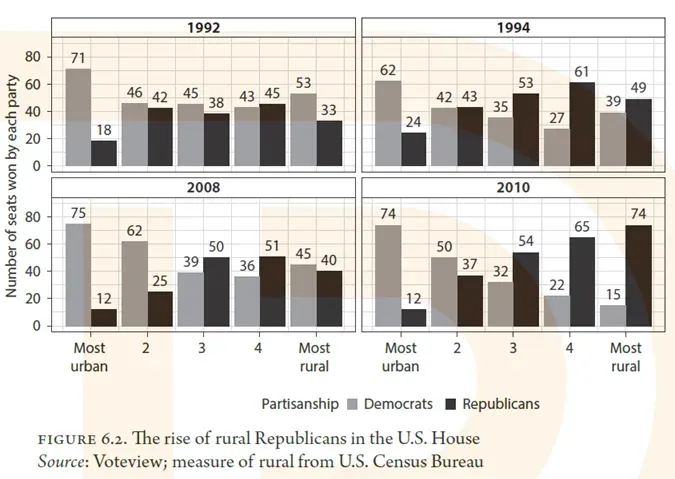
A single chart from Mettler's book, Figure 6.2, helps bring the story home. It shows the partisan makeup of the House by quintiles of rurality (based on county-level data) following four key elections: 1992, 1994, 2008 and 2010. In all four elections the most urban quintile stayed relatively stable, with a huge Democratic advantage. In the 2010 Tea Party wave, Republicans failed to pick up even a single new seat. But the most rural quintile tells a starkly different tale.
In the 1992 election, Democrats held a 55-33 lead in the most rural quintile, reflecting the political dominance the party had enjoyed since the New Deal. In fact, the 62.5% percentage was actually 3% higher than in the House as a whole. But that lead flipped to a 49-39 GOP advantage in the 1994 "Gingrich revolution," which widened dramatically to 74-15 in the 2010 Tea Party wave. In between, however, in 2008, the second of two elections with Howard Dean’s 50-state strategy, Democrats had regained a 45-40 edge.
There have been similar, but less sharply-defined shifts in the Senate, Electoral College and Supreme Court as well. But the House is the most fine-grained channel through which these changes have flowed. This chart reflects three things that the book describes: (1) the New Deal gave Democrats a healthy majority in the nation’s most rural districts, as a direct result of its policies (2) which the rise of neoliberalism destroyed, (3) but that a determined party-building effort temporarily reversed.
The party-building effort was possible, in part, because the urban/rural divide isn’t fundamentally about issues or ideology. While there are some issue/ideological differences between white urban and rural Americans, they’re relatively modest. Gay marriage is the most divisive, with a 12-point difference, but the most striking fact, the book notes, is that both groups are moving in parallel to become more accepting. Rather than issues, the divide is an us/them matter of identity. In 2020, white rural Republicans rated Democrats just 14 points on a 100-point feeling thermometer, while white urban Democrats put Republicans at 17 points.
But there’s a difference as well as a similarity reflected in these figures. Rural Republicans often openly express hostility to Democrats, leading rural Democrats to become less visible, feeding into a downward spiral.“Many Democratic county chairs told us about local supporters of the party who’ve become afraid to put political signs in their yard or sign a petition, for fear of losing friends, the services of repairmen, or even their job,” the book notes. “Local business people worry they’ll lose customers if they reveal their political preferences. A few even mentioned receiving death threats,” (p. 5). Reversing this trend is hard work, and requires outside support to make headway over the long run.
In “Rural Versus Urban” Mettler told Liberal Currents, “We are more specific in terms of the party-building that needs to be done. One thing that most political scientists agree on, and it can come as a surprise to people, is that a means toward reducing our polarized politics today would be to strengthen, not weaken, political parties.” What she means is quite specific, “to strengthen them at the organizational level,” she said. “We strongly recommend that the Democratic National Committee and state parties devote considerably more attention and resources to support organizing in rural places. And we think that a first step in that process needs to involve listening to rural voters, to understand their needs and concerns, as well as why they have been turned off to the Democratic Party.”
While a minority of voices within the party have long argued for a return to Dean-style year-round party-building, Rural Versus Urban makes the case with new forcefulness, grounded in county-level analysis spanning five decades, along with extensive interviews of rural party chairs from both parties.
Liberals who live predominately in urban areas have a hard time grappling practically with the rural/urban divide, but this wasn’t always so. In the book, Mettler notes that the New Deal placed a high priority on dealing with rural issues, reflected in advance by how Roosevelt campaigned (p. 44).
He believed that the farm crisis of the 1920s had played a major role in causing the Great Depression and that rural poverty sustained it....
Roosevelt’s “Brain Trust,” in considering what should be the top priority among his campaign themes, selected not the problems of industrial production in big cities, but instead agriculture.
Once elected, Roosevelt’s New Deal placed a high priority on dealing with rural issues, specifically benefiting farmers with the Agricultural Adjustment Act, the Soil Erosion Service, the Farm Credit Administration, and supporting rural America more broadly, with the Tennessee Valley Authority and the Rural Electrification Administration. It also enacted regulatory policies that benefited smaller cities and rural places generally, with the Glass-Steagal Act, the Miller-Tydings Act and the Robinson-Patman Act. Together with Roosevelt’s vigorous antitrust enforcement, they note, “Over the next half century, these politics fostered stability in the economy and helped rural communities to thrive,” (p. 47).
This policy legacy was hugely consequential, but is virtually absent from public memory. Without understanding it, we lack significant understanding of our past, how we got here, and how we might move forward in the future.
When Roosevelt campaigned for president, Mettler told Liberal Currents, a third of Americans still lived in rural areas, as he himself did. Perhaps this is why he centered rural concerns in building the broad coalition that got him elected, she noted. After that, he worked hard to secure their loyalty, with party building that was matched with regulatory policies that helped farmers and rural places more generally. This tradition was sustained by elected Democrats over the next half century, some as moderate power-brokers who struck compromises that helped everyday Americans, others as progressives who supported policies specifically helping working-class people.
Unfortunately, Mettler went on to say, today's Democratic Party "has lost touch with this tradition and the transformative potential it holds for American politics." Party leaders, disproportionately highly-educated urbanites, often rely on stereotypes of rural people "assuming they are bigots," who can't be made part of a broad coalition. But the data shows this is mistaken. “We find that non-Hispanic whites in urban places differ little, in fact, on measures of racism from those in rural places,” she said. “One in four rural Americans, furthermore, is a person of color, and the rural-urban political divide means that their needs are severely overlooked by both parties.”
It was the dismantling of the New Deal order, and the rise of neoliberalism in its place, that hit rural America especially hard and left rural residents feeling that Democrats had abandoned them.
New Deal era regulatory policies aimed to equalize costs across the country, shielding both rural and urban areas from raw economic forces. In contrast, late 20th century deregulation "made life cheaper and helped economies thrive in more densely populated places, but were to the detriment of rural places," Mettler said. Free trade measures were promoted by politicians in both parties without adequate consideration for "communities on the losing side, particularly in rural places." More recently, Democrats have promoted renewable energy policies in seemingly high-handed ways, with inadequate democratic processes for rural needs and concerns to be considered and addressed. Here matters may be more complicated than Mettler allows, as some resistance is clearly generated by fossil fuel industry propaganda. However, the most robust consultation process, undertaken in Texas in the late 1990s, resulted in Texas becoming the leading windpower state. So her point still stands, despite undiscussed complications.
Rural stagnation contrasted with the relative health of urban America, bolstered by the growth of the knowledge economy, which was increasingly seen as elitist, Democratic and domineering. While pundits praised Bill Clinton in 1992 for supposedly moving the Democratic Party “back to the center,” that’s not at all how rural America saw things.
The book’s analysis of how the divide emerged is three-fold. It began “when rural communities were ravaged by economic changes that matched the Industrial Revolution in their scope and power,” which “were exacerbated by policy choices: The United States’ embrace of deregulation and free trade removed the regulatory supports that had long been built into the political economy to sustain rural places,” (p. 222). At the same time, many urban places more easily rebounded, aided in part by public officials promoting the knowledge economy. All this led to place-based economic inequality, and as a result, in the 1990s and early 2002, the counties hardest hit by it shifted away from supporting Democrats to supporting Republicans.
The second phase, most evident from 2008 onward, deepened the divide as rural Americans “grew to resent what they perceived as overbearing Democratic elites—from urban places—advancing policies in which they felt they had little voice.” This wasn’t a matter of policy views, but of process, of having things imposed on them by outsiders. One example is rural opposition to wind energy projects, pushed in the same sort of high-handed way as fossil fuel projects in the past—with decisions made by outsiders behind closed doors, presented as a fait accompli. In a study of opposition to wind farms in northern Indiana, one resident summed up, “I’m not anti-wind. I’m anti-how-it-was-done-here.” This is yet another result of failing to know and appreciate New Deal history, which placed significant importance on public engagement.
A third compounding trend was conservative mobilization. As political party organizations weakened, growing less able to play a sense-making role—connecting the dots between votes for parties and outcomes in people’s lives—Republicans were aided by civic organizations such as Evangelical churches, Right to Life organizations, and gun clubs affiliated with the National Rifle Association which were particularly concentrated in rural places. Evangelical churches, for example, have been concentrated disproportionately in rural areas by nearly three to one ratio, on a per-capita basis. At the same time, the Democratic Party lost similar support as labor unions that had long bolstered it were decimated by deindustrialization and GOP-backed attacks on them. This has also harmed rural support for the party. (Conservative media and the demise of local newspaper likely played a role as well, but appropriate data was lacking.)
While a single chart captures what’s happened in the House, the full impact flows through multiple channels where matters are more opaque, and analysis requires more nuance. In the Senate, for example, citizens in small population states wield disproportionate power—41 times as much for South Dakotans vs Californians, but some small-population states like Delaware and Rhode Island are largely urban. Still population size and rurality “are fairly well correlated” and “most states tend to be more rural than the United States at large”—32 of them as of 2020. “As a result… rural people have been over-represented in more than half of all states over the last four decades,” (p. 158) despite the ongoing growth of the nation’s urban population.
Looking at the Senate from 1980 to 2024, the picture is clear. Democratic senators have always represented more people per senator, but the gap has more than doubled from 400,000 (2.5 vs 2.1 million) in 1980 to 1.1 million by 2024 (3.8 to 2.9 million). Over this time, Republicans controlled the Senate twelve times, but only twice did they represent a majority of the nation—“and by very slim margins,” Mettler notes. On average, Republican held 53 seats representing 48% of the population when they were in control, while Democrats held 54 seats representing 59% of the population.
Add to that, there’s the filibuster. It “was invoked in 2009 and 2010—when Republican senators represented just 39 percent of the population—more times than during the twenty-nine Congresses in the years running from 1917 to 1974,” (p. 163).
And then there’s the Electoral College, where the impact, in contrast, is blunt: Since the rural-urban divide opened up, popular vote winners have lost the presidential election twice, less than 20 years apart, compared to just three times in the two centuries before.
The Supreme Court is analyzed via the lens of Senate confirmation votes, from 1980 to 2020 and the percentage of Americans represented by those voting in favor. Two related trends stand out as partisan teamsmanship has increased: the percentage of Americans represented declines along with votes from members of the opposing party. While Clarence Thomas was an outlier when he was confirmed by senators representing a minority of Americans in 1991, he’s now been joined by all three Trump nominees, while Justice Alito’s support eked into majority territory with 50.2%.
As a result, the minority-supported justices reshape the law to make it harder for the federal government to address the public’s needs, including rural Americans, And—as highlighted by the repeal of Roe v. Wade—their views aren’t in line with public opinion (rural or urban) on many important issues “The consequences, in short, will be both long-lasting and harmful to democracy in the United States,” (p.175).
These institutional results and their rural roots are peculiar and specific to America, but not to the benefit of rural voters themselves. While the pre-distributional policy impacts of the New Deal order have been eroded, the redistributional impacts—more strongly associated with its Great Society elaboration—have survived to a certain extent with somewhat perverse results.
While, as noted before, private sector employment has stagnated, federal transfer payments, and government employment have taken up some of the slack. Per-capita transfer payments to rural and urban Americans were nearly identical 1970, and rose in near lockstep through 1990, when they began to diverge. By 2019, on the eve of the pandemic, rural people received $1,749 more per person. But they weren’t necessarily pleased. As the book notes, “like most Americans, they would prefer for themselves and their fellow citizens to make a living by gainful employment,” (p. 185). And, in addition, as a study in rural Wisconsin found they mistakenly believe “urbanites relied more than themselves on government benefits and paid less in taxes,” (p. 185).
Similarly, public sector jobs were more common in urban areas prior to 1992, on a per-capita basis, but the reverse has been true ever since, with gap widening over time. Even when the Biden administration “made more federal funds available to rural areas for economic development than they had received in many decades,” the “initiatives likely garnered little appreciation,” because they went unnoticed (p. 194). “Without a stronger presence of the Democratic Party, or other organizations such as labor unions that could highlight policies, even an infusion of federal resources can go largely unnoticed by local residents,” (p. 195).
Which is why it all comes back to party-building, particularly in rural counties. There are places where the downward spiral has been reversed, showing what’s still possible. Even without the support Dean’s 50-state strategy provided, rural party chairs in Georgia were key to electing two Democratic senators in 2020, securing a Senate majority.
Frank Phillips, a county chair in Marjorie Taylor Greene’s district, was cited as an example. When he became chair in 2016, Democrats were only on the ballot for 8 out of 140 open seats for federal and county elections. He set out to recruit candidates for every race and nearly succeeded in 2018 and 2020. “By getting people on the ballot, we got Democrats out to vote,” he explained (p. 207). And in the Senate runoff in January 2021, by making phone calls, text banking, and advertising, they increased turnout from the general election, while Republican turnout fell. They only won 18% of the vote, but “losing by less” in rural counties across Georgia was key to winning those races.
While this enabled passage of a substantial domestic agenda with significant rural benefits, the lack of local party vitality was part of the reason they went unrecognized by many, resulting in subsequent Democratic losses. While most polarization discourse blames both sides and denigrates parties, the picture that emerges from “Rural Versus Urban” is quite different. When one party feeds on minority rule, the other has to become a champion of democracy, which of necessity involves listening to the people. Doing that more deeply in a more sustained way can shift identity perceptions, while bringing practical policy solutions more to the fore.
“In terms of policy solutions, here again it will help to listen to rural voters,” Mettler told Liberal Currents. “Much of what rural Americans want is the same as what urban Americans want. For some issues, rural people may feel that policies need to be designed or delivered in ways that are attuned to the specific needs and characteristics of their communities and places they inhabit.”
This doesn’t mean ignoring the Democrats' more urban, more diverse base. As the New Deal showed, it’s possible to heed and tend to the needs of communities on both sides of the rural/urban divide. We can’t simply wave a magic wand and recreate the New Deal, but we can rebuild. The divide links up with constitutional barriers to action, and reducing it would reinvigorate our democracy, in what could become a virtuous circle. Reducing economic inequality would be good for rural America, and would become far more possible if the divide were lessened. Similarly, when we had rural liberals like Birch Bayh, Frank Church and George McGovern in the Senate, there was much more stomach for limiting executive power, as well as a healthier, more well-rounded image of what patriotism looked like.
“I think it is helpful to put the two books in dialogue,” Mettler told Liberal Currents. “Many might conclude from Four Threats that what’s most needed now is institutional reform, at least along the lines of those that followed Watergate—to give Congress a stronger voice, for example, relative to the presidency.” There’s certainly a strong desire for this—witness the “No Kings” movement. But, “While such reforms are warranted, I don’t think they are sufficient in such a highly polarized nation,” Mettler cautioned. “Until we can reduce polarization, our politics is going to be fraught, and any institutional reforms can be captured for partisan advantage rather than serving to restore the rule of law and separation of powers.”
In light of that, “The rural-urban divide is, to my mind, our worst and most dangerous form of polarization today,” she said. “And it’s so unnecessary, given that people living on either side do not differ much at all in their views about policies—only in their views about parties,” she added. “As long as the divide persists, it will subject people on either side to one-party government, with the lack of accountability that entails, and it fosters nasty and dangerous, us versus them-style politics for the nation as a whole. Most problematic, it permits minority rule through several mechanisms. Our most pressing need today, therefore, is to mitigate this divide, to restore democracy.”
Featured image is "View north along Virginia State Route 78," CC BY-SA 4.0 Famartin 2017.
Sign up for the newsletter and get our latest stories delivered straight to your inbox.
_just_north_of_U.S._Route_23_Business_(Main_Street)_in_Appalachia,_Wise_County,_Virginia.jpg?ref=liberalcurrents.com)