
Editor's Notes: Your Local Fascists
We know what to do with Trump and his stooges. The harder question is what to do with the ordinary Americans we will have to live alongside afterwards.
The right wing's assault on Religion and Humanities programs is an assault on our ability to understand the world, from Hindutva abroad to Christian Nationalism at home.

In August 2025, about a week before the start of the Fall semester, we as faculty in the Department of Religion and Culture received an email from the Dean of Virginia Tech’s College of Liberal Arts and Human Sciences announcing that she had “directed a plan to be formulated to discontinue the Religion and Culture degree.” Part of this plan, the email went on, would also involve closing the department itself via a “process that involves an internal and external process for an organizational change.” Although there’s been no formal announcement made by the university as of our writing this piece, all of Religion and Culture’s faculty have been transferred to new departments and at their recent meeting Virginia Tech’s Board of Visitors approved the department’s closure, which will be effective July 1, 2027.
As (former) faculty in Religion and Culture, we were surprised by this announcement and will note that the process of dissolving the degree and closing the department hasn’t been entirely frictionless. But that decision and that process have alerted us to the critical work that scholars of religion—of the Humanities more generally—do at public universities like ours. We are now more fully aware that, although politicians and university administrators tend to justify these closures purely in financial terms, as a low “return on investment,” the stakes are much higher: the nationwide attack on the Humanities is an attack on the public good.
The closure of the Department of Religion and Culture at Virginia Tech is one within a nationwide pattern, with Humanities programs, especially in Religious Studies, being particularly susceptible to these administrative maneuvers. In addition to Virginia Tech, programs in Religion have been shuttered at public institutions such as the University of North Carolina–Asheville and Miami University in Ohio, among others, while still others remain in administrative limbo, hovering just next to the chopping block. But the assault on aligned departments in the Humanities is, of course, much larger, and has touched universities across the country and even across the Atlantic.
Typically, these closures are announced as austerity measures designed to ensure institutional solvency in troubled financial times. In addition, the administrators deciding on these closures and cuts often say that they rely upon “data points” and metrics, although they choose which metrics—number of majors, student credit hours, faculty-to-student ratio, direct tuition generation—they use to justify the decisions. In so doing, such supposedly data-driven decisionmaking often leaves aside the fact that Humanities departments tend to be revenue positive because of their low overhead costs and the large numbers of students they teach, the fact that the metrics administrators use can be deeply flawed, and the fact that employers are increasingly looking to hire Humanities graduates as generative AI erodes critical thinking skills.
In some ways, our institution is fortunate; Virginia Tech does not have immediate budget problems, though administrative officers are certainly wary about the uncertain future of federal grant funding. Still, the Virginia Tech decisionmakers who are closing the Department of Religion and Culture alluded to such financial concerns and appealed to such corporatized metrics. The resolution closing our department made no explicit mention of financial exigency but rather only noted potential financial concerns, stating that the department’s undergraduate enrollments were “unable to consistently meet…program productivity and viability benchmarks, and [the department as a whole] had a low financial return on investment.”
Starting with the last claim first, about “financial return,” closing the department will supposedly save Virginia Tech $121,185 per annum—barely a rounding error in an institutional operating budget of $2.5 billion. The neoliberal university may function like a corporation, but budgets are always moral documents that demonstrate what an institution values. So, if we’re talking about such a small portion (0.004%) of the budget, and yet “financial return on investment” was supposedly a driving factor in the decision, then we have to ask about those institutional values. Or, to put it another way, it’s fair to ask what Virginia Tech received for its $121,185.
The Department of Religion and Culture was known for being “small but mighty.” In 2018, RLCL was designated a University Exemplary Department for demonstrating “exemplary teaching and learning for both students and faculty in a variety of ways including a merger of technological innovation with the conceptual and ethical insights of the humanities, multifaceted engagement with Virginia Tech’s founding Land-Grant mission, and commitment to the rigorous study of cultural and religious diversity both locally and globally.” In 2019, we were also awarded the Presidential Principles of Community Award, meant to honor individuals and units who fostered a welcoming, inclusive teaching and learning environment in accordance with Virginia Tech’s Principles of Community.
In addition, our individual faculty members have consistently won research and teaching awards. Our department’s innovative “Humanities for Public Service” major was highlighted by the American Council of Learned Societies (ACLS) and praised by national media. Our students have been named the top graduating students in their respective classes. We’ve had several graduates of our degrees join the Peace Corps, others who work for regional civic and cultural centers, still others who have gone to professional school to begin their careers working with underserved populations. Indeed, the collaborative development and launch of this major (alongside a more traditional BA in Religion and Culture) created an atmosphere of consistent growth in our undergraduate enrollment and graduating students since the major launched in 2012.
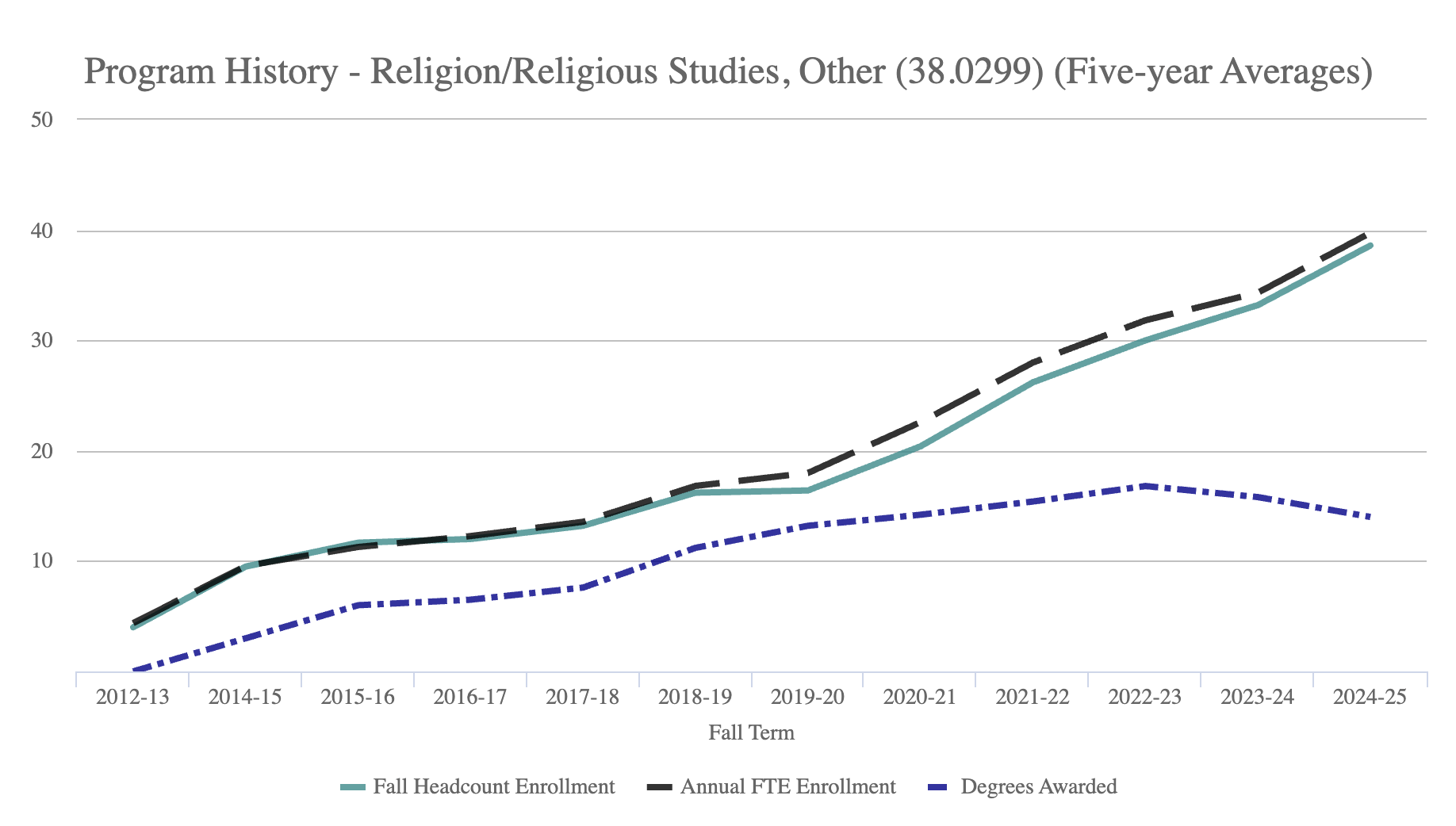
Beyond the purely functional, there’s a particular irony to closing a low-cost, high-performing, growing department such as ours. Our courses and our major equipped students to understand how, across the globe, religious power impacts our day-to-day lives. From Hindu nationalist violence against religious minorities in India, to the rising tide of antisemitic hate crimes, to Christian nationalism here in the US, we cannot escape the effects of this power—if not on ourselves, then on our friends and neighbors. In addition, the power that tech oligarchs seek to wield, the way that the public uses and engages with LLMs, intersects with religion. There is a reason that the new pope’s first encyclical letter was directed specifically at the role of technology on contemporary society. Indeed, religion even determines how we mark time—when we have to work and when we don’t.
Understanding these examples, among many others, is not at all dependent upon whether or not we ourselves are religiously-affiliated. The study of religion at a public university is not theology, nor evangelization. Religion is part of culture and vice-versa—hence, our department’s name. Taking from students the analytical tools to recognize the often invisible or unarticulated ways that religion influences their lives is tantamount to rendering them unable to recognize the forces that are working across societies around the world, and because they remain invisible, students cannot combat their abuses. As colleagues have said in a similar context to ours, as citizens of the modern world, you might be done with religion, but religion isn’t done with you.
Why, then, are universities dismantling the very departments that teach students to navigate their reality? Why, then, are these attacks happening primarily at public universities—ones explicitly designed to serve the communities they are embedded within?
There isn’t just one reason that all this is happening, of course. Context matters, and anyone who offers a simple answer to a complex economic, cultural, and political problem is selling something. But at least one part of the reason these attacks are coming is that on every campus there are two universities—the administration and the faculty—who are competing with one another. Indeed the two are fundamentally at odds about what a university is. Faculty may incline more leftwards in their personal politics, but those who really run the university enact right-wing policies to discipline faculty and students, having long histories of overcomplying with mandates—going far beyond what’s required to pacify potential (right-wing federal and state) political pressure.
What all this means is that the attack on the study of Religion is part of a broader attempt to exclude certain people from the public sphere, therefore limiting their very ability to participate in our democratic society. It also means, however, that Religious Studies is the discipline perhaps best poised to understand and combat this trend.
To see why, it helps to know that our modern Western understanding of “religion” views it primarily as an interiorized discourse—that is, concerned with personal beliefs rather than with community or society. We are living in the world that 19th-century Europeans made by looking in the mirror and defining “religion” in terms of their own Protestantism. But this masks both the existence of other traditions, as well as the actions that people take on behalf of that interiorized discourse. In other words, because the ways that religion operates in our culture and society are often “invisible,” the power it can exert is not always immediately recognizable as “religious” power.
Our tendency to see religion as a matter of personal, interiorized belief has led us to view its study as intellectually niche—or, to put it in neoliberal corporate speak—as a “low-skill” distraction. This is true of how we view the Humanities in general, of course—that, as Lauren Horn Griffin has so well explained, they’re seen as little more than “personal enrichment.” But that, she continues, is a right-wing act of controlling unruly ideas, of pushing to the margins disciplines that ask difficult questions of “invisible” power structures—say they’re irrelevant, deny them resources, call them “unprofitable,” make them disappear. But faculty, especially but not exclusively in Religion and other Humanities disciplines, often work directly against these forces. Because the discipline of Religion is attuned to issues of (presumed) interiority as well as actions in the public sphere, it’s these faculty who are some of the best situated to ask uncomfortable questions of those in power—be they federal policymakers or university administrators.
At (regional) public universities like ours, this means highlighting a population that is quite different by class, race, gender, and sexuality than found at, for example, the Ivies. Humanities education, including Religious Studies, helps inure students to authoritarian thinking. At their best, the Humanities are attentive to the frictions that create lived experiences—particularly those that are oftentimes marginalized. The Humanities explain how things have been different, could have been different, could be different now, and may be different in the future. They are about possible worlds.
And those possible worlds can be seen as “dangerous.” Faculty—the good teachers, at any rate—empower students to think for themselves, to ask questions of authority, to imagine the best of those possible worlds. For faculty, the university is not a neoliberal corporation but an institution of education and, when necessary, a site of solidarity with our students.
The university—especially the public university—has never been an “ivory tower,” but rather a place where we help create the public sphere we want to see in the world. Centering the public good means offering to our students the same robust intellectual environment their elite private-school peers enjoy. In higher ed’s austerity era, Humanities degrees are poised to be the purview of the wealthy alone.
Virginia Tech’s motto is “Ut Prosim”—“That I may serve”—and our hope for the future springs from expanding access to an education that exemplifies our motto, allowing future generations to more fully participate in all aspects of American society. This is the work ahead of us both here at Virginia Tech, and at universities elsewhere—to fight for that public good. All students deserve the benefits of wide-ranging intellectual training in the Humanities, deserve to be full members of our twenty-first century society, even those who attend a regional public school in Appalachia.
Featured Image is a depiction of the Bonfire of the Vanities, picture taken by G. Dallorto
Sign up for the newsletter and get our latest stories delivered straight to your inbox.
