
The First Vibe Shift Left in Years
Elections can both shape and be shaped by culture.

2026 was a vibe shift election. You can sense it, right? After Democrats’ sweeping win, something feels different. The change is larger than a shift in governmental power, reverberating in the culture, shifting expectations. New possibilities opened up. There’s some generational turnover. Things that seemed indefinite now appear on their way out.
Politics never stops, the electoral high will wear off, and the frustrating reality of divided government with a lawbreaking president will settle in. But the vibe shift will carry forward. And it feels like such a big change because it’s the first real leftward vibe shift since 2008.
“Politics is downstream from culture,” wrote Andrew Breitbart. It’s a popular line to cite, especially on the right; the sort of adage that sounds smart until you think about it. Yes, elected leaders and platforms are of the culture that empowers them, rather than alien to it. The next Indian prime minister will not be a devout Christian who denigrates vegetarian diets, fails to recognize a single Bollywood actor, and conducts all public communications in Swedish.
But the problem with Breitbart’s adage is that politics also influences culture. One isn’t downstream of the other. They’re deeply intertwined, shaping each other in a swirling eddy of mutual causality. Does anyone seriously think Donald Trump’s 2016 electoral victory and subsequent presidency had no cultural impact on the United States?
With that in mind, we can define a “vibe shift election” as one that both highlights something big in the culture that had been underappreciated by politics, and shifts power and expectations in ways that cause cultural change. This is different from a wave election, in which one party flips many seats in Congress, though the two often overlap. A narrow electoral win can have a big political and cultural impact, as did Trump’s incredibly close defeat of Hillary Clinton in 2016.
National elections are the only thing that can have this kind of impact. Cultural shifts can happen in civil society, without politics, but elections provide public verdicts in a way nothing else can. Politicians and other public figures can claim to speak for the people. Polls can estimate public opinion. Media and sales metrics can measure what’s popular. But national elections are a big, undeniable gauge. Candidate X won, party Y lost seats, group Z turned out in large numbers and tipped the balance. Even politicians who lie about election results can’t help but treat the vote like a scoreboard.
Social reactions are an essential part of vibe shifts. Societal elites—in media, business, law, finance, academia, etc.—altering their behavior in response to an election helps create the cultural change they’re supposedly just observing. Their words shape public understanding of what the election means, while their adjustments to changes in state power are one of the main mechanisms by which politics influences culture.
The easiest example is 2024. Trump won narrowly in a politically favorable environment, albeit not as narrowly as 2016. That brought about significant changes in the US government, not just from Democratic to Republican but from democracy towards authoritarianism, with majorities on the Supreme Court and in both houses of Congress readily enabling it. But beyond that, a vibe shift came from a combination of (1) the impact of a plurality voting for Trump as an anti-democracy coup plotter, vocal bigot, adjudicated rapist, and convicted felon, and (2) civil society elites rushing to appease Trump as if he were a king, thereby making him more like one.
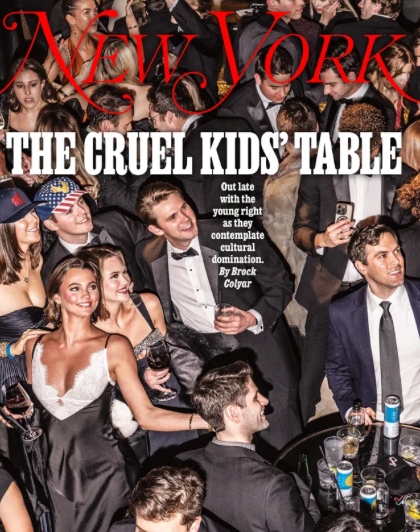
Political media presented Trump’s numerically narrow victory as a sweeping triumph, an affirmation of right-wing culture warring. Trump’s win, in particular his gains among Latinos and young men, was cast not as frustration with pandemic-driven inflation amidst a global anti-incumbent wave, but as a permanent realignment. Centrist pundits declared “the kids are on the right,” and scolded Democrats to drop progressive positions on immigration, trans rights, and climate lest they never win an election again. We heard a lot about the “manosphere” and Democrats supposedly needing a “Joe Rogan of the left.” California Governor Gavin Newsom started a podcast and brought on right-wing guests such as Steve Bannon and Charlie Kirk, trying to show their audiences he could hang. Like an entertainment magazine’s “what’s hot / what’s not” trend monitor, American media acted like diversity was out, and bigoted cruelty was in.
Business executives, especially tech billionaires, started bribing the president and stood with him at the inauguration. Prominent law firms responded to Trump’s threats by agreeing to do work for him for free. Media organizations, such as CBS and ABC, paid Trump millions to drop frivolous lawsuits and altered their coverage in his favor. Universities such as Columbia entered negotiations to give the federal government greater control over courses and admissions.
After the 2026 election, leading Congressional Democrats have told those law firms to expect subpoenas. Other non-governmental figures who bribed or otherwise made a corrupt deal with Trump will likely follow. I bet some of them are regretting their choice to collaborate.
Did you have a reaction when reading that? An inkling that comeuppance may finally be coming to people who very much deserve it? That’s the vibe shift.
On that admittedly unscientific measurement, here’s how I’d score the last ten national elections:
2008: Big vibe shift left
The high point of “hope and change.” First Black president, large Democratic victory. Obama won nine states Bush carried in 2004 and two states he carried twice, including Virginia, which had voted Republican ten presidential elections in a row. Democrats gained 21 in the House, and eight in the Senate, allowing them to achieve a filibuster-proof majority by July of 2009.
2010: Vibe shift right
Tea Party, ongoing problems from financial crisis and war, Republicans win many seats in what Obama called a “shellacking.”
2012: No vibe shift
Obama won reelection, but by a smaller margin and with lower turnout than 2008. Republicans kept control of the House. Basically confirmed the two-steps-left, one-step-right story of 2008 and 2010.
2014: No vibe shift
Republicans gained, but in the House it was a relatively low amount for a party that doesn’t control the White House. The core dynamic remained the same.
2016: Big vibe shift right
Trump, MAGA, Russia, all of it—the era we’re still in started here
2018: No vibe shift
Democrats get control of the House in the midterms, but don’t get the national repudiation of Trump and MAGA that they hoped for.
2020: No vibe shift
I considered calling this a small shift left, since Biden beat Trump and Democrats won Congress, but it’s remarkable how little the culture changed in response. People were exhausted from a year of pandemic, protests, and an intense presidential campaign. Trump lost, but got millions more votes than in 2016 despite mismanaging the pandemic, showing that MAGA had staying power. Democrats kept the House majority they won in 2018, but lost 13 seats. They didn’t win the Senate until Georgia’s runoff on January 5, 2021, and any positive feeling from that curdled the next day with the January 6 attack.
2022: No vibe shift
Trump remained the main character in American politics, and faced little accountability for his crimes. Withdrawal from Afghanistan, the Delta wave of covid, and Russia’s invasion of Ukraine contributed to sour vibes. Republicans won control of the House in the midterms, but with only a nine seat gain, and Democrats gained a seat in the Senate, adding to their slim majority.
2024: Big vibe shift right
Trump wins, America chooses authoritarianism, corruption, ethnic cleansing, protectionism, abandoning democratic allies, and abdicating global leadership—even if many voters did not understand it as such—and a wide swath of elites rush to embrace or at least acquiesce to the new order.
Which brings us to 2026.
America finally got the backlash to Trumpism that pro-democracy, pluralist forces were hoping for. Part of it was economic (e.g., high prices) but part was unmistakably cultural. Backlash to ICE abuses and the Trump regime’s campaign of ethnic cleansing drove big Latino turnout and swings to the left, which played a large role in Democrats finally flipping Texas—and doing so not narrowly, but decisively. Backlash to the Supreme Court gutting the Voting Rights Act and red states trying to disenfranchise voters with racial gerrymanders drove big Black turnout, which played a large role in flipping seats in Mississippi and other southern states. Young voters, especially men, swung hard to the left. Hundreds of millions of dollars on Republican ads—much of it paid for by Elon Musk—pushing anti-trans and anti-Muslim smears flopped hard. The post-2024 sense of a lasting demographic and cultural realignment is gone.
This didn’t come out of nowhere. Cultural moments presaged this electoral vibe shift. Public outcry over Trump deporting Kilmar Abrego Garcia to CECOT prison in El Salvador. The wave of censorship after the Charlie Kirk killing and the failed attempt to force comedian Jimmy Kimmel off the air. Minnesota anti-ICE protests and widespread public recoil to the murders of Renée Good and Alex Pretti. Tennessee Democrats walking out of the state legislature in objection to racial gerrymanders. Massive No Kings protests. And more.
The election solidified and advanced those cultural developments. There’s generational turnover, prominent victors who ran on values, not merely economics, along with a bunch of demographic firsts.
Biden was a figure from the past returning to power—almost 78 years old when elected president in November 2020, vice president 2009–2017, first ran for president in 1988—but Democrats now have prominent younger faces. The party’s national image looks more like incoming first-time senators Annie Andrews (46 years old), Scott Colom (43), Abdul El-Sayed (42), and James Talarico (37), joining reelected senator Jon Ossoff (39). That adds to New York City Mayor Zohran Mamdani (35) who made the Democratic Party look younger, more active, and more appealing after winning election last year and continuing to crank out social media videos. Alexandria Ocasio-Cortez (37), a face of young Democrats since her initial election to the House in 2018, won comfortably and is primed to seek higher office in 2028.
None of those figures were alive when Joe Biden was first elected to the U.S. Senate, in 1972.
El-Sayed is America’s first Muslim senator. Incoming Georgia governor Keisha Lance Bottoms is the first Black woman elected governor in U.S. history. Colom will be the first Black senator from Mississippi since Reconstruction. Deb Haaland of New Mexico is the first Native American woman to become a governor, and Peggy Flanagan of Minnesota will be the first Native American woman in the U.S. Senate. Gina Hinojosa will be the first Latina governor of Texas. Aaron Ford will be the first Black governor of Nevada—or any state west of the Mississippi. David Crowley will be the first Black governor of Wisconsin, and Xavier Becerra the first elected Latino governor of California. Amy Klobuchar will be Minnesota’s first woman governor, while Amy Acton will be Ohio’s first woman and first Jewish governor.
With a few races still counting, the Democrats are on track to hold the most House seats either party has had since 1990, and will have made the biggest gain for their party since the 1974 post-Watergate wave.
That said, Democrats will not be able to govern from Congress, much as Republicans weren’t after the 1994 vibe-shift midterms that made Newt Gingrich Speaker. Trump making Stephen Miller his new chief of staff, and House Republicans picking Jim Jordan as the new minority leader, show they intend to double down, not pivot. And the 2028 electorate won’t be the same as this year’s.
But the 2026 vote not only flipped Congress and multiple states, it also opened new possibilities for 2028—perhaps a Democratic trifecta, and maybe a filibuster-proof Senate as well. That possibility will prompt civil society leaders to recalculate, to appease Trump less and align more with forces that appear on the rise. And that, in turn, will boost the vibe shift.
One could reasonably say the 2026 election has caused “change”—a change that, for the first time in a while, spread some hope.
Featured Image is US President Barack Obama taking his Oath of Office, by Master Sgt. Cecilio Ricardo, U.S. Air Force

Read next

Scharf’s Pseudoconstitutional Barf
Robert Garcia, Will Scharf, Scott Colom, Pete Hegseth, and Jensen Huang, out.

The Family Annihilator Presidency
Donald Trump has dragged the entire Republican Party into the tomb with him.

The Next Congress Begins to Take Shape
Jim Jordan, Chuck Schumer, Pete Hegseth, and Will Scharf, unleashed.

The Left Needs to Get Serious About World Order
The progressive restrainers’ proposal is fundamentally incoherent.