
Editor's Notes: Your Local Fascists
We know what to do with Trump and his stooges. The harder question is what to do with the ordinary Americans we will have to live alongside afterwards.
The descent of stable societies into ones of endemic violence rarely produces anything but new forms of tyranny and terror.

On August 31, Erin Piacenti, a 32-year-old vice president at Bank of America, was stabbed to death in New York’s Times Square. The murder was a tragic but completely random act by an assailant with no clear motive, a total stranger to Piacenti. This did not stop some from reacting to the news with a kind of bloodthirsty glee. On X, the filmmaker Lexi Alexander quoted a breaking news post about the stabbing with a meme image of Luigi Mangione’s face being projected like the Bat-Signal.
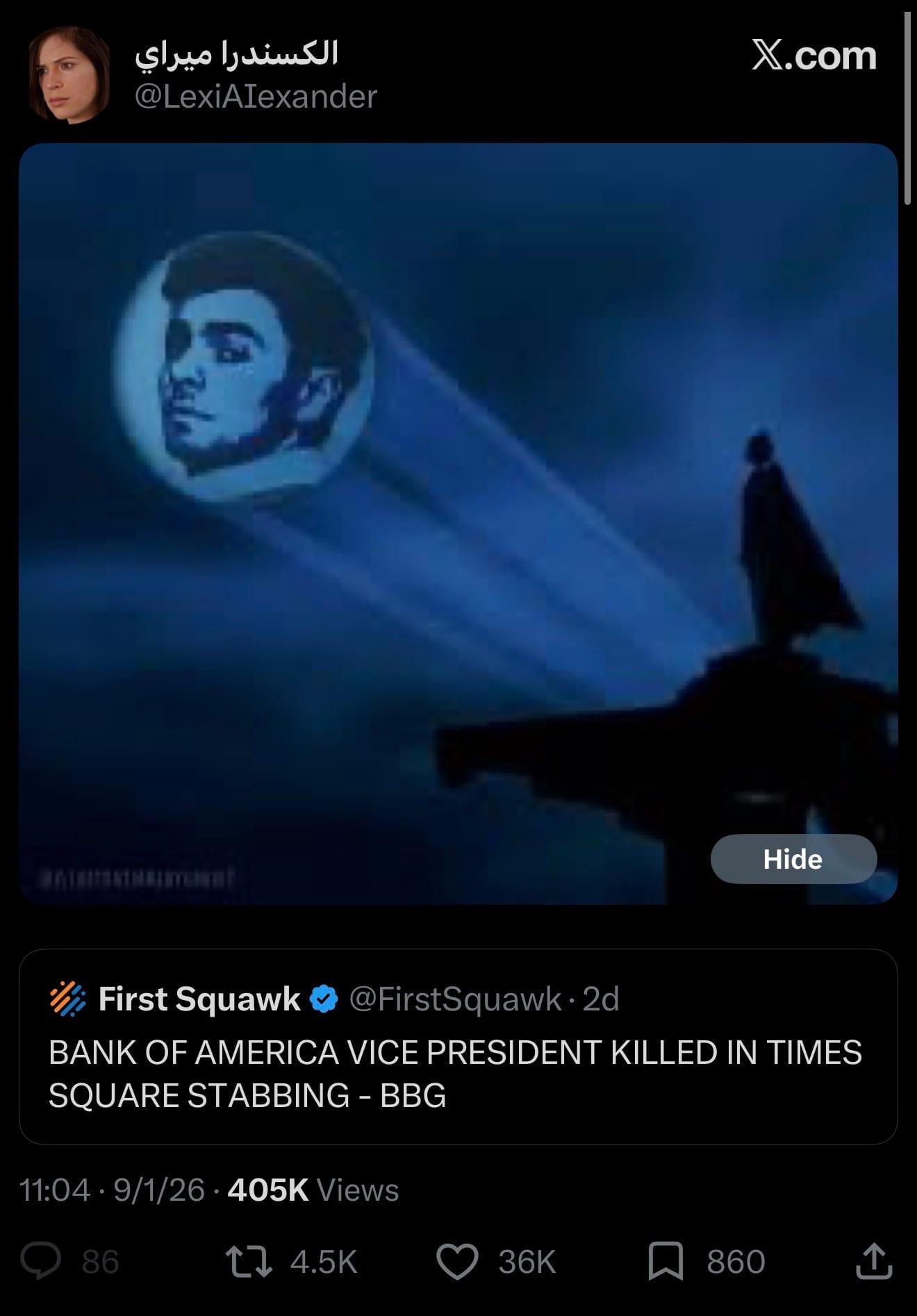
Never mind that Piacenti’s “vice president” title indicates that she held a middle-management position; a large financial-services firm such as Bank of America will have thousands of employees with that title. And never mind that this killing was not an act of political terror but rather the explosion of one person’s tragic instability. The message from many is that the violence of our system is so great that the extrajudicial murder of anyone seen as complicit in that system is justifiable. Something that will achieve justice.
That is a dangerous idea, even if it is one built on timeless human impulses. The descent of stable societies into ones of endemic violence rarely produces anything but new forms of tyranny and terror. People are fond of citing history’s most famous revolutions in support of such extremism, but the full record of armed revolt is mixed to say the least. Widespread revolt in contemporary America is unlikely, but it is also not something we should wish for.
Luigi Mangione is not patient zero for revolution discourse, but he is a good example of how febrile contemporary American politics has become. A few weeks ago, Mangione pled guilty to federal stalking charges in relation to the killing of UnitedHealthcare CEO Brian Thompson. It’s a move that has resulted in the postponement of his state-level murder trial out of concerns over double jeopardy. The news has pushed Mangione back into the headlines, and drawn renewed attention to his legions of fans and online supporters. Since his shooting of Thompson, Mangione has been celebrated both as a vigilante hero and a sex symbol by those who feel his act of murder was a justifiable crime against the injustices of private healthcare and capitalism’s excesses, as well as those who seem to primarily drawn in by the titillation of a handsome young man’s moment of explosive violence.
In December of 2024, Mangione was being heralded by users across places like X, Bluesky, and TikTok as a hero. Even well-known commentators like Taylor Lorenz expressed sympathy with his actions. While Lorenz herself said she would not advocate the killing of anyone, even executives in an “evil” healthcare system, the sentiment that “Luigi was right” remains prevalent. One of his most extreme fans, speaking to the New York Post, described the murder of Thompson as “a revolutionary act of protest, the likes of which we haven’t seen since the civil rights era.”
Lorenz’s defense of her description of Mangione back in 2024 also carried echoes of revolutionary violence. As she put it:
We have a lot of violent systems in America. Our immigration system is violent. Our prison system is violent, our healthcare system is violent. And until people feel seen and heard and have that violence recognized by people in power in the media, they're going to feel unheard, and they're going to see that the only language that people in power seem to speak is violence.
This is a thorny proposition at best. Functional states do not, after all, typically respond to violence with acquiescence. The civil rights era of the mid-twentieth century was marked by complex and variegated campaigns for social change achieved through mass protest, individual activism, legislative policy, jurisprudence, and shifting cultural mores. The efficacy of violence in that story is tenuous at best, and we most often think of the self-defeating brutality of Southern segregationists like Bull Connor. It was the hateful, authoritarian violence unleashed on King’s marchers that helped turn the tide of American public opinion. No one can watch those scenes and think nonviolence is cowardice.
A generation of racial activists followed that era who did believe that revolution was upon us, ushering in the closest thing modern America has seen to a Years of Lead. In his book Days of Rage, Bryan Burrough describes the 1970s as “a decade when self-styled radical "revolutionaries" formed something unique in postcolonial U.S. history: an underground resistance movement…it was real, and it was deadly.” Burrough argues that many of those groups—groups like the Weather Underground and Symbionese Liberation Army—truly believed they were going to usher in change, perhaps even epochal revolution, through their efforts. They did not, and it’s now easy, as Burrough himself notes, to dismiss these movements as the stuff of kooks and misfits. But people died. And many other societies, modern and ancient, have succumbed to centrifugal forces of violent civil conflict. Yet today’s America is not in anything like the years in which those groups bombed its cities, robbed banks, and carried out tabloid-fodder kidnappings.
We are, though, as many recognize, in a precarious period. There are people who do want to plunge this country into deeper and bloodier conflict. Take the now-pardoned January 6 terrorist Enrique Tarrio, who posted in August, “They’re still doing it because we didn’t hang them last time.” Just years removed from the height of the worst pandemic since 1918, with midterms approaching and a sitting president who has made it clear he may attempt to stay past 2029, Americans should be attuned to real dangers of indulging in violent revolutionary fantasies.
We have seen the legacy of The Turner Diaries and its apocalyptic white supremacist vision from Oklahoma City to January 6. Dreams of “the Day of the Rope” drove Timothy McVeigh to kill over 150 people in 1995 and inspired insurrectionists to erect a gallows at the Capitol in 2021.
Actual revolution, far right or far left, has not come. But too many Americans seem to think we are immune to such a fate or, worse, that they would find themselves to be the beneficiaries. “Sure,” they seem to think “the violent breakdown of social order might be bad for some. But I’m built different.” Some deserving elites may die, but the virtuous will win out. And if not the virtuous, then at least the clever and deserving. As a friend noted, "They watch Mad Max and see themself as Max, never as the poor bastards tied to the front bumpers of the dune buggies."
In her book A Savage Order, Rachel Kleinfeld describes the ways countries fall into and become trapped in the miasma of violence. Kleinfeld and other researchers describe this deleterious process as “decivilization.” As Kleinfeld argues, “Decivilization’s deepest damage, however, is wrought not by professional killers but by ordinary people normalizing violence.” And the damage wrought by years of formal and informal violence tends to affect thousands, even millions, more lives.
Consider the example of 1990s Bosnia, where genocide returned to Europe a half-century after the world said “never again.” In addition to the mass loss of innocent life, countless communities were beset by the horrors of gangsterism and sexual violence. As Amnesty International’s Jelena Sesar observed in a 2017 op-ed at Al Jazeera, the legacies of these crimes remain deeply felt:
At least 20,000 women and girls were raped or abused during the conflict’s three years. Many witnessed the torture and killing of family members, and some, even today, are searching for the remains of their loved ones who were taken to the camps and never returned. They suffer from the devastating consequences of these crimes and psychological trauma that does not subside. Yet, they face numerous barriers preventing them from accessing the legal redress and support they desperately need.
Civil conflict and endemic violence touch all of society. They leave dead bodies. But they also victimize communities in countless other ways. They cut trenches through the psyches of nations.
When Thomas Hobbes wrote Leviathan, his conservative defense of royalist sovereignty, it was not because he was a cold-blooded authoritarian. Hobbes was haunted by the destruction of the English Civil Wars, which exacted a greater loss of life as percent of the population than World War One. I’m a modern liberal democrat, so of course I think Hobbes was wrong in his defense of monarchy. Yet he was right to fear the chaos of civil conflict. Hobbes understood the same basic truth Alex Garland did in his film Civil War, chillingly captured by Jesse Plemons’s unnamed character, that the main beneficiaries of societal breakdown are the most ruthless and murderous among us. Hobbes knew that when violence becomes widespread, when decivilization takes hold, most of us are the ones being thrown into the pit by Plemons’s character and his compatriots.
Featured Image is The Death of Sir William Lambton at the Battle of Marston Moor, by Richard Ansdell

We know what to do with Trump and his stooges. The harder question is what to do with the ordinary Americans we will have to live alongside afterwards.


We must channel our anger at current injustices into productive direct action.

Social media has been a boon to autocratic regimes and their allied movements in democracies.
Sign up for the newsletter and get our latest stories delivered straight to your inbox.
