
In the Times of Global Capitalism
Books from Alessandro Stanziani, Clifton Crais, Trevor Jackson, Jeremy Adelman, and Branko Milanović.
Books from Alessandro Stanziani, Clifton Crais, Trevor Jackson, Jeremy Adelman, and Branko Milanović.

Welcome back to Breakwaters, the Liberal Currents weekly books newsletter. Please subscribe for exclusive access to our book reviews, author interviews, news analysis, and deep dives into the world of ideas. Grab a coffee mug and a tote bag for more comfortable reading.
President Luiz Inácio Lula da Silva recently completed a remarkable comeback in the Brazilian election. At stake in that election was the ecological future of the Amazon rainforest. A Flávio Bolsonaro win would have surely accelerated the deforestation of the region. In the 20th century, the Amazon forest was raided for raw materials. In the modern age, its trees are cut down to make way for roads connecting human destinations through the mystical forest. Times change, but the logic of capitalism seems to remain the same. What can we learn about the history of capitalism and the way it has shaped our world to the present? A number of new books offer a grand tour of the millennia-long coming, triumph, and possible future of this radically transformative economic system.
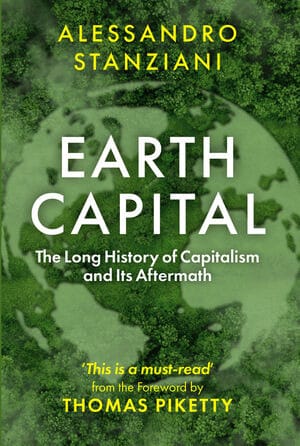
As Alessandro Stanziani explains in his new book, Earth Capital: The Long History of Capitalism and Its Aftermath, the rapid degradation of the planet since the late 19th century has gone hand-in-hand with greater civic freedom for wage workers and more investment in human and physical capital, at the expense of what he calls ‘‘earth capital’’—the value of our planet as an indispensable resource for human sustenance and flourishing. Stanziani argues that the period 1870–1970 was the turning point in the history of man’s relation to the planet. [Read the full review here.]
Prior to that century, both humans and animals were worked to death to enrich authorities and to fulfill the presumed order of nature. It was not until the introduction of mechanized labor freed masters from the need to depend so totally on the dual exhaustion of human and animal energy that moral concerns for the well-being of all kinds of humans—and animals—really began to be taken seriously. And yet despite this moral progress, humans still struggle to see the earth as their most vital capital in the fight for a better future.
Stanziani’s book is a wake-up call to center the earth in our discussions of a coming age of superabundance. His prescriptions are simple, but challenging. ‘Stop wasting food’ is something a parent would say to a child, but in a country like France, where food is responsible for 36% of national greenhouse emissions, and 10 million tonnes of food are thrown out every year, this is not such bad advice after all (Earth Capital, p. 245).
Stanziani agrees in broad outlines with the way much of the existing scholarship portrays the modern industrial period as the most destructive phase of our earth’s recorded history. His history of capitalism suggests that the ‘era of the peasant’ produced significant but relatively lower pollution than the explosion of carbon dioxide that characterizes the age of machines. While generally true, he is also insistent on asking the question ‘at what cost?’
Become a Community Subscriber for just $30 for the first year, and join our vibrant Discord community!

Those writing obituaries for Christian nationalism need to hold off.

Pro-democracy voters delivered a resounding message that the South wants to move forward and not backward.


Sign up for the newsletter and get our latest stories delivered straight to your inbox.