
European Election Results, Racist Militias, and Jared Kushner (Half the Answer #104, with Hunter CG)
News of the Old World and the ongoing adventures of our "special envoy for peace."

What does the Callais decision mean for voting rights and other anti-discrimination protections in the United States? How is anybody supposed to defend their rights against race-based discrimination if they're not allowed to use disparate impact as proof? Catch the discriminators confessing on a voice recording carrot pen, "Zootopia"-style? Bust out the mind-reading machine? We ask Madiba Dennie, author of The Originalism Trap, to explain it, and to help us figure out what to do now.

Half the Answer can be heard on Spotify, on Apple, on YouTube, on Amazon, and elsewhere via its RSS feed.
Get The Reconstruction Papers in Print!
 Madiba K. Dennie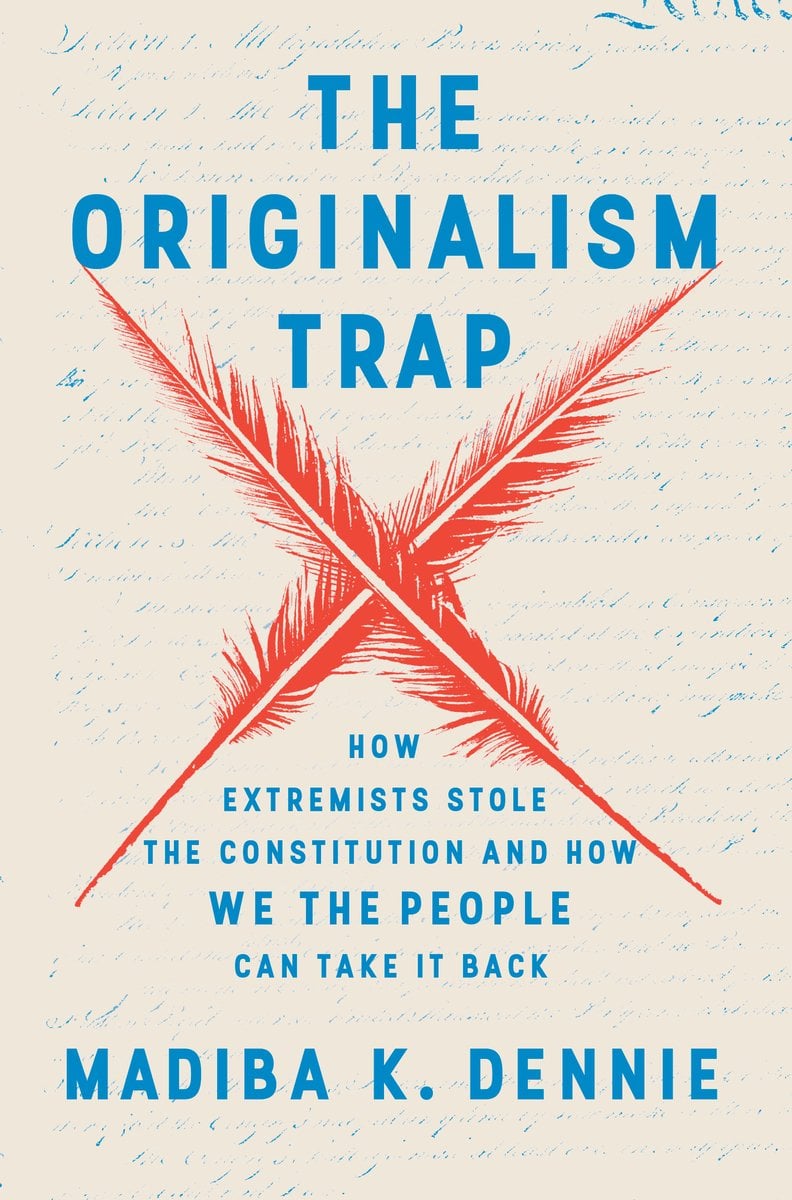
 Balls & Strikes
**Caitlin M. Green [00:00:30]**
Well, happy days are here again. It is summer. You can't beat that. The sprinklers are on, the schools are closed — unless you need a little extra help, and there's no shame in that. Have fun with your summer school. This is, of course, Half the Answer, where understanding a question is half the answer. I am your host, Caitlin M. Green, along with me as my co-host, Trent R. Nelson. And we are back again. You can't stop us, it turns out. How are you?
That's right. It's hard not to when you're this vindicated — you kind of just have to shout it from the rooftops, I think.
Yeah, dad rules don't just persist, that's crazy. I don't know why you would think that. Right. Well, it's just like the food chain, really. If it was a bad rule, it would have been eaten by another rule. So, yeah, exactly.
Yeah, well, the good news is nobody's ever gotten away with doing something racist by saying it's not actually racist, right? That's impossible. So fortunately, we don't really have to worry.
**Trent R. Nelson [00:01:03]**
Right? I'm doing well. Half the Answer, official podcast of people going to summer school again — as Caitlin said, no shame in that. Get your education going, and keep it doing so. That's what we love here on this program, hence why we're here each and every week. And this week is no different. We have one of our beloved recidivists — you know how we love a repeat offender — coming on to the program. Well, it's Madiba K. Dennie. We love her so much. We love her book, *The Originalism Trap*. It just celebrated its second birthday. Happy anniversary for your book, our friend. You can find her words and editing over at Ballsandstrikes.org, and you can hear her yelling about how right she's been for years all over — and there's nothing wrong with that. Let them know, let them know. That's good, it's good. Madiba, our wonderful friend, how are you today?
Pleasure is absolutely all ours. And, well, Caitlin, we got to speak with the marvelous Thomas Zimmer just a little bit ago, and what an education he gave us. We spoke about the first reconstruction, as well as the second reconstruction — which many are saying the Callais decision by the Supreme Court has officially closed the door upon. And since we had a marvelous history lesson with Thomas, we figured we needed more. We needed more, and we needed it from courtside. Madiba, you are the only person we could imagine bringing on. As Thomas, as we spoke about — Callais was really just the death knell, as it were, to the sort of civil rights movement that Thomas notes began when Johnson finally consummated the grand trick that he played on all of his southern counterparts. Richard Russell was big mad. Good, good. Madiba, can you sort of explain that process that he notes sort of ended with Callais, but certainly did not begin there?
**Madiba K. Dennie [00:01:44]**
Thank you. I am doing all right. Thanks so much for having me back.
Callais is very much not the start, I think. As the ruling came down, and as we're in this sort of post-Callais hellscape, I regularly have that feeling — that meme of, like, "stop, he's already dead, you don't have to be doing all this." But the Voting Rights Act was, if not dead, on life support for a long time already. The first real deadly blow, I think, in the modern era would have been, like, a decade ago in Shelby County versus Holder. That was where the Supreme Court basically nullified the heart of the Voting Rights Act — the pre-clearance provision. It was the most innovative part of the Voting Rights Act. It basically said: if a state, or some sort of county or government jurisdiction, has a track record of violating people's rights — they have a history of discriminating on the basis of race against voters of color — you can't be trusted, you need to get permission first.
And the Supreme Court basically nullified that permission. They said, "Oh, this formula is so outdated. Why are you bringing up old stuff? We've had a Black president now, the voter turnout gap no longer really exists" — which is entirely unrelated from the time that Barack Obama was on the ballot. Never mind that. This is definitely representative of elections. And so he says all that, and says, "This is a terrible departure from our longstanding principle of equal sovereignty, because you're treating some states worse than others." Mind you, laws have always treated some states differently than others. That's just the way laws work. And this purported historic principle that he's referring to is basically nowhere to be found. This equal sovereignty doctrine is not a thing. He was referring to the equal footing doctrine, and that was referring to the terms by which states enter the union — how you get to become one of the United States. It had nothing to do with laws affecting states differently when they're already in the union. And even in that limited area where it was supposed to apply, it didn't even consistently apply then anyway. So he's just pulling out this sort of historical grab bag of nonsense to say racism's over, and we don't need this provision of the Voting Rights Act anymore.
So that's already where we're starting from — where we no longer have the tool to stop bad acts before they happen. We now have to rely only on checking things that have already happened, so there's already harm that's occurring. You're forcing affected communities to spend a bunch of time and money litigating against this. So that's the world that Shelby County puts us in. And then the court chips away at that too. Even that remaining provision, they start making it harder and harder to prove violations under the provision they had left alone. So they say things like, "Oh, you really need to make sure you're taking the legislatures in good faith, and you should make sure that you're not just trying to set aside election rules that folks have had for years, because if they've been around for a while, they were probably okay." Because that makes sense.
**Trent R. Nelson [00:07:57]**
Right, the marketplace of ideas sorts them out, just as the economic marketplace — a bigger rule, right?
**Caitlin M. Green [00:08:00]**
It's like the food chain.
**Madiba K. Dennie [00:08:11]**
Yeah — like, why does the biggest rule not just eat the smaller rule? So it is just coming up with all of these ways to make it harder and harder to prove a violation. And now what Callais basically does is say that even if — so it makes it even harder to prove a violation — and says that even if you somehow manage to overcome all of those burdens, now there's basically nothing you can do about it, because Callais changes the remedies that are available. Basically, it says that if you are a voter of color and the state is doing racial gerrymandering, tough luck for you — unless you can present an alternative map that does all the things that the racist map sought to accomplish. And furthermore, a state can basically get away from any sort of legal liability for a racial gerrymandering claim by saying, "Oh, their goals weren't actually racial, their goals were partisan." Never mind that racially polarized voting is a thing. Never mind that party affiliation is also entirely connected to, driven by, race. But it says you need to actually disentangle these two things fully. There needs to be no overlap in the Venn diagram. And if you can't do that, and you can't get this alternative map, then basically you just have to eat it. You just have to be stuck with the racist map you have. Because — yeah. States have never done that. The court itself has never done that. Nothing to worry about.
**Trent R. Nelson [00:11:12]**
It seems kind of — forgive me for stating the obvious, right, as you're making your beautiful explanation for us — but the Supreme Court saying that Congress has to conceive of these state legislatures with some sort of good faith, it sort of belies the point that state legislatures historically have not acted in good faith at all. And to suppose that they would is to give them the benefit of a doubt that, methinks, they don't really deserve, and that doesn't actually serve the process.
**Madiba K. Dennie [00:11:25]**
Yeah. The opinion basically says you need to think the best of state legislatures, despite all evidence to the contrary. And ironically, I think it also thinks pretty poorly of federal legislators, because it just could not care less about the law that Congress enacted. They're basically saying it's reverse racism — that fixing a racial gerrymander is racial gerrymandering, because you're taking race into account. And that's some real galaxy-brain-type reasoning that they really are opposed to. They would never let that fly if it was applied to states doing something racist — they would be like, "Absolutely not, you can't make that kind of inference." But they basically completely discount the federal legislature. They discount the role of the Constitution in empowering the federal legislature to enforce the Constitution's prohibition on racial discrimination. They just care so much more about the purported right of state legislatures to be racist, to maximize their partisan advantage at the expense of voters of color. They care about that so much more than they do the actual constitutional right of people of color to participate in democracy on an equal basis with everybody else. They just could not care less. You get to see a really obscene weighing going on of their priorities, and it's detached from the Constitution, it's detached from the Voting Rights Act, it's detached from any sort of concern for multiracial democracy. All it actually is is imposing this jurisprudence of white supremacy — and really, sort of white grievance as well — and being like, "How dare you accuse these legislators of doing something racist? That's the actual racist thing to do."
**Caitlin M. Green [00:10:57]**
It feels like saying something like, "Well, I think that we should only elect the pure of heart to the Senate." Okay, sure. What's in your heart? Is it pure? I hope so. Or, "Oh, let's do this in only good-faith readings." Oh, okay, sure, I'll just check the good-faith open reader and see how it did.
Now, Trent, don't snort. Reverse racism is real.
**Madiba K. Dennie [00:14:21]**
That's classic John Roberts and classic Sam Alito.
**Trent R. Nelson [00:11:26]**
Yeah, Alabama — Alabama, famous for good-faith litigating. Am I correct? Seriously.
**Caitlin M. Green [00:13:49]**
Honestly, this goes back forever, right? "It's divisive of you to call attention to racism. How dare you." That's my emotional support white supremacy — you can't take that away.
And classic — my grandpa — it's just everywhere. But we're always having that fight, right? It's with voting rights, it's with affirmative action, it's with employment discrimination. It's everywhere. Whenever you're trying to fix a problem that comes from discrimination, you get accused of discrimination. I will cite one of my favorite — well, it's old now — a linguistics paper from like 2018 about white liberal racism, where when you confront somebody with the idea of racism, a lot of times they are completely comfortable and happy using the language of social justice and race consciousness to flip the table, right, and say, "Well, actually, that feels racist towards me as a white person. I don't like how you're bringing up all of these differences and things."
**Madiba K. Dennie [00:14:21]**
This feels racist to me. And something you're saying — how this has been a longstanding problem — it makes me think about one of the first Supreme Court rulings applying the Reconstruction Amendments. Hilariously, it was like 1870, something comical like this. There were literally people walking around with visible whip marks still — very recent. These justices probably had enslaved people, or knew enslaved people, and they were just bemoaning any sort of remedial policy from Congress. My favorite quote was like, "For how long will the Negro be the special favorite of the laws?" And it's like — it's 1870, what are you talking about?
So there are two funny things happening in the Slaughterhouse case. One is that it's one of the earliest cases applying the Reconstruction Amendments, and it's not actually involving people, much less Black people. It's involving a corporation that's suing over a law that's preventing it from having a butcher shop where they want it, because there's a really restrictive law giving a monopoly to one company. So that's one weird thing about that case. And another is how it basically, as soon as these amendments were passed, read one of the provisions out of existence. That's where we got the privileges and immunities clause — which is part of the 14th Amendment — and the Supreme Court basically says, "Oh no, that doesn't apply here, that only applies to rights related to the federal government, the right to run for federal office," and just really specific narrow things. And it's not clear where they got those from — how they decided that these alone are actually what this amendment applies to.
So I think it's a really good early example of how the court will just decide a perfect-for-itself reading, independently from what Congress put into the Constitution, or what Congress had to say about the matter, or what the people whose lives this is affecting had to say about the matter — just saying, "Oh no, that actually doesn't apply, for reasons." And since then we basically have never really had a privileges and immunities doctrine at all. It is kind of one of Clarence Thomas's little hobby horses, because as much as he hates substantive due process — and he really hates substantive due process — one of his several problems with it is that he's like, "Shouldn't the privileges and immunities clause be used for stuff like that, as opposed to the due process clause?" But the privileges and immunities clause has basically meant nothing for 150 years.
And we see the Supreme Court today engaging in that same sort of nullification — saying that Congress's power to pass appropriate legislation to enforce the 14th Amendment and 15th Amendment, apparently that means nothing, because the Supreme Court consistently shuts down the parts of the Voting Rights Act, or whatever legislation Congress passes. And it's not just that provision either — it's plenty of them. We saw them just basically nullify the constitutional prohibition against insurrectionists running for office. We see, time and time again, the court just decides that doesn't actually apply here, or there are these new hurdles that appear nowhere in the Constitution, but, "I'm telling you that these boxes must be checked in order for this right to mean anything." And, as you know, these boxes can't be checked.
**Caitlin M. Green [00:17:38]**
It's a running bit now that Trent tries to get every guest to explain Slaughterhouse, and then they don't. It just sounds like absolute Calvinball — like the rules are what I want. Oh no, how do we stop them? I'm excited. I can see why a lawyer might go, "But, but —" but I get it.
**Trent R. Nelson [00:16:42]**
I mean, again — you brought up the Reconstruction, and I wanted to ask you, since your lovely book is behind you and it's just celebrated its two-year anniversary: which Supreme Court is this Supreme Court trying to be original regarding? Is it Roger Taney's court? Because he's getting a lot of those vibes. But something we actually just briefly touched upon in the last episode, and this might actually be useful for some context regarding the machinations of the courts as it concerns Black folk — can you explain Slaughterhouse, if possible? Perhaps that could give us a little bit more understanding of how this is not without precedent.
**Trent R. Nelson [00:21:35]**
Right. Well, I mean, the reason it came to my mind was because of what you were saying regarding the court's sort of creation of this doctrine of sovereignty, which you said is a reference to something else that doesn't really exist as they say it. And it's just this constant — I guess — gaslighting, right? Like, "Yes, it says this. People who don't know anything about the history of the courts, it says it right here, right?" But then they're just sort of hoping that nobody has anybody like you to be like, "Actually, it does not say that there, it has nothing to do with that."
**Madiba K. Dennie [00:22:22]**
Yeah — there's a really outrageous example of that in Shelby County, where literally John Roberts uses some strategic ellipses, uses a dot-dot-dot to make a sentence say the opposite of what it means. He just took out a relevant part. And it's like, this is crazy. But if people aren't familiar with the court's history, and if they don't look back at what is he quoting here, and then you see the quote and you're like, "Oh, that says and means something entirely different" — they're counting on people not calling them on it. And that's one of the reasons why it's so important to call them on it, because they are just lying. They're just playing in our faces, and they're using it to stifle democracy, to help ensure white authoritarian rule. The court cannot be permitted to continue like this.
I'm very much an all-options-are-on-the-table kind of person. I'm a yes-and person. I don't think we need to say this is the one thing to do, because there are several things that ought to be done. Among them, of course, court expansion — that's an obvious one. Term limits, also an obvious one. This one is a little bit more controversial, I think, at least among lawyers. When I say this around lawyers, I get a little, "Oh," but when I say it around non-lawyers, they're like, "Yeah, that makes sense." But I would say jurisdiction stripping. Congress has the power to define what kinds of cases the court even has the ability to decide. And so I think the court just shouldn't have the power to strike down the Voting Rights Act. When Congress has to pass the new Voting Rights Act, they should put a provision in there that deprives the Supreme Court of jurisdiction. And this isn't unprecedented — Thomas, a member, might have gotten into a little bit of this as well, about how in the Reconstruction era Congress was dealing with a hostile court then too, and so they had to exercise their authority over the court, because they have that authority.
Congress sounds so cool. I wish it were real. Yeah — part of it is definitely voting in better people, because even if you have Congress members with the good letter next to their name, some of them are still more inclined to fold than fight. They don't want to push for the necessary changes. And if they don't do that, then it's game over.
**Caitlin M. Green [00:28:23]**
How do we get Congress to happen?
**Trent R. Nelson [00:21:35]**
Like, yes — it says this, right here. They're just hoping nobody has anybody like you to call them on it.
**Madiba K. Dennie [00:27:55]**
Then the Supreme Court will just continue to steamroll everything. So anything you actually want to accomplish, you need people who are willing to fight for it — and willing to fight the court for it — because the court is such a primary antagonist to multiracial democracy right now. But I don't want to put that all on — I'm not trying to say "gotta go vote" or something, because you can only vote so hard, especially with the gerrymandering that the court is encouraging. Voting in numbers that can overcome these structural odds is a ridiculous challenge that people should not have to bear.
I also think — I do think this would be much harder to pull off on a grand scale, but I think about people like Calvin Duncan, and how the Louisiana legislature responded to his election as clerk of the New Orleans criminal court by quickly passing a law to get rid of his position. So we're living in this extremely anti-democratic — small-d democratic — extremely anti-democratic moment, where voting is clearly necessary but insufficient, in that we'll see the votes diluted, or suppressed, or even just thrown out altogether, apparently. So I fully recognize that that's not enough, and it's going to call for really creative advocacy in all sorts of ways — putting pressure on electeds and on the court, whether it's at the polls, or in the streets, or in people's wallets, all sorts of stuff.
This is a really lowbrow way to put it, I guess, but I feel like a lot of various schools of thought and advocacy can all essentially boil down to either persuade people to join your side, or make it too uncomfortable for them not to. Just make it too irritating and too unsustainable, where they're like, "God, fine, fine, I'll just do it." They don't want to, but they'll do it because it's too big of a hassle not to at this point. So I do think you've gotta just make some people's lives hell until they decide to act right.
**Caitlin M. Green [00:30:58]**
Yeah, here we can learn from the children, I think. Like an understudy — it's totally cool. We love, love, love to pretend that things have always been the way that they are. It is so fun for us, apparently. It's like, "Oh yeah, gender relations have always been — the man goes out and then he returns to a home-cooked meal and 3.5 children." And it's like, actually, that's not quite right. "Oh, the court has always been that size. Don't worry, don't look into it too hard. It's fine." Where was his meatloaf? I want to know why it wasn't waiting for him when he came back home. "Oh, I've seen Hedwig and the Angry Inch, I don't need to read your books. I don't need your book-reading, learning, hoity-toity ivory tower academies. I'm a cool Democrat, so I don't have to worry about that stuff anymore. If you're gonna do it, my six-year-old daughter, I'd rather you do it in the house." What about quarterly performance reviews? What exactly is it that you do around here?
**Trent R. Nelson [00:25:19]**
Absolutely. Ultimately, what I think American history sort of illustrates to some of us, at least, is that while the Supreme Court is the highest court of the land, it often makes rulings where you say to yourself, "God, wouldn't it be great if there was a higher court? Wouldn't it be great if there was somebody there to be like, 'No, no, no, actually this is not good.'" And, well, Congress is just out here not doing its job for, I don't know, 250-ish straight years. I joke all the time — before Thomas Brackett Reed helped to destroy the silent quorum in the House, the silent quorum that used to exist used to be able to stop a quorum from being called by not saying you're present during roll call, right? Literal five-year-old stuff. And it was only in the 1890s that Thomas Brackett Reed of Maine was like, "This is crazy, we have to get rid of this." I don't know how they got anything done for the first 110, 120 years. But in any event — those are all really positive innovations. You mentioned that it'd be great if Congress existed. What is that going to take? Is that going to take the American people voting in better people? How do we get a Congress?
**Madiba K. Dennie [00:34:55]**
I think — as you're saying — does term limits force out people who sort of know what they're doing? I think there's some good evidence behind that in the elected-official context. That's sort of why term limits could be bad, in that if the elected officials are there for a limited amount of time, they become more reliant on the lobbyists who have been around the block forever. And also, elected officials sort of have a kind of built-in term limit, in that we have elections, so voters could throw them out. But the court doesn't have any of those regular mechanisms like that, and so term limits become more important there.
But I think probably the first thing I would do with a Democratic president and Congress would be adding at least four more justices. I don't think I would even immediately worry around with, "Oh, do we do this age cutoff, do we do this?" Just give me a simple — we hereby increase the size of the court to 13 justices, enacted this day, done. And then you start your confirmation hearings. I feel like that's my step one. Keep it simple, immediately get the more justices, in order to neutralize immediately the Roberts court. Stop the bleeding, basically. In order to do anything else, we first need to stabilize our patient, which is democracy. And so to stabilize that patient and stop that bleeding, the first thing we can and should do is just add more justices. Because again, when we're doing more legislation — say you want to pass a term limits law, and that law then goes to the Supreme Court, and the Supreme Court's like, "Well, that's unconstitutional, and I'm not leaving" — so perhaps if we expand the court first with justices who would say, "Yes, term limits are constitutional," then I feel like that might be a more helpful order of operations as well.
**Trent R. Nelson [00:31:22]**
Calvin takes his place with many fine and brilliant folks in the South since the end of the Civil War who had their jobs stripped or removed or voted out of a state senate or state house. It is not, unfortunately, in our American history, rare. It has happened, and it likely will happen more, as you noted, as a result of these rulings and the turn of the country.
Now, FDR — his Supreme Court scheme, his court-packing scheme, as it was, relied on the age of the justices already sitting on the court. It had to do with, "Well, these are all old folks, and this legislation — it's not really packing, it's just, these are all old folks, and if they're above a certain age, maybe I should just be allowed to replace or add another. Wouldn't that be — that's not a big deal, right? You are old, you need somebody young, let's get you a friend, even if you don't agree with them." Well, Madiba, as we know from American history, the court has not been a static size, it has not been a static format. Turns out we just do whatever we want, right? We made the thing — you can shape it like warm clay.
**Trent R. Nelson [00:33:25]**
Read Plato's other half, and that's the original we're going to go with, instead of — I don't know — but I'd love for you to read it and explain to me what you think of people before Zeus split them up. We were just big balls with hands and arms, right? Cool, let's drink at the house. Absolutely. Well, Madiba, I guess my question with all of that lead-up is: what is Madiba's sense of expanding the court? What does that look like in your mind, and what do you do? Do you create an age cutoff? Do you create term limits? I know within the congressional discussion there's always a sort of push and pull, by having term limits — do we limit good actors and good intellectuals and good functioning politicians from being able to maintain their jobs? Can you explain it in five sentences? Yeah, exactly.
**Caitlin M. Green [00:38:06]**
She takes that compliment about as well as I do, so good job. Yeah — but then you see a world in which Mitch McConnell has failed to achieve his deepest dream, and we wouldn't want to do that to a nice old man like that, would we? Legacy in tatters. Yes, let's do it.
**Madiba K. Dennie [00:39:17]**
If we can send Mitch McConnell to his grave devastated about seeing his life's work come undone — that's a win. That's a win.
But like you said, the Supreme Court — I think sometimes people get uncomfortable with the idea of court expansion, and they think court packing is politicizing the court and stuff. And it's like, the court has always been political, it has been politicized, it has been weaponized. This isn't packing the court, it's unpacking the court. When we have multiple justices who were nominated by presidents who lost the popular vote, confirmed by senators who didn't represent a majority of the country, and who are serving these lifetime positions without any sort of meaningful ethics constraints — they're deviating from their own rules and procedures and precedents, they're buddy-buddy palling around with these billionaires who are paying for them to go on these luxurious, lavish trips, they are undercutting the plain text of the Constitution, they are not enforcing the laws passed by Congress. They are in fact making it so that Congress can't enforce their laws, or can't act to enforce the Constitution's provisions.
And — I almost stopped there, and I'm like, "No, wait, actually, hang on, I got some more." They already changed the size of the court by holding the seat open, and they claimed that it was too close to an election to do otherwise, and then they confirmed Amy Coney Barrett in the middle of an election, when votes were already being cast. So there's just this total lack of legitimacy. Not to mention that we have tens of millions of people in the country being ruled by this minuscule group of like nine guys — usually nine guys, usually white guys, who went to Harvard, and whose names are like John or like Robert. So, Johns — I checked once. You got it. You can't have both. I checked once, and there were literally twice as many white guys named John as anybody else. It's something obscene. I similarly checked once, and I was like, "We got Shrek the Musical before we got a woman of color on the Supreme Court."
At capacity of Johns. No more Johns. Declaring a moratorium on Johns until we figure out what the hell is going on.
I should also just note, as we're thinking about how the right has had its dedicated court-takeover plan for a long time — that literally 50-odd years ago, Lewis Powell wrote a memo. In this memo, for listeners who may not be as fully in the weeds on this as we are, he straight up spells out, "Man, I think the right has been taking some losses recently. We have this whole social justice movement happening, Black people and women are getting rights, college kids are protesting against going to Vietnam, labor unions are a thing. We need to push back against this..."
**Caitlin M. Green [00:41:50]**
So many Johns. Oh my god. Sometimes their name is both John and Robert, that doesn't seem fair. Okay, hang on a minute — I'm gonna defend Shrek the Musical, it's a very good musical. The opening number, where Fiona is singing a trio with her two younger selves — I mean, you can't top it. Anyway, the point being: I actually was talking to somebody about baby names, and we were talking about what you see around, because boys' names do tend to vary a little bit less than girls' names, and they were like, "I don't see any Johns or Johnnies running around." And I was like, "Yeah, 'cause we're full up on Johns. We have enough, we did it. You can't fit another John in there, that's it." Exactly. No, we can never have enough Johns — J-W-N. You gonna deprive the people of Philadelphia of everything? Now you're speaking my language.
I'm obsessed with that memo. There's a disturbing anti-business sentiment — "anti-business" is so funny. I'm so sorry, they do suck, though.
**Trent R. Nelson [00:42:54]**
Full of John. Yeah, we had maximum overload on the John. No, that's true — and that's John's O-H-M, that's John's O-N, that's even John's A-W-M. It is a placeholder for everything.
Madiba, so court packing is not court packing. What they have been doing, what I've been watching for the last 26-plus years, is court packing — got it, saved moving forward.
**Madiba K. Dennie [00:44:59]**
...this anti-business, anti-capitalist, egalitarian agenda — and the way we do so is through the courts. That might be the best way to do so. And literally a few months later, this dude was confirmed as a Supreme Court justice. This has been an explicit plan to make the courts serve the white and wealthy, as opposed to everybody, as opposed to the public at large. They are working to make an already — already a sort of anathema in a democratic society, the way our court is structured — they're working to further that anti-democracy along, to concentrate more power in the hands of oligarchs. And that's been a deliberate and concerted, decades-long effort, and very successful. So what we're experiencing now isn't — it is just the latest sort of capstone achievement of this long-standing movement.
**Trent R. Nelson [00:46:10]**
What Lewis Powell articulates in that memo actually brings up a phrase that is from that time as well — an excess of democracy. That is what the conservatives have been fighting ever since, you know, these movements in '65 and into the '70s. An excess of democracy. An excess of democracy doesn't seem like a bad thing to people who are trying to function within a democratic society.
**Caitlin M. Green [00:46:10]**
There's a disturbing anti-business sentiment. We have a big problem in this society, and it is that everybody thinks that they can have a say in how the society is — which carries through, right? Because Peter Thiel is also famous for saying things like, "We can have freedom or we can have democracy, but we can't have both." He's like, "Oh yeah, I just really don't think that everybody should get to say how we run the country, sorry." And it's like, yeah, so that's not democracy anymore, and the fact that you're comfortable saying that is very upsetting.
Well, I guess it just worked so well that now people can be like, "Anyway, what we're really trying to say is, if your skin is any darker than this, I don't really want to hear from you anymore — we're just all done with that part," I think.
**Madiba K. Dennie [00:47:08]**
They're so comfortable. They're becoming increasingly comfortable saying it out loud. They used to try, like, hem and haw, at least a little bit, or use — you knew how to gussy it up. I think originalism is an exercise in gussying it up and trying to use more objective and neutral, law-sounding words instead of uncouth white supremacist words. Hoods off.
I think it's really funny — I mean, horrible and tragic, but also a little comical — in this wake of Callais, that Roberts and Alito and them basically said anything goes as long as you don't say "we're being racist, we're doing this for race reasons." As long as you don't do that, it's fine. Just make sure you use the words like "partisan." If you do that, it's good. And then immediately afterwards, a bunch of state legislators are like, "Oh boy, I'm so excited to keep Negroes from voting!" And it's like, "Y'all, you had one thing to do. They gave you one limitation and you couldn't do that."
Oh, I don't know if I know this one, actually. Oh — so this isn't a super recent case you're talking about. Okay. I thought it was something that just happened, and I was like, "What did I miss?" Right. I think, if I'm recalling that decision correctly, I think Kavanaugh may have had a hilarious line in it, basically saying that it's not a bribe, it's a gratuity. It's just like — a congressman can put out — your legislators can put out a "tips welcome" jar at their door. It has to be the most explicit thing ever, or else it doesn't count.
I think something for all of us — even, perhaps especially, those of us who are not on the Supreme Court — is to remember and always assert that the court does not have a monopoly on what the Constitution means. Saying that their interpretation is not the be-all and end-all. We have the right to say the court is wrong, and to demand that the court and Congress and whoever else do otherwise. We can say that our interpretation is the right one. And there are lots of examples of that throughout history — of people working to make their interpretation the right one, and saying it enough, and saying it to the right people in the right places, or to enough people in enough places, that it becomes the new standard legal thinking.
That's what the right has done. That's what we're seeing right now in voting rights as an example of that. No one would have — excuse me — no one would have thought reasonably, people would have been laughed out of courts or Congress, if they had said just a few decades ago that, "Oh, there's a constitutional problem with the Voting Rights Act," or, "You cannot consider race in order to remedy racial discrimination." People would have thought that was absurd. But the conservative legal movement wanted it this way. They spent a lot of money to teach people to feel similarly, and put those people in statehouses and state attorneys general's offices and Congress and on courts throughout the country. And so now you have this new way of thinking. So I think we can say a different way of thinking. We can say, "No, that's nonsense. Of course the Constitution permits that — not only permits it, it commands it. And we are going to assert our contrary constitutional interpretation. We're going to enact legislation acting on that."
**Trent R. Nelson [00:47:39]**
So my question, Madiba, actually has to do with another recent ruling that was had — I believe it was in Indiana, regarding corruption. I believe it had to do with Mayor Snyder. And this is an interesting case, because it actually has had wide, resounding implications in the state of Illinois, surely, where the leader of the house for — what was it, 24 terms — Michael Madigan was convicted of corruption, and then this case came to the Supreme Court, and essentially they articulated a similar excuse for corruption as you just articulated about race. They said — I think it's like two, three years ago at this point — essentially they say, "Right, corruption — it's only a corrupt deal, it's only a quid pro quo, if you tell the person beforehand that, 'Hey, if they do this thing, we'll give you this thing.'" They said, "Well, if you just don't say that you're going to give them the thing, and they just expect the thing will be given, that's not the same."
**Trent R. Nelson [00:50:41]**
And this is the same type of logic behind, or that reconciles itself with, this recent decision. When I was speaking about that case to the Better Government Association with President David Greising back in the day, we talked about — sort of half joking, half exasperatedly — like, who would be dumb enough to commit a crime in that environment? You'd have to be, as Caitlin just alluded to, a billboard-happy — you know? So what can you do? Again, I feel like we keep coming back to the same place: we need more Supreme Court people who know how to Supreme Court. We've got a lot of Supreme Court people who seem not to know how to Supreme Court, and that is causing us problems.
**Caitlin M. Green [00:48:30]**
"Hello, it's me, Racist, nice to meet you. I'm Racist." That is just a nice surprise. Just straight up sounding like a mob boss, like, "Yes, absolutely." You have to rent a billboard declaring your intentions for anyone to be able to impugn them. Just telegraphing it from space. Yeah, what do we do? Help.
Right, we're back in Discourse Land, I'm so happy. You construct the reality by repeatedly engaging with it the way you want to see it. Yep. Unfortunately, some of these Supreme Court justices are not going to read it if it's in a paper, but they'll read it if it's in, like, The Atlantic or something, so you gotta try and put it there too, I think.
Accepting the framing, right? We got Seth Moulton out there saying trans girls are mowing down cis girls on the soccer field, and it's like, "Calm down, dude, it's not happening."
**Madiba K. Dennie [00:54:39]**
We are going to confirm justices and judges willing to act on that as well. We're going to have professors writing papers about how this is the right way to do things. We're going to have regular people saying, "This is my constitutional right. I have a right to a district in which I can actually be heard." And we're going to do that until it's true.
**Trent R. Nelson [00:53:24]**
Noise.
**Caitlin M. Green [00:55:20]**
Whoa. We have to assume that they woke up this morning having met three ghosts, and that they now are very interested in making sure that all of us get to live in a free and fair democracy. Yeah, exactly. They would certainly take away his benefits.
How would you say the book has aged — very well, or extremely well? Super depressed. Yeah, this really is the bummer. I told you they'd get out of control.
**Trent R. Nelson [00:55:20]**
Well, Madiba, you bring up something that I think, here on the program — here on Half the Answer — we speak about fairly regularly: that the conservatives have taken their hammer and they have mashed the same place over and over and over again for years upon decades, and that has made an impact on the society. How the society thinks and how the society behaves — and you can see that just in when you speak with lay people, the sort of things that they conclude are common-sense things. For example, that liberals have taken over all of higher education, and that immigrants are just flooding across the border at all times. Their talking points have won out. And I'd like to say that it's all them, but it's not all them. The Democrats have played a part in being too milquetoast and arguing within that terrible frame, and this disjointedness from the Democrats has allowed the field open for public opinion to be molded, to be shifted, to be manipulated. And unless we get a strong Democratic party — as I think you sort of alluded to earlier, voting strong isn't going to be enough. We need an actual plan. We need a DNC that has a plan, that is not as worried about AOC and Bernie Sanders as they are about the fascists who are out in the streets and in the courts and in the courthouses, and who we apparently should act with very good faith towards, because they're just — as Caitlin would say — they're just small beads.
**Madiba K. Dennie [00:57:42]**
Accepting their framework — horrible.
**Caitlin M. Green [01:02:35]**
Excellent. You gotta hold on tight and don't be scared about being called a Marxist or whatever, because, like, whatever — they just say stuff. So just let them say stuff. They honestly, all the time — it's hard to tune it out sometimes, there's so much stuff. Bullshit. Little colonies, easy. It's an easy win.
**Trent R. Nelson [00:57:45]**
Tiny Tim — if they something. Well, Madiba — why isn't he working, right? Good for nothing. Madiba, you are good for literally everything. We are so appreciative of you, just absolutely brilliant. As I ask you to plug *The Originalism Trap* after its two-year birthday, could you sort of give us a little bit of insight into — and again, this is extended cool plug — what in *The Originalism Trap* can it help us to understand about the current moment we're in, and how can we maybe weaponize the wonderful read to be better?
**Madiba K. Dennie [00:58:37]**
A hilarious question. On one hand, I'm very happy with how the book has aged. On the other hand, I'm also like Jeff Goldblum in Jurassic Park, just like, "I hate being right all the time." I feel good about my work, and I'm also like — but yeah.
I think *The Originalism Trap* does, if I may say so myself, a good job of really explaining how we got here — the genesis of the conservative legal movement, and how originalism and the takeover of the courts is not any sort of neutral exercise of law, but a deliberate plot to advance that movement, to conceal their standard reactionary BS with the veneer and legitimacy of law. In the same way that they have advanced all of that nonsense in areas like voting rights, and as they're trying to push back against substantive due process rights — like abortion, or gender-affirming care, and so on and so forth — there are other alternative interpretations of the Constitution that are just as, if not more — and I would say definitely more — legitimate than what the court is doing.
And this is not just well-wishing, it's grounded in law. We have the Reconstruction Amendments, which constitutionalize the prohibition on chattel slavery, which create guaranteed birthright citizenship; we got due process of law, we got privileges and immunities we mentioned earlier, we got equal protection, and we got prohibition on racial discrimination in voting. We have so much within the Reconstruction Amendments. And the point of those amendments was to counteract and confront the political, economic, and social inferiority that, for basically the whole history of the United States, had the imprimatur of law and legitimacy. It was a constitutional rebuke of that, a condemnation of that, and empowering Congress, commanding Congress, to act on that. It transformed the Constitution in order to transform the country. And so if your constitutional interpretation is failing to account for that, you're doing it wrong.
The point of the Constitution, as amended by the Reconstruction Amendments, is to facilitate a functioning, inclusive, multiracial democracy, and so our constitutional interpretation must make that real. I call this inclusive constitutionalism, and I think we have to have that to get out of this moment. It's sort of doubling down on the Reconstruction, since they're doubling down on redemption and doubling down on Jim Crow. So we need to get out of this by seizing our constitutional power to build a democracy that works for all of us — because we have that power, and they're trying to take it away, and we cannot allow them to do so.
They do just be saying stuff.
**Caitlin M. Green [01:04:26]**
Every child in history: "I'm smarter than my parents." Yeah. Interesting, honestly. There's a reason we didn't carve this stuff into stone. Let's try better next time.
Yeah — well, I know it's a little bit cliché to bring up MLK Jr., but I think his metaphor of the check is really good too, where it's like, "This was a promise, but there's still more you have to do." You can't just write the check, you have to actually back it up. It has to — it was due when they cut it. What are we doing? Stop it. Stop it now. You gotta go get on a horse, and Paul Revere, ring the bell. That's right.
**Trent R. Nelson [01:02:51]**
Oh, so annoying. They don't stop moving their mouths. You know, Mr. Lincoln — he gets a lot of praise, and of course he was an imperfect individual, as, to varying degrees, we all are. But one thing I always think of when I hear this sort of holier-than-thou rhetoric regarding the Constitution is what he thought, which was that this Constitution is a working compromise to the actual holy document, which was the Declaration of Independence. The actual holy document says that all men are created equal. The Constitution has all of these caveats about, "Well, maybe not these people, these people can't do this, and maybe these people shouldn't be doing this." But we can't be stuck and grounded with that wrong-headed compromise — those compromises which the founders made for various reasons, some because they were racist pieces of shit, and others because they were like, "Oh God, I wonder what France is gonna do if they're just 13 isolated states? I wonder what would happen there?" But with that being said, we don't need to be stuck with them.
And in fact, the founders were pretty well convinced — and I find this to be one of their more naive thoughts — they were pretty well convinced that their sons were gonna fix their compromise. They were pretty well convinced of it. They were like, "Yeah, it's a little late in the game for us, but surely our children, who will be smarter than us — because we were smarter than our parents — surely they'll get it done." And what they failed to understand is that you didn't get John Quincy Adams' generation, you got Andrew Jackson's generation. You didn't get a generation of people who have all of this enlightenment thought, you have a person who becomes a judge at 20 and can't spell his name. And this really sets the country back a squirt, because we're relying on people to fix a problem who, like many sons, like many daughters, like many children, come to lionize what their parents did, what the past did — instead of, as Jefferson notes, "We can't be wearing the same clothing as our parents." Yes, I do too. It's one of his shining moments, because he was a terrible piece of shit.
**Madiba K. Dennie [01:04:25]**
I love that quote. One of the multiple things I enjoy about the quote was — he was like, "A man might as well still try to wear the coat that fit him as a boy as to remain governed by our barbarous ancestors." And I was like, "So you recognize that you're barbarous." But the point remains that it's kind of funny that we have this lionization of the founding fathers, and this originalist idea that we have to be locked in in perpetuity to whatever it was that Republicans tell us they wanted. But if you do look at what they wanted, they're like, "Do not be governed by us forever, we're just trying out here, we're just people, y'all are presumably going to know better than we do as time goes on, so keep doing better."
The way I think of it — and I think I say this in the book as well — the Constitution is an aspirational document, so we should not be listening to these originalists and these Republicans who tell us to stop striving. That is the opposite of what the Constitution tells us to do. And the check is due — past due.
**Trent R. Nelson [01:07:12]**
And we're still waiting for it to be cashed, and it feels like — yeah, that's a fact. What a generous bank. Well, Madiba, you are so generous with your time, and of course all of your wisdom. We appreciate it. You take the genius compliment just about as well as the other genius here — looking at you, Caitlin. But we have to let you go, because you've got to warn more people about *The Originalism Trap*. You've got to educate more people, and surely we appreciate it. Absolutely. But before we let you go, can you please plug everything that you are a part of? Just go down the whole list and let us know where we can find you, where we can read you, where we can hear you, where we can give you some money, if we got some. All the tea, please.
**Madiba K. Dennie [01:08:09]**
Okay, well — wherever you get your books, you can get *The Originalism Trap: How Extremists Stole the Constitution and How We the People Can Take It Back*. On a day-to-day basis, you can find my writing at Ballsandstrikes.org. It's not a baseball blog, it's making fun of John Roberts. I like to think so. So that's your source of snarky progressive legal commentary and analysis. I gave you the book-length version, and the article-length version, and then there's the post-length version. I spend too much time online — my account is audrelawdamercy.bsky.app. That's A-U-D-R-E-L-A-W-D-A-mercy dot bsky dot app.
**Caitlin M. Green [01:06:22]**
Amazing screen name. And don't worry, we will link it — you can just copy-paste it, it'll be linked in the description.
**Trent R. Nelson [01:07:12]**
Yeah, legend. Well, Madiba, you are supreme. Certainly, we appreciate you so much. And, well — you know that understanding a question is half of an answer, and this has, of course, been Half the Answer, with your co-hosts Trent R. Nelson and Caitlin M. Green. And until we do this thing all over again, well, we hope you have a wonderful day. Catch you soon. Bye-bye.

News of the Old World and the ongoing adventures of our "special envoy for peace."

With great wealth comes great power and great responsibility.

Taking a look at the ways that tech elites exert, and wish to exert, their power.

How elites got hoodwinked by the vibe shift.
Sign up for the newsletter and get our latest stories delivered straight to your inbox.