
Editor's Notes: Your Local Fascists
We know what to do with Trump and his stooges. The harder question is what to do with the ordinary Americans we will have to live alongside afterwards.
Chapter 10 (pp. 78–83) from The Reconstruction Papers.

This article was previously published as part of The Reconstruction Papers. The entire book is available in print and as a PDF.
How should we rate US fiscal policy? More than forty years ago, Herbert Stein, who served as chair of the Council of Economic Advisers under Presidents Richard Nixon and Gerald Ford, offered a blunt answer: the United States has no fiscal policy—not if that term means a systematic approach to taxes, spending, deficits, and debt over a period of years. Congress simply makes annual decisions without much thought to long-term planning and hopes that something will turn up before a crisis arrives.1
Stein’s observation remains true today. The United States still lacks a rational framework for managing public finances. Instead of meaningful debates, we have debt-ceiling standoffs, government shutdown threats, or piecemeal tax and spending measures. There is no shared understanding of what fiscal sustainability requires over the long term.
In this essay, I ask what a sustainable fiscal policy might look like if the United States chose to adopt one. I will make no attempt to prescribe the size of government, the details of taxes, or the allocation of spending among defense, infrastructure, and social programs. Those questions lie in the sphere of democratic politics. Instead, my focus will be institutional: what kind of fiscal rules and institutions could allow a liberal democracy with a market economy to put debts and deficits on a sustainable path over time?
Several seemingly simple answers turn out not to work very well.
Some argue that fiscal sustainability is not a problem for a country like the United States that can borrow all it needs in its own currency. Unlike Argentina, we can always create new dollars to repay dollar-denominated obligations. In a narrow technical sense that is true: governments that borrow in their own currency face essentially no risk of outright default. But solvency in that narrow sense is not the real issue. Excessive borrowing and money creation can still spark inflation, raise interest costs, and trigger political pressure for abrupt fiscal retrenchment. The question is not whether the United States can pay its debts but whether and under what conditions debt can remain on a stable and predictable path over time.2
At the opposite extreme are proposals requiring the federal budget to be in balance every year. Variants of a balanced-budget amendment have appeared repeatedly in Congress over the past several decades.3 The appeal is obvious: if deficits are forbidden, debt cannot grow. The difficulty is that the specific rules proposed in these amendments would be sharply procyclical. During recessions, tax revenues fall and outlays on programs such as unemployment insurance automatically rise. An annual balanced-budget rule would require tax increases or spending cuts precisely when the economy is weakest, amplifying downturns rather than stabilizing them. Depending on just how the rules were drawn, they could also feed inflationary booms with excess fiscal stimulus.
The only rule now in place, the federal debt ceiling, looks like a nod in the right direction, but in practice, it is worse than useless. It has no automatic adjustment for either inflation or economic growth, so even an entirely sustainable fiscal policy would constantly bump up against it. Even when adjustments are made, no rational analysis is applied. Instead, the new value is set solely on short-term political considerations such as the timing of the next election.
We can do better. Here is how.
Despite disagreements about fiscal policy, there is widespread agreement on the arithmetic that governs the trajectory of public debt over time. We can express the key relationship with this simple fiscal balance equation:
Bp* = (R − G) × DEBT
Where:
The equation is valid only when R and G are either both real (adjusted for inflation) or both nominal. Beware: interest rates are almost always reported in nominal terms while growth rates are typically reported in real terms.
The key implication of the fiscal balance equation is that the deficit or surplus a government can sustain while keeping the debt ratio stable depends on (R−G), the difference between the interest rate and the growth rate. If the economy grows faster than the rate at which interest costs add to the debt (that is, if R<G), moderate annual deficits can be consistent with a stable or even declining debt ratio. If interest rates exceed growth (that is, if R>G), persistent deficits become far more problematic.
A simple example illustrates the point. Suppose federal debt equals GDP, roughly the situation in the United States today. If nominal GDP grows at 5 percent per year while the average nominal interest rate on the debt is 3 percent, the government could run a primary deficit of 2 percent of GDP while keeping the debt ratio stable. The total deficit, including interest payments, could thus be as high as 5 percent of GDP without increasing the debt ratio.
Economists across the political spectrum agree that the fiscal balance equation captures a basic truth about long-run debt dynamics. The political and economic points at issue concern the values of the variables—interest rates, growth, and the deficit—not the equation itself.
One intuitive interpretation of the equation is to see it as a race between the growth of the economy and the growth of the public debt. When economic growth outpaces the rate at which interest burdens add to the debt, the debt ratio can remain stable even with continuing deficits. When the interest horse outruns the growth horse, stabilizing the debt becomes much harder.
Although the arithmetic is simple, applying it in the real world is not. Interest rates, growth, and fiscal balances depend on economic, demographic, and political forces that policymakers cannot fully control. Unfortunately, several of those forces are now creating serious fiscal headwinds.
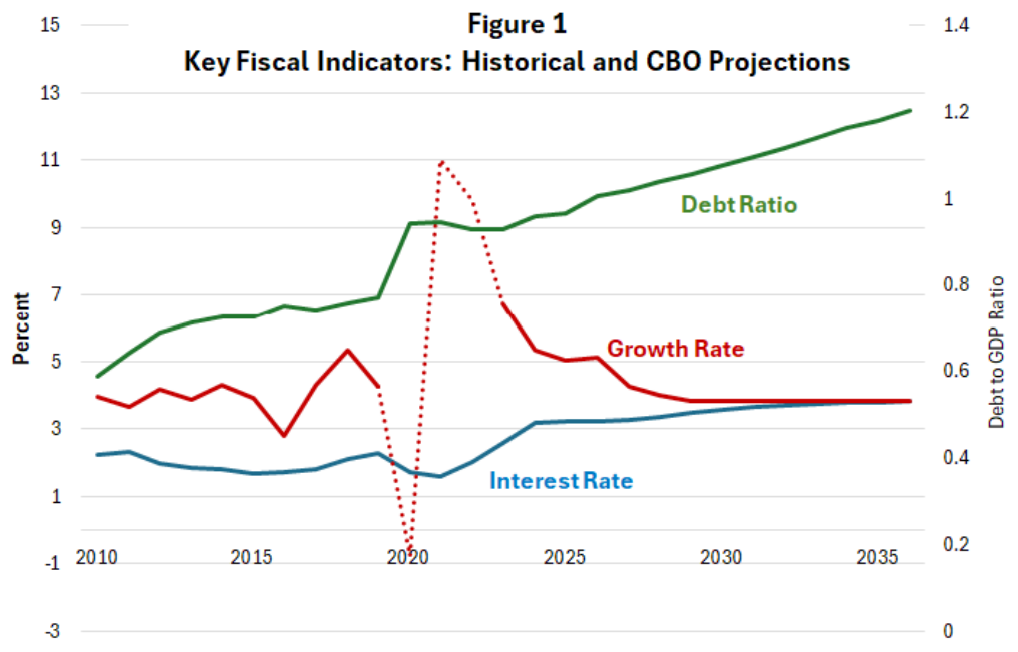
A first headwind comes from the fiscal outlook itself. As Figure 1 shows, recent projections from the Congressional Budget Office suggest that the variables in the fiscal balance equation are shifting in unfavorable directions. Over the coming decade, the interest rate on federal debt held by the public is forecast to rise while economic growth slows. The gap between the two, which was strongly favorable not long ago, will narrow substantially. Stabilizing the debt ratio would now require a significant improvement in the primary balance. But current projections instead show continued primary deficits, implying a steady increase in the debt ratio over the next decade. In short, fiscal policymakers will face a much smaller margin for error than during the unusually low-interest-rate environment that followed the global financial crisis.
A second headwind arises from demographic change. In advanced economies on all continents, populations are aging as life expectancy rises and birth rates fall. In the United States the age dependency ratio4—the ratio of people over 64 to the working-age population—has risen sharply and is expected to continue rising. As a result, healthcare workers, many paid directly or indirectly through public programs, have become one of the fastest-growing segments of the labor force. Spending on Social Security and other retirement benefits is also rising. These trends do not make fiscal sustainability impossible, but they do make it more challenging.5
A third headwind comes from the international environment. The decades following the end of the Cold War saw declining large-scale conflict and a “peace dividend.” Since then global conflict has increased substantially.6 In such an environment, governments must remain prepared for the increasing fiscal demands of national defense, alliance commitments, and responses to international crises.
A fourth headwind is political. Across many democracies populist movements have gained support by arguing that existing institutions are ineffective or corrupt. Polling shows growing support for leaders willing to break established rules. Yet cross-national evidence7 suggests that governments operating within stable institutional frameworks—including fiscal rules—tend to exhibit stronger state capacity. When rules weaken or lose credibility, the ability of governments to manage public finances deteriorates.
Taken together, these headwinds do not imply that the United States faces an imminent fiscal crisis. The United States still enjoys deep capital markets, strong financial institutions, and the advantage of issuing debt in its own currency. But they do suggest that maintaining fiscal sustainability will require a more carefully crafted policy than simply allowing deficits and debt to evolve year by year as the winds carry them.
The fiscal balance equation serves as a natural lead-in to a discussion of the kind of fiscal rules and institutions that might be suitable for the United States. Specifically, it suggests a rule that links annual budget decisions to a long-run objective for the debt ratio plus a set of institutions strong enough to enforce it with enough flexibility to accommodate normal cyclical fluctuations, longer-term trends, and extraordinary disturbances.
More specifically, the equation suggests targeting the structural primary balance (PSB) as a way of combining the objective of sustainability with the needed flexibility. The PSB is the government’s surplus or deficit, adjusted for the business cycle and excluding interest payments. By focusing on the structural primary balance rather than the simple annual surplus or deficit, policymakers can avoid forcing procyclical tax increases or spending cuts during recessions. Smaller deficits or surpluses during expansions would offset larger temporary deficits during economic downturns, keeping the debt ratio broadly stable over time. When economic growth exceeds the interest rate, a moderate PSB deficit is consistent with a stable debt ratio. If R rises above G, a PSB surplus may be necessary.
Importantly, such a rule does not dictate the size or composition of government. A country with high taxes and high spending could satisfy the rule just as easily as one with a smaller government sector and lower taxes. What matters is not the level of taxes or spending but whether the resulting fiscal balance keeps the debt ratio on a sustainable path.
Needless to say, there is no unique PSB target that applies to all times and places. The four headwinds discussed earlier illustrate the need for periodic adjustment of the target. But whether the challenges are aging populations or an increase in global conflicts, voters and elected leaders would be the ones to decide whether to finance higher spending through higher revenues or through adjustments elsewhere in the budget consistent with long-run debt stability.
In short, fiscal rules do not resolve political debates over the role of government. Their purpose is narrower: to ensure that those debates take place within a framework that preserves fiscal sustainability.
Fiscal rules can help stabilize the relationship between debt, growth, and interest rates, but rules alone are not enough. Their effectiveness depends crucially on the institutional framework within which they operate—a framework that must combine technical expertise with an appropriate degree of insulation from short-term political pressures.
Monetary policy in the United States provides a familiar benchmark. The Federal Reserve possesses extensive analytical resources and, by law, retains substantial independence to carry out policy within broad mandates set by Congress. It has also managed to maintain a substantial degree of insulation from short-term political pressure over a full century of its existence.
But we should not take the “Fiscal Fed” analogy too literally. A key difference is that the Federal Reserve both sets monetary policy and executes it by adjusting interest rates and other parameters that influence the money supply. Fiscal policy is different. Under the US Constitution, the execution decisions—the actual imposition of taxes and authorization of spending—remain under democratic control.
Instead of “Fiscal Fed,” then, we will use the generic term Independent Fiscal Council (IFC) for the kind of institution we envision. The IFC would therefore play a more limited role. Its closest analogue within the Federal Reserve System is not the Fed as a whole but the Federal Open Market Committee, which analyzes economic conditions and sets policy targets while leaving the mechanics of implementation to the Board of Governors and the 12 regional Federal Reserve Banks.
Like the Open Market Committee, the IFC would apply agreed fiscal rules, evaluate fiscal projections, and assess whether fiscal plans are consistent with long-run sustainability. As such, we can best think of it as one part of a broader system of fiscal governance that operates on three distinct layers:
Countries differ in the ways these layers interact. In some systems, operational aggregates are determined first and then constrain subsequent program decisions. In others, policy debates begin with individual programs, and aggregate fiscal outcomes emerge only afterward.
Systems also differ in how fiscal rules influence the process. In some countries rules determined by an independent fiscal council constrain budget aggregates from the outset. In others the budget is formulated first and then evaluated by an IFC, which may trigger formal correction procedures if fiscal targets are missed. In still others, the council’s assessments are advisory, but departures from fiscal norms carry reputational and political consequences that ensure those departures are not simply ignored.
In short, the effectiveness of fiscal frameworks depends not only on the rules themselves but also on the institutional mechanisms that give those rules practical force. Whether formally binding or advisory, fiscal rules succeed only when political institutions make it costly to ignore them.
Such rule-guided fiscal institutions are not just theoretical. Fiscal systems in several countries illustrate how rules, procedures, and independent analysis can work together in practice.
Sweden provides one of the most durable examples. Following a severe financial and fiscal crisis in the early 1990s, Sweden adopted a comprehensive fiscal framework, including a structural fiscal target, a long-run debt anchor, and multiyear expenditure ceilings. Equally important were reforms to the budget process itself. Sweden introduced a top-down system in which parliament first establishes aggregate budget limits before debating individual spending programs. This sequence—rules first, then aggregates, then program decisions—helps ensure that individual policy choices remain consistent with the broader fiscal framework.
Sweden’s IFC, called the Fiscal Policy Council, is composed largely of academic economists and policy experts. The council does not set fiscal policy but evaluates the government’s fiscal plans over a rolling three-year horizon and publicly assesses whether they comply with the fiscal framework. By increasing transparency and providing independent analysis, it strengthens the credibility of the rules and raises the political cost of deviation.
The Swedish framework has remained in place for nearly three decades despite numerous political and economic changes. By the early 2000s, sustained budget surpluses had reduced government debt from more than 65 percent of GDP to a bit above 35 percent. As the debt ratio stabilized, critics argued that surplus-oriented targets discouraged needed public investment in infrastructure, defense, and other areas—an illustration of the broader concern that excessively tight fiscal rules may bias policy toward austerity. In response, the framework has recently been adjusted to emphasize balance rather than mandatory surplus.
Chile offers another instructive example. Since the early 2000s, Chile has operated a fiscal framework centered explicitly on the primary structural balance. Because the Chilean economy depends heavily on copper exports, structural targets are adjusted not only for the business cycle but also for fluctuations in copper prices, using forecasts provided by independent expert panels. Chile’s version of an IFC—the Autonomous Fiscal Council—oversees the system by evaluating fiscal projections and monitoring compliance with the PSB rule. The framework helped Chile maintain fiscal discipline during the commodity boom of the 2000s while providing room for countercyclical policy during subsequent downturns.
In recent years the system has faced greater pressure as economic shocks and political turbulence have pushed public debt upward. These challenges illustrate an important point: fiscal frameworks cannot eliminate political conflict. Their purpose is not to replace political choice but to structure it in ways that keep policy broadly consistent with long-run sustainability.
Over the past two decades, many countries—including the United Kingdom, Canada, France, Denmark, Slovakia, and Australia—have created independent fiscal councils of one form or another. Although these institutions differ in structure and authority, they typically perform several common functions: evaluating fiscal forecasts, monitoring compliance with fiscal rules, assessing long-run sustainability, and improving transparency in the budget process. Most operate with a relatively small staff and limited formal authority, relying instead on analytical credibility and public scrutiny to influence fiscal policy.
The United States offers a less encouraging contrast. Here, fiscal debates typically begin with proposals for particular tax changes or spending programs, and aggregate fiscal outcomes emerge only later as the cumulative result of those decisions. The process lacks any clear operational rule linking annual budget decisions to long-run fiscal sustainability. Putting it in terms of our three layers of fiscal governance, we could say that rather than the 1-2-3 approach, we effectively have a 3-2-0 system.
As we noted at the outset, the only formal rule in place—the statutory debt ceiling—bears little relationship to any coherent notion of sustainability. It does not adjust automatically for inflation or economic growth and attempts to limit borrowing only after fiscal decisions have already been made. In practice its principal function has been to provide periodic opportunities for political grandstanding and brinkmanship.
Sadly, things remain pretty much as Herbert Stein observed decades ago: The United States has no fiscal policy—only a sequence of political motivated decisions whose fiscal consequences become apparent after the fact. Indeed, over the past decade, matters have grown worse still, with even the minimal fiscal framework in place increasingly circumvented.
Can we do better? No fiscal framework developed abroad can be transplanted directly into the American system, and any fiscal framework will require every party to adhere to it, especially so long as control of Congress and the White House regularly rotates. The examples of Sweden and Finland, which have survived repeated changes of government, show that this is not impossible when supported by transparent procedures and public opinion.
Some analysts have suggested that an existing institution such as the Congressional Budget Office—designed to provide nonpartisan fiscal analysis but currently lacking any direct authority over policy—could serve as the foundation for a distinctly American independent fiscal council. Doing so would require closer integration of fiscal rules, budget procedures, and independent evaluation.
Such reforms might eventually produce something resembling a “Fiscal Fed”—or at least a fiscal counterpart to the Federal Reserve’s Open Market Committee. In light of the successful institutional reforms undertaken elsewhere, placing the United States on a path toward fiscal stability might be less radical than it first appears.


Chapter 11 (pp. 84–91) from The Reconstruction Papers.

We focus mainly on court reform but other topics come up as well.

Support a publication that is really committed to liberal values and to triumphing over fascism.
Sign up for the newsletter and get our latest stories delivered straight to your inbox.