
Tax the Wealthy, Not Wealth
Don’t miss the forest for the tallest trees.

We need higher taxes in America. Decades of Republican tax cuts have left America in dire fiscal straits, with debt service expenses eclipsing defense funding, even as demand for military spending spikes amidst Donald Trump’s war with Iran.
GOP sabotage of our nation’s finances is not limited to the tax code. The IRS itself has been crippled by Republicans to enable tax evasion by the richest Americans. In 2022 President Biden’s Inflation Reduction Act allocated $45 billion to the IRS for tax enforcement. Congressional Republicans have whittled that down to just $3.8 billion as of 2025.
Raising revenues is necessary not just for stabilizing the nation’s fiscal picture, but for reversing the Trump administration’s wide array of disastrous spending cuts. Future administrations will need financial headroom to rebuild agencies like USAID, restore SNAP and Medicaid funding, and replace cancelled research funding. There is no “one neat trick” for generating this revenue. The reconstruction of our nation will be expensive.
Some elected Democrats have decided to not just ignore this reality, but actively run away from it. Senators Chris Van Hollen and Cory Booker have proposed sweeping tax cuts in the name of “affordability” with a disconcerting number of co-sponsors. I expressed my dismay with these proposals a few months ago in this very magazine.
Unfortunately, some on the left who are favorable to taxes have fallen victim to a different siren song of bad policy. They are fixated on aggressively and punitively taxing the ultra-wealthy, particularly with ambitious wealth taxes or ideas of a “wealth cap.” But these policies are not a practical or effective solution for America’s tax problems, nor will they address our almost-trillionaire problem.
Most of the world has abandoned wealth taxes, and for good reason. Of the twelve OECD nations that had wealth taxes in 1990, just three still do today. We know now that wealth taxes are not very good at generating revenue or reducing inequality, that specific proposals like the California billionaire tax are ill-conceived, and that obsessing over them distracts us from the task of implementing more effective progressive policies. Top UK tax lawyer Dan Neidle put it bluntly: “Your position is objectively pro-billionaire because it prevents the promotion of tax reforms that would tax billionaires more fairly and effectively.”
I was seemingly joined in my opposition to Democratic tax cut proposals by Justin Briley. But however much I agree with the gist of Briley’s article, I cannot agree with one particular point that speaks to a broader bad trend in the public conversation regarding taxing the rich. In the last paragraph, Briley puts forward a proposal out of far-left field: that we should tax away every dollar of a person’s wealth over $100 million.
Wealth is obviously powerful and highly concentrated wealth can be dangerous—look no further than Elon Musk leveraging his wealth to buy elections and dismantle USAID—but that means it must also be respected. This is not an argument for respecting any individual wealthy person, but for respecting the economics of wealth generation and maintaining a clear-eyed view of how to regulate it. The left-wing tendency to use the (often deservedly) unsympathetic nature of the wealthy to justify a flippant attitude toward public policy is not a healthy one.
The subtitle to Briley’s article is “Reject Slopulism,” an ironic illustration of the problem. At the core of “slopulism,” a derogatory term for populist politics, is the displacement of difficult tradeoffs onto a vague group of powerful villains responsible for all the world’s problems. Populism is so appealing because it flattens complicated questions to simple, easy answers. “What if we just took all the rich people’s money and gave it to poor people?” is appealing because of its simplicity, but it simply doesn’t work.
Join our Discord community, get a copy of The Reconstruction Papers, and pre-order next year’s issue now!
California’s one big beautiful billionaire tax
With wealth inequality on the rise as a political concern, interest in wealth taxes have had a resurgence in recent years. Senators Elizabeth Warren and Bernie Sanders made wealth taxes of varying degrees a centerpiece of their 2020 Presidential campaigns. California recently put Proposition 40 on this fall’s ballot, which is ostensibly a one-time 5% wealth tax on billionaires in the state.
The California billionaire tax is the most ambitious attempt at a wealth tax in the world and, if passed, will certainly be the centerpiece of future wealth tax debate (for better or worse). This report authored by some of the initiative’s authors and Gabriel Zucman’s essay in the New York Times cover many of the arguments for the tax. The primary justification for the tax is to fill the multibillion dollar gap in the state’s budget left by federal Medicaid cuts in HR1, otherwise known as the One Big Beautiful Bill Act. Temporary emergency tax increases to fill budget gaps are reasonable, since state governments cannot do deficit spending like the federal government does. But implementing a brand-new bespoke policy—especially one with such potentially large second-order effects as a wealth tax—only introduces more uncertainty to the situation.
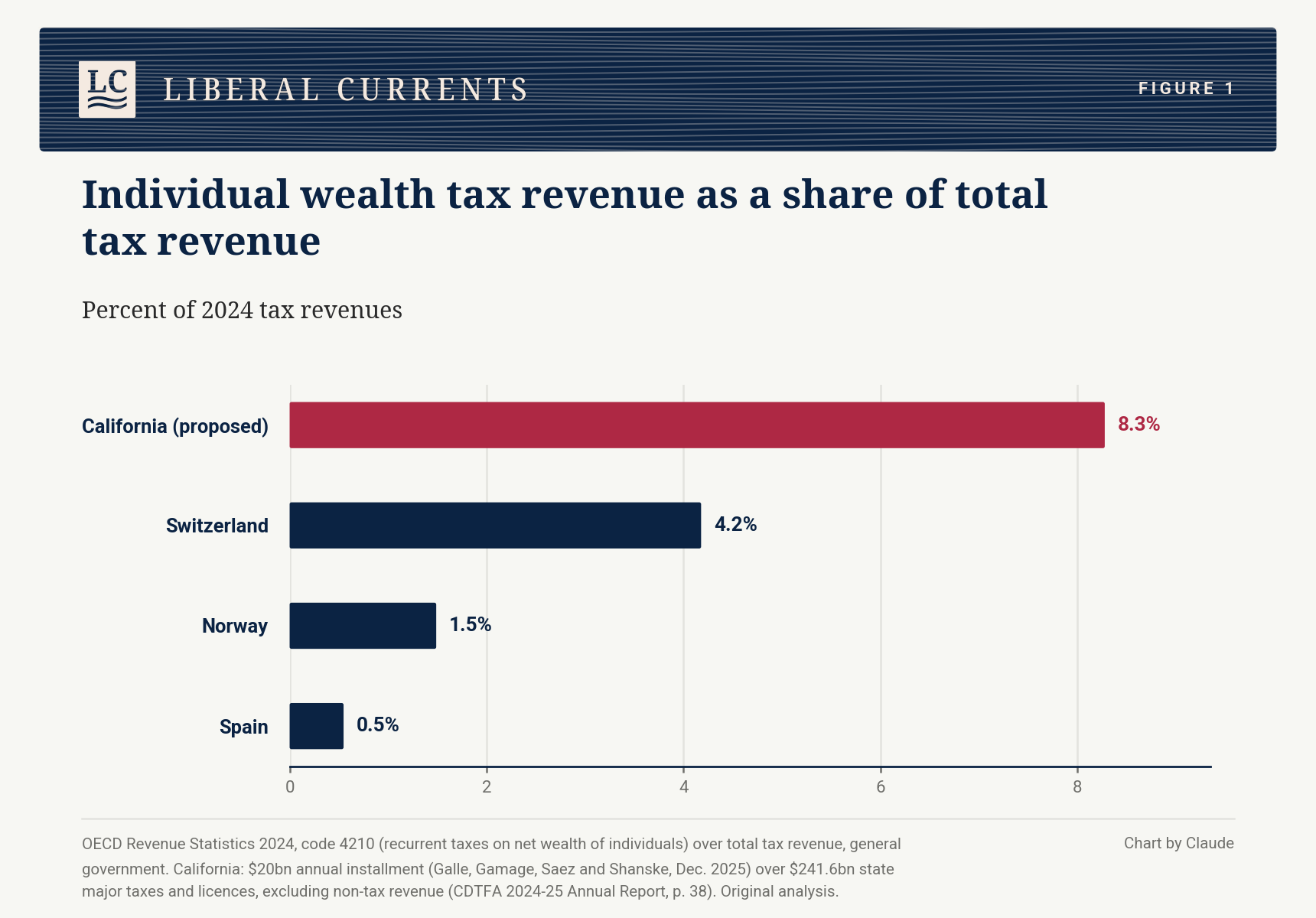
This proposed 5% rate would be the highest wealth tax rate anywhere in the world. Norway’s top rate is 1.1% on assets exceeding ~$2 million, Spain’s rates top out at 3.5% on assets exceeding ~$12 million, and Switzerland varies by canton but does not exceed 1%. It would also comprise a much larger share of California’s budget than wealth taxes typically do. Zucman and Emmanuel Saez’s estimate for revenue is $100 billion paid over five years, though the California Legislative Analyst’s Office is less confident. Taking the authors at their word, this billionaire tax would make up over 8% of California’s tax revenue. This dwarfs the contribution of any other wealth tax to their respective nation’s budget—twice that of the runner-up.
California’s billionaire tax seems almost specifically designed to amplify the problems with wealth taxes. In contrast to the lower rates and broader base of actual existing wealth taxes, Prop 40 threatens extremely high rates on just a few hundred individuals, who could move outside California’s jurisdiction—like Google billionaires Larry Page and Sergey Brin did last Christmas. Zucman believes that capital flight is a non-issue for the billionaire tax because it will apply to anybody who was living in California in 2026. Setting aside any legal questions about jurisdiction and retroactive taxation, that argument fails on the most basic of levels. The billionaire tax’s authors calculated their original $100 billion revenue figure with an assumption of a 10% evasion rate. Page and Brin together have a combined net worth of nearly $500 billion, much more than 10% of the $2.2 trillion held by Californian billionaires—and they moved out last year.
Capital flight doesn’t just eat into that 8%, it also causes losses from other tax sources. Jared Walczak estimates nearly three billion dollars in recurring revenue losses counting only nine billionaires who have announced their intent to leave the state (or have already left, in the case of Page and Brin). Zucman has not been dissuaded and has even entertained the idea of making the billionaire tax annual instead of a one-time payment, which will ensure further flight.
There are even unanswered fundamental questions of how exactly wealth will be measured. Walczak has pointed out how the language of the initiative could be interpreted such that equity would be determined by voting power, a bizarre calculation that could create tax liabilities in excess of the actual financial stake. This is not a responsible way to budget the fifth-largest economy in the world.
Taxes and trade-offs
California’s billionaire tax is likely a bad idea, sure, but is there a more reasonable one? As part of his argument against Prop 40, Governor Gavin Newsom endorsed a national billionaire’s tax, though it’s unclear whether this would be a wealth tax. Earlier this year Senator Bernie Sanders joined Rep. Ro Khanna to propose a national version of California’s 5% billionaire tax. Other countries like Norway and Switzerland have wealth taxes, why shouldn’t we? America has no shortage of wealth, seems like a no-brainer—right?
Simply put, wealth taxes are probably not worth the cost.
Not all taxes are created equal. Where, when, how, and from whom the tax is collected affects the potential revenue, ease of administration, and how people react—its “distortions.” As a rule of thumb, most economists are not big fans of taxes that distort behavior away from capital investment. This is not because economics is capitalist propaganda designed to enrich Wall Street investors, but because capital investment is a crucial source of economic growth; this is the logic underpinning policies like capital gains having lower tax rates than other forms of income or allowing companies to write off investments as tax exemptions. Economic growth is a good thing—it is the good thing from which most other good things flow—and dampening it should not be taken lightly. Tax policy is the balancing act of determining how we can pay for things the market economy does not provide without giving up too much of what it does provide.
In 1990 twelve OECD nations had some form of net wealth tax, but today only three do: Spain, Norway, and Switzerland. (Colombia also has a wealth tax, but it only just joined the OECD in 2020). The OECD summarizes the main reasons for the decline:
“The main arguments relate to their efficiency costs and the risks of capital flight, in particular in light of increased capital mobility and wealthy taxpayers’ access to tax havens; the observation that net wealth taxes often failed to meet their redistributive goals as a result of their narrow tax bases as well as tax avoidance and evasion; and concerns about their high administrative and compliance costs, in particular compared to their limited revenues” —OECD Tax Policy Studies, 2018
Let us look at wealth taxes both past and present so we might learn what makes them tick—and why so few places have kept them around.
First, a lightning round of some nations that once had wealth taxes but have since left them behind. Austria removed its wealth tax in 1994, “mainly due to the high administrative costs that accrued in the data collection process and because of the economic burden the wealth tax meant to Austrian enterprises” (Drometer et al. 2018). Finland removed its wealth tax in 2006, “motivated by the fact the tax had an unfair impact on enterprises and provided many possibilities to evade the tax” according to a 2014 European Commission report. The same report states similar reasons for the Netherlands and Sweden removing their wealth taxes in 2001 and 2007. Iceland removed their wealth tax in 2006, brought it back as an emergency measure following the 2008 financial crisis, and then let it expire in 2014.
Ireland
From 1975 to 1978 Ireland briefly implemented a wealth tax, a comprehensive case study of which was published in 1985 by Cedric Sandford and Oliver Morrissey. In their report, Sandford and Morrissey thoroughly assess the Irish wealth tax both on its proponents’ arguments in favor and its critics’ arguments against. In terms of horizontal equity (the idea that income tax fails to account for the benefits of wealth for otherwise equal incomes), the tax failed due to its narrow base: only 2,500 out of 740,000 taxpayers were even subject to the wealth tax. For vertical equity (reducing the gap between rich and poor, the core of most wealth tax advocacy), the tax was so riddled with exemptions and carveouts that it failed to accomplish anything of note. In fact, the new tax collected less from the wealthy than the previous capital taxes it replaced.
However, the biggest failure of this tax was not its failure to achieve anything of note; it was the monumental cost of administering itself. While no official numbers were published, the authors estimate that the wealth tax’s administration cost was almost 15% of its revenue. For comparison, the IRS collected over $5 trillion in 2025 on a budget of $19 billion, a ratio of under 0.4%. Meanwhile, the cost of compliance of Ireland's wealth tax for taxpayers was at a minimum 19% of their liability, as the authors did not factor in additional costs like travel or the opportunity cost of labor. Put together, no less than a third of the tax’s revenue was being spent on collecting the tax itself.
France
Until 2018 France had a net wealth tax, the heavily-accented Impôt de Solidarité sur la Fortune (ISF). The ISF was significantly better-managed than the Irish wealth tax, costing around 1.6% of its revenue to collect, but a 2008 paper by Eric Pichet estimated that the ISF caused around €7 billion in tax losses while only raising €3.6 billion in revenue. The primary reason for this is capital flight, as wealthy French taxpayers moved to Belgium, Switzerland, and other nations to avoid paying. In 2018 the ISF was replaced by a real-estate tax and a new flat 30% capital gains tax. Prior to this change, the ISF brought in around 1.3% of France’s tax revenue based on OECD figures.
The French left, supported by Zucman, recently tried to bring back the wealth tax, but to no avail. In 2022, a report found that while there were not yet observable changes in investment since the tax’s replacement, the net flow of wealthy people had reversed from outwards to inwards.
Switzerland
Switzerland is one of the few remaining countries that still implements wealth taxes, and among them it is the wealth-taxiest. Just over 4% of Swiss tax revenue comes from its wealth taxes, but the Swiss wealth taxes very much do not resemble what left-wing advocates have in mind. Switzerland does not aggressively tax its ultra-wealthy; it moderately taxes everybody. Specific rates vary by canton, but nowhere does the rate exceed 1%. Furthermore, the threshold at which wealth is taxed is far, far below any colloquial definition of “wealthy” that we imagine. Again the numbers vary locally, but the wealth tax kicks in at anywhere from 70,000 to 200,000 francs (~85,000 to 250,000 in US dollars)—often less than the median net worth for US families. The most successful example of a wealth tax in the world today collects not from the top 1%, but the literal definition of middle class.
The fantasy of funding the government with the dragon hoards of ultra-wealthy billionaires is just that: a fantasy. A recent survey found that 47% of Medicare for All supporters believed it could be fully paid for by only taxing billionaires, a delusion multiple orders of magnitude removed from reality. Entirely liquidating every billionaire’s wealth would net around $20 trillion, according to Zucman’s estimate of their current net worths (a significant overestimate due to the impracticalities of selling off such assets). That one-time windfall wouldn’t be enough to fund the government for just Trump’s second term.
Wealth tax advocates spell their own doom by targeting ultra-wealthy individuals with aggressively high rates. The richer an individual is, the more incentive they have to evade the tax, the more able they are to evade the tax, and the more it costs should they succeed. The only country on Earth that raises more than one or two percent of its money from wealth taxes collects it at low rates from across the whole tax base; that is no coincidence. The other two long-time OECD countries with wealth taxes are not much different: Norway and Spain’s wealth taxes begin at $175,000 and $200,000 (after a home and personal business deduction), far from the multi-millionaire and billionaire thresholds advertised by Warren or Zucman. The only argument I can see for why governments should bother with the hassle of taxing wealth is that there is something special about wealth that demands a response unrelated to raising tax revenue, and on that I remain unconvinced.
Addressing the arguments
Wealth tax advocates argue that there are merits to taxing wealth aside from raising revenue. I am open to these arguments. There are plenty of cases in which taxes are good policy for reasons other than balancing Uncle Sam’s checkbook. Pigouvian taxes (e.g. a carbon tax) seek to enhance economic decision-making by internalizing the cost of externalities. So-called “sin taxes” can be a useful lever for discouraging unwanted behavior without outright banning it. However, the arguments for secondary benefits of wealth taxes being worth the trouble are unconvincing.
Dead billionaires don’t pay taxes
A common argument I hear in favor of wealth taxes is about the ability of wealthy people to leverage their assets as a form of untaxed income. Much digital ink has been spilled over the “buy-borrow-die” strategy that supposedly allows wealthy individuals to live lavish lifestyles without ever paying taxes. The plan, in theory, is that a rich person goes to a creditor and puts up their valuable assets as collateral for a loan. This loan in turn becomes their spending money, like a super-sized version of a credit card. The “die” part of the strategy is the claim that wealthy individuals cascade these loans into each other until their eventual demise, never selling the underlying asset and thus avoiding any taxes. Even if wealthy individuals are not literally Ponzi-scheming all the way to the grave, the ability to pick and choose when and how to sell assets to pay for living expenses is a real benefit compared to other forms of income. An NFL quarterback or Hollywood actor does not get the same luxury of choice when to pay taxes, even if they are living similar million-dollar lifestyles to the asset-rich.
I just disagree that wealth taxes are the way to solve this.
If it is true that the asset-rich are skirting taxes with loans, the obvious solution is to close the loophole. Economists Edward Fox and Zachary Liscow studied the “buy-borrow-die” strategy directly in this recent paper. They find that while the ultra-wealthy do borrow often, it is not replacing any significant share of their unrealized income. If we replaced all borrowing among the top 1% with sales of assets, their average tax rate would only increase by 0.2 percentage points. As a fraction of their total unrealized income, the wealthy borrow around 4%. Taxing overall wealth on these grounds is severe overkill for a relatively minor problem that can be solved much more easily. Fox and Liscow themselves propose such a solution here: treat loans as realizing the gains on assets used as collateral and raise $100 billion over ten years in the process. Repealing step-up basis for inheritances or outright replacing the estate tax with capital gains taxes could each raise over $200 billion over the next decade and solves the “die” part of buy-borrow-die.
Rising tide; sinking ships
Some argue that wealth taxes are good in and of themselves regardless of revenue generation because they can decrease wealth inequality. But wealth taxes just do not have a proven track record of meaningfully redistributing wealth from rich to poor. The most likely way for wealth taxes to reduce a nation’s wealth inequality is by turning its billionaires into foreign billionaires. There is a strain of progressive and leftist thought that holds that any decrease in inequality is good—even if it means just lowering the ceiling—and I could not disagree more.
The world is not zero-sum. Our current right wing is possessed by this worldview—that if someone wins it must necessarily come at the loss of somebody else. They incorrectly believe that immigrants are stealing jobs, filling up houses, eating up the government budget. But the left has a mirrored blindspot. Just because somebody is losing doesn’t mean somebody else wins. The left might roll their eyes at the “a rising tide raises all boats” cliche, but threatening to sink a few yachts won’t raise any boats either.
In Capital in the Twenty-First Century, Thomas Piketty endorses an 80% marginal tax rate on the highest incomes (see chapter 14). The purpose of this tax rate is explicitly not to raise government revenues or fund social welfare programs. Piketty writes:
“A rate of 80 percent applied to incomes above $500,000 or $1 million a year would not bring the government much in the way of revenue, because it would quickly fulfill its objective: to drastically reduce remuneration at this level but without reducing the productivity of the US economy, so that pay would rise at lower levels.”
Piketty is aware that such a tax rate could impede valuable economic activity—he spends most of the preceding chapter arguing that high marginal tax rates would not harm productivity—but the primary motivation remains “lowering the ceiling.” The trade-off Piketty is making is not one between economic growth and helping the poor—it is between economic growth and hurting the rich. Making rich people less rich is to him, and many others, the ends of tax policy rather than the means.
If we do care about wealth inequality, then we should seek to remedy it in ways that actually meaningfully benefit the less wealthy. One figure many point to as the source of rising wealth inequality is the rising share of capital income. Historically speaking, national income has been roughly split between two-thirds for labor and one-third for capital. That has changed in the 21st century, with the labor share falling as low as 57% in recent years. While a decent chunk of this decline can be attributed to accounting—namely tax incentives for high-income workers to classify themselves as business owners and the increasing occurrence of non-cash compensation—there remains a trending decrease in the labor share of income. This can be mitigated with good welfare programs and economic policies that enable people to work better jobs with higher wages, but there are also bolder approaches. Rethinking Social Security as a way to automatically invest every American into capital assets could give everyday workers a share of the growing asset pie, rather than tasking the government with transmuting capital income into labor income.
The Elon problem
Elon Musk is the single greatest counter-argument against capitalism to ever exist. The man has grown his inheritance of apartheid wealth into a business empire sustained by a seemingly infinite supply of failed promises and absurd predictions. He decided to use this wealth not to build public works, universities, or contribute to the common good as Rockefeller and Carnegie did before him. Instead he bought Twitter, installed a child-porn generating robot that named itself Mecha-Hitler, and spends hours every day reposting and endorsing violent white supremacist propaganda. He decided to buy his way into the White House, violated every conceivable anti-corruption law in the book, and condemned potentially millions of people to suffering and death by illegally shuttering the world’s biggest foreign aid agency. Then earlier this year he (briefly) became the world’s first trillionaire.
It is difficult to look at a man like Musk and not feel some sense of injustice. How can a man so wretched, so void of any redeeming qualities, also be the wealthiest man alive, bestowed with more financial power than small countries? He may own his wealth in the legal sense, but he certainly does not deserve it.
More broadly, Musk represents what I believe to be the strongest argument for tempering the wealth of the ultra-wealthy. Not a moral argument about fairness, or a social argument about equity, but a political argument about power. Money is power, and billionaires have a lot of both. Jeff Bezos, currently the third-richest man on Earth, bought the nation’s second-largest newspaper and sat on it for several years before deciding to decimate its newsroom and destroy its reputation. Larry Ellison, currently the sixth-richest man on Earth, funded the merger between media conglomerates Paramount and Skydance which put his son, David Ellison, in charge of CBS. David then personally installed Bari Weiss as editor-in-chief of CBS News where she proceeded to obstruct 60 Minutes’ coverage of the Trump administration’s illegal detentions at CECOT. As part of an agreement to avoid being banned in the US, TikTok agreed to be sold to a group of American investors led by Larry Ellison. The Department of Justice recently approved Paramount-Skydance’s bid to buy Warner Bros-Discovery, which would bring CNN under the Ellisons’ umbrella—and potentially give Bari Weiss another promotion.
I am not a socialist. I do not believe wealth inequality is inherently immoral, nor do I believe wealth accumulation is inherently exploitative. I do, however, believe that concentrating this much power in the hands of single individuals is inherently risky. My response to those who say billionaires must be taxed out of existence for the sake of preventing the Musks and Ellisons of the world from thriving is this: Elon Musk belongs in prison, not poverty.
The problem with Elon Musk is not his wealth; it is what he chose to do with his wealth. Yes, in theory, if you implemented this miraculously robust wealth tax that successfully limited personal wealth from growing from millions to billions, Elon Musk would not be a problem. But you know who would be? Secretary of State Marco Rubio, who enabled the gutting of USAID, revoked hundreds of student visas for political speech, and is personally instrumental in the United States’ ongoing war crimes in both the Caribbean and Persian Gulf. Or OMB Director Russ Vought, the man in charge of actually enacting DOGE personnel cuts and deciding to withhold billions of federal funds from Democratic states. A more appropriate response to wealthy individuals leveraging their wealth to destructive political ends is to harden the political system, not tweak economic policy in the vain hope of preventing the existence of wealthy individuals.
The cynical left-wing argument is that the wealthy are so powerful and so influential that no campaign finance law or media regulation could ever restrain them. If that is the case, then how exactly do you intend to tax their wealth? The level of wealth taxation required to “solve” this problem has never been achieved at any point in time in any country on Earth. Switzerland, Norway, and Spain all have billionaires, too. Either way you slice it, reining in the wealthy necessarily requires a government both able and willing to do so. If such a government does exist, it should not waste its time taxing Elon Musk for a slice of his ill-gotten riches. All his assets will be forfeit on his way to prison regardless.
You can still tax the rich
Do not mistake any of this for an opposition to taxes or taxing the rich. We can and should raise taxes in the United States. Wealth taxes are just a bad way to do so. I personally do not care about taxing the rich out of resentment or spite—it is merely the fact that rich people can afford to pay more—but if you really must get your populist juices flowing by targeting the rich, there are smarter ways to do so.
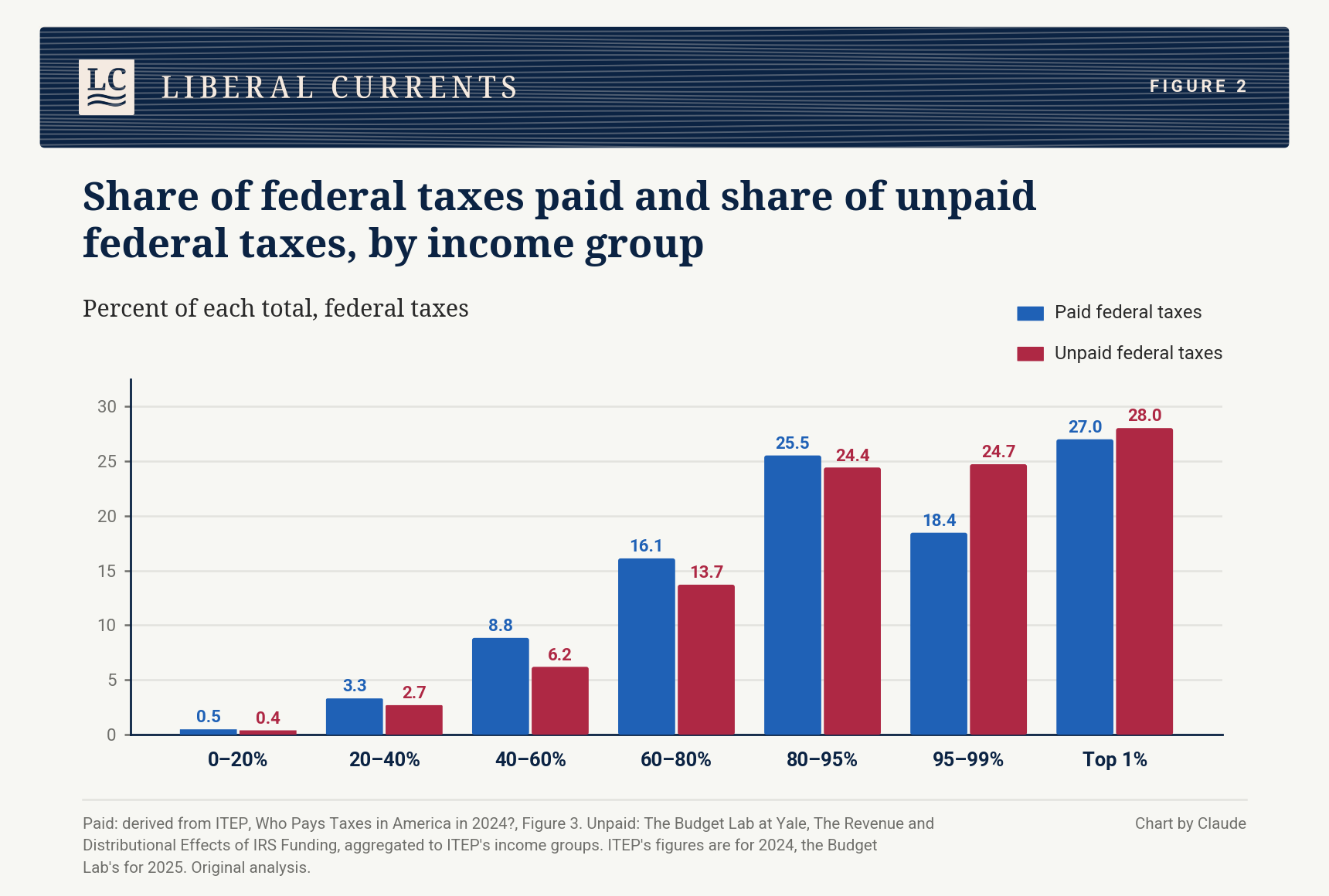
One tactic doesn’t actually require raising any taxes at all. Instead, we should dramatically expand the IRS’ capacity to enforce and collect taxes. In 2022 the IRS estimated there were $600 billion in unpaid taxes that year, about as much as the government spent on Medicaid. After the Trump administration’s budget cuts at the IRS, the gap is sure to grow even larger. Tax evasion is, unsurprisingly, a rich man’s game. Over three-quarters of unpaid taxes are from the top 20% of earners, over half are from the top 5%, and over one quarter are from just the top 1%. Uniformly improving tax enforcement across the board would already be a de facto tax increase on the rich, but targeting enforcement at particularly high earners can easily be justified from a cost-benefit perspective. As an added bonus, perp-walking some of the crypto scammers and white-collar fraudsters currently infesting our government would do wonders for morale.
Giving credit where credit is due, New York Mayor Zohran Mamdani—who is considerably to my left on most issues—has one particular instance of a “tax the rich” idea that I like. Mamdani’s new pied-à-terre tax will charge up to and over double the property tax rate on homes valued more than $1 million (provided they are not the owner’s primary residence) and is expected to bring in $500 million in revenue. This plan is savvy because the typical risk of capital flight isn’t as much of a problem, since they didn’t live in those homes in the first place. The worst case scenario is that some wealthy people decide to sell their million-dollar side homes, making room for other wealthy people to live in the city full-time.
There are countless ways to tax the rich that are far better than wealth taxes. Authors of the upcoming The Everywhere Millionaire Owen Zidar and Eric Zwick argue that a significant driver of the increasing capital share of the economy is just high-income workers classifying their salary as business income as a tax strategy. Donald Trump’s extension and expansion of the TCJA overwhelmingly benefitted wealthy taxpayers, including expansions to this type of business pass-through income. Repealing many of the OBBBA’s cuts (perhaps keeping a few of the decent reforms like full expensing, which should also apply to housing) is the obvious starting point for a future Democratic agenda. Stock buybacks, a popular bugbear of the left, mostly exist as a tax-efficient way for corporations to return value to shareholders as compared to paying out dividends. Biden’s 2022 Inflation Reduction Act implemented a 1% excise tax on stock buybacks; increasing it could raise hundreds of billions at relatively minor cost. Sometimes the simplest ideas work just fine. Raising the capital gains rate from 20% to 30% shrinks the deficit by $400 billion and has essentially no effect on anybody outside the top 1%. Simplicity has real value when it comes to tax policy; taxes that are easier to pay are easier to collect (and harder to evade).
The second Trump administration, even more so than the first, has been radicalizing for many—myself included. Accurately describing the reality we live in makes one sound like a crazed schizophrenic wandering around Shutter Island. Billionaires are buying up newspapers and media outlets so they can spread political propaganda. The President, who was best friends with the most notorious child sex trafficker in history, is sending the FBI to harass his rape victim. Masked federal agents are executing unarmed American citizens on camera and walking free with no trial. The world’s richest man is a neo-Nazi who bought his way into government so he could condemn potentially millions of African children to death out of spite. Liberals, progressives, and the left are correct to be angry. But that anger must not cloud our judgment. I say this not out of any stoic virtue of calm rationality, but for the sake of accomplishing what we want.
Wealth taxes, however appealing they may be on an emotional level, are not a good priority to pursue. Their redistributive effects are greatly hampered by a lack of significant revenue, worsened by high risk of evasion and expensive compliance costs. The versions of such taxes in the current limelight—namely California’s billionaire tax—are designed in ways that maximize their flaws. Promises that broad government spending can be funded solely with taxes on the few ultra-wealthy are mathematically impossible and poison the well for those that care about funding good programs. Acknowledging the problems with wealth taxes does not require a defense of the wealthy. We already know how to tax the rich; no need to try anything fancy.
Featured Image is Tax the rich, not our future placard, by Plashing Vole
Read next

Americans Are Angry. The Democratic Base Is Furious.
We must channel our anger at current injustices into productive direct action.

Social Media Has Not Brought Liberation
Social media has been a boon to autocratic regimes and their allied movements in democracies.

Holly Berkley Fletcher and Benjamin Wittes Talk to Adam Gurri About The Reconstruction Papers
We focus mainly on court reform but other topics come up as well.

Don't Abandon Ukraine (Out of the Jaws #12, with Dylan Burns)
Tactical and technological innovations on the battlefield, and the brutal realities of war.