
It's Never Very Funny With These Clowns
Richard Blumenthal, Aaron Reitz, Ilhan Omar, JD Vance, and gerrymandering, getting worse.
Some fan mail informs me that Democrats are seeking permanent one-party rule.

This is the fourth issue of Editor's Notes, a newsletter that will provide occasional thoughts and updates for paid subscribers. Readers of our free articles can sign up below to gain access.
In an essay I wrote about our information environment, I referenced a 2024 conversation about January 6 that has really stuck with me:
Saying that he had simply been misled by the media initially, that with information we’ve learned since he’d come to change his view, he completely dismissed the significance of the events of January 6 as anything but a propaganda coup for Trump’s opposition due to the optics of it. The “only person who was killed” was “on the protesters’ side,” and therefore any supposed danger the “protesters” posed, or the laws they broke, could be dismissed. The relentless physical assaults on law enforcement at the scene went unmentioned (never mind the circumstances under which the “person who was killed” was shot). And “it isn’t as though Trump said to do an insurrection.”
Many of us have been there, I'm sure: suddenly encountering the mirror universe of the right, where up is down and bad is good.
Yesterday I received some mail. It came in a beat up envelope with no return address:

In it were a bundle of printed out articles with no note or other sort of direct communication from whomever sent it.
Each of these articles offered a view into the mirror universe.
It was because of this unprompted mail from a conservative fan that I learned Liberal Currents, and indeed I myself, had been mentioned in the Wall Street Journal.
To give some background on this particular op-ed, at the beginning of March I was reaching out to any academic with experience writing about democratic transitions. I dearly wanted to have someone with that expertise write an essay for The Reconstruction Papers about what we ought to do, and what pitfalls we would face, in the immediate period after Trump was out of power. Nicholas Grossman ended up writing an essay focused on the practicalities of these short-to-medium term concerns.
But in early March I was casting a wide net, concerned that no such piece would be written at all. I would search for book collections on the topic and reach out to the authors I found there without much further research into their body of work. One such author was Bruce Gilley, who wrote the WSJ op-ed.
His reply was another of those through-the-mirror moments:
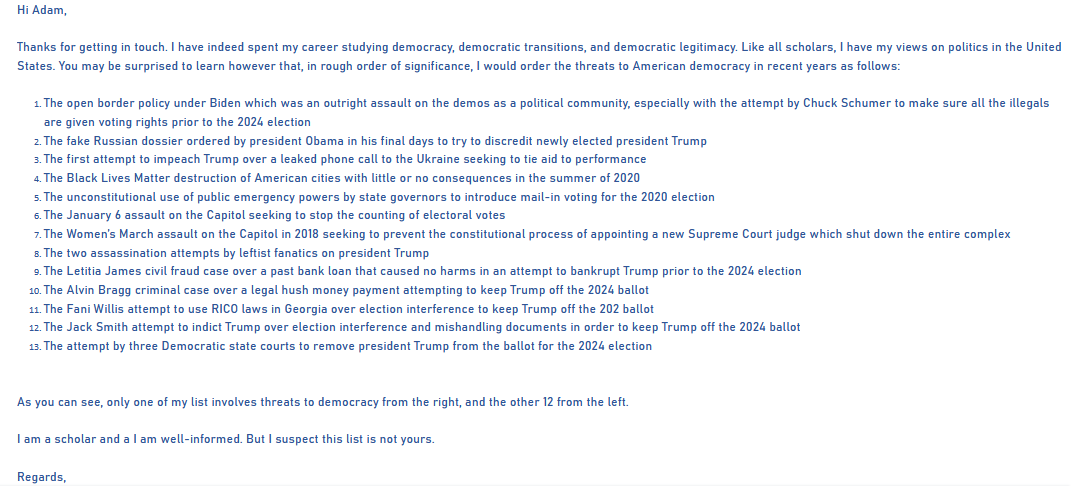
Needless to say, Gilley—who apparently in addition to his work on democratic transitions also wrote things like "The Case for Colonialism" and sued his university for blocking his Twitter account with their Twitter account—did not write an essay for us.
He then apparently turned around and wrote an op-ed for the WSJ, who for some reason published it, on how the implication of my request was that Democrats are seeking to establish one-party rule.
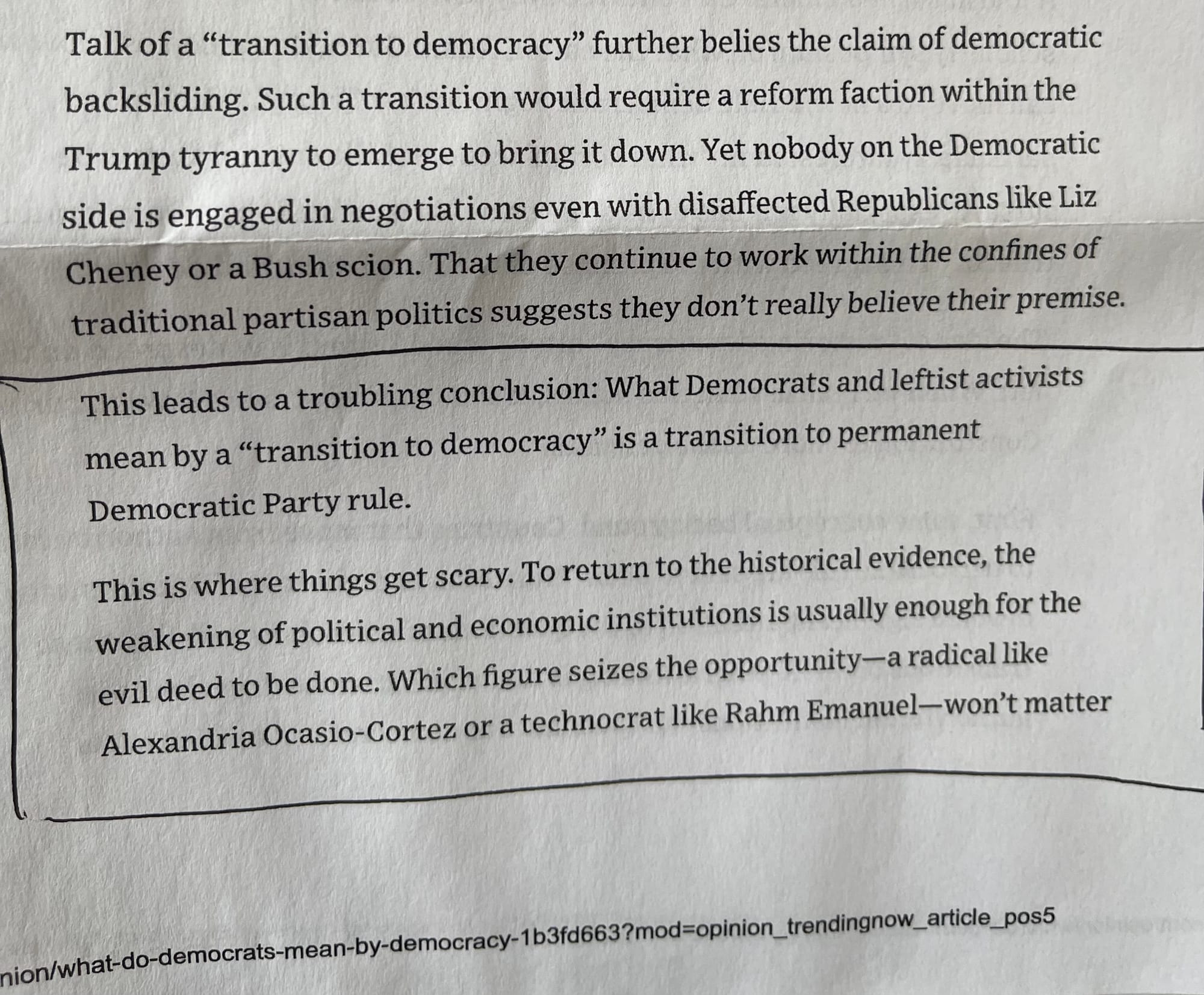
To be clear: Gilley walks through a chain of deductions from specious evidence (mostly having to do with being selective about criticizing Republicans but not Democrats) and concludes that the only thing people like me could mean by a post-Trump democratic transition is that the Democratic Party, specifically, will rule forever.
Gilley could of course have simply asked me to clarify what I meant; it wouldn't have obligated him to take me at my word, but it would have meant calling me a liar rather than playing this silly game of implication. But one thing that Liberal Currents frequently and explicitly calls for, of course, is election reform aimed at creating a competitive multiparty competition. Consider Dennis Lytton recently quoting political theorist Kevin Elliott calling proportional representation:
… a selfless reform that will severely harm the Democratic Party by inviting the formation of a proper left party. So, advocating it as a democracy-saving reform has more than face validity given that it would be electorally costly to those who would have to be the agents of its imposition.
Calling for "a selfless reform that will severely harm the Democratic Party" does not sound like a plan for permanent Democratic Party rule. Indeed, the many, many calls for proportional representation in our publication are as far at odds with permanent rule by any party as possible, and that is the entire point.
As Adam Przeworski put it, democracy simply can be thought of as a system in which "parties lose." We at Liberal Currents are uniform in our desire for the more complete implementation of that system at every level of American government. Gilley could not have known this (but I would have told him if he asked) but my own contribution to The Reconstruction Papers includes the argument that federal law ought to mandate the implementation of proportional representation in state governments for at least one legislative chamber.
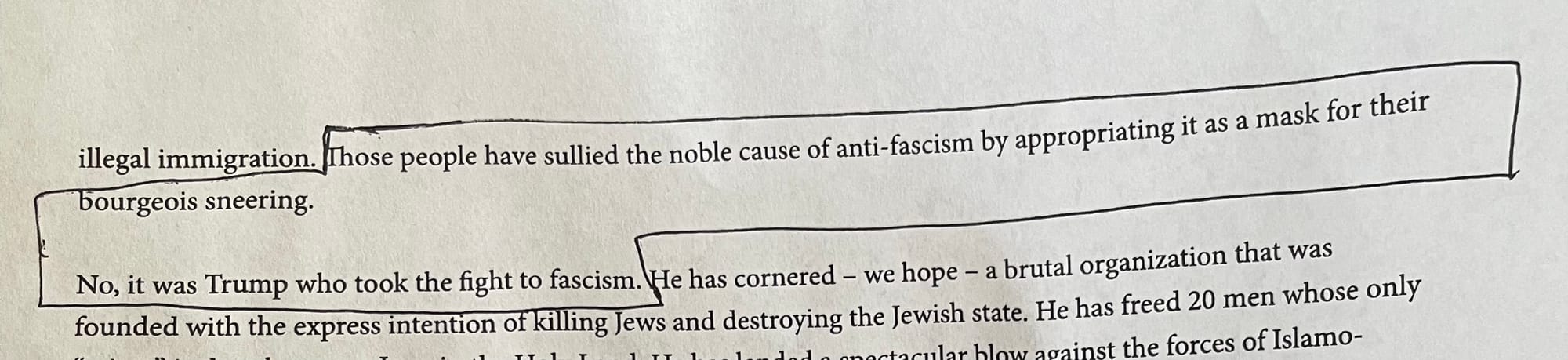
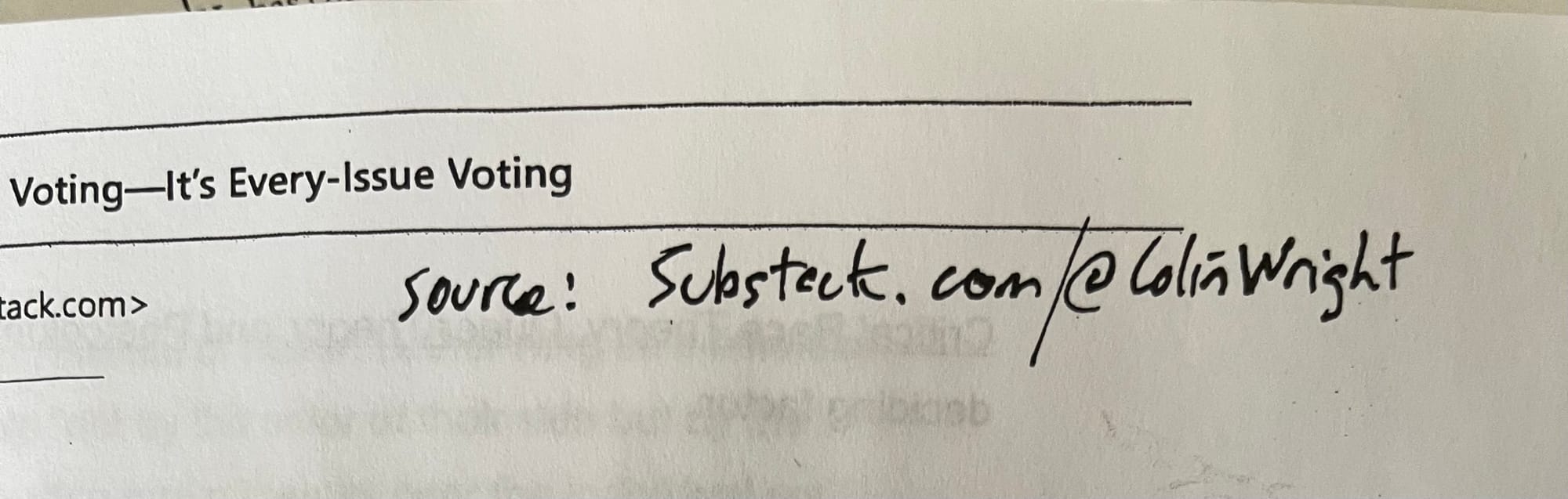
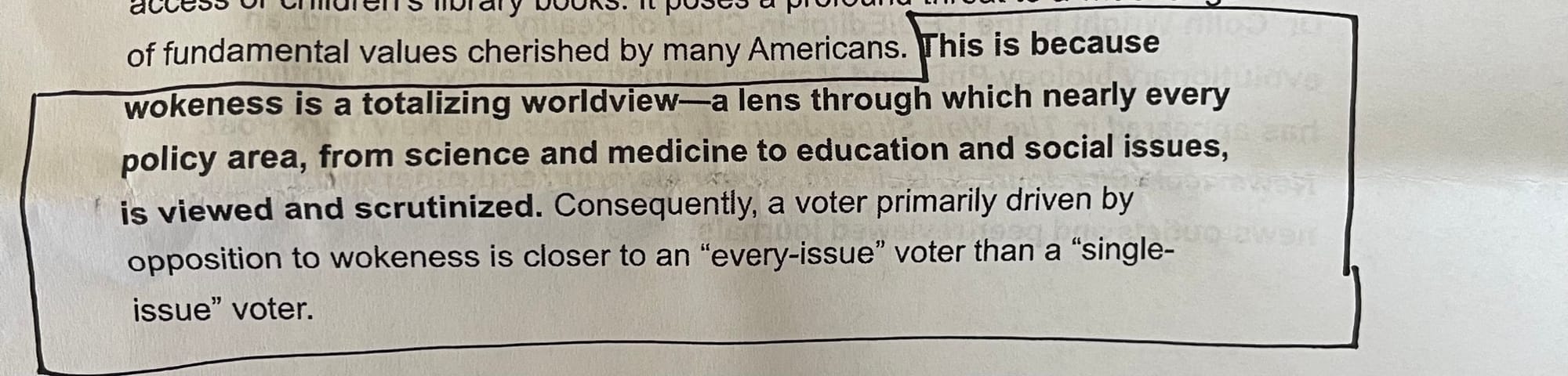
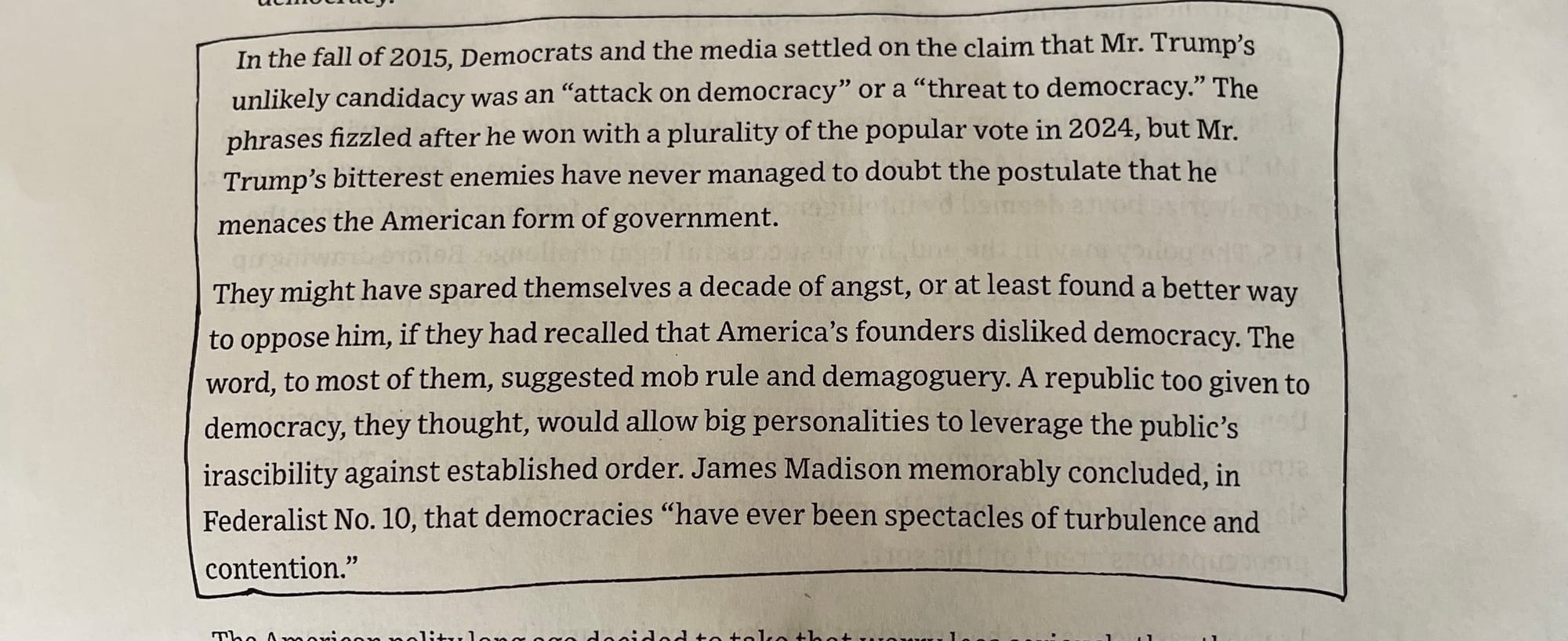
This is the reality of my own project and of Liberal Currents, but reality matters very little to those living in the mirror universe. The other articles sent in this mystery letter are much the same, from The Spectator declaring Donald Trump an anti-fascist hero, to another WSJ op-ed declaring him "the embodiment of rule by the people," to a 2024 Substack post asking readers to vote for Trump to oppose the "totalizing worldview" of woke. The last article is by the very person I spoke to in 2024 about January 6th, to add insult to injury.
Beyond having a laugh, or making the serious point about the absolutely delusional state of the right, I do want to make a specific point about democratic transitions and resisting authoritarian consolidation. As often as not, the very tactics one side needs to engage in to defend itself from an authoritarian consolidation are perceived, by the other side, as moves towards one. Indeed, the authoritarian themselves nearly always casts what they are doing as responding to a threat from the other side, as an attempt to stop the other side to do precisely what they are doing themselves. The attempt to overturn the 2020 election results, for example, went under the moniker "stop the steal." While attempting to steal the election themselves, they branded it as an effort to reverse a theft.
The German case should be taken as both a warning and an inspiration in many ways. The generation of Germans who supported the Nazis never truly changed their minds, on the whole. Those who were against the Nazis stayed against the Nazis, those who were for the Nazis learned to keep quiet about it or equivocate when pressed, but never really learned their lesson. Subsequent generations became far more anti-Nazi, and they did successfully transition (though it helped to have the powers that defeated them in war looking over them, something we will not have in 2029).
We do not need to bring everyone back from the other side of the mirror universe. But we will have to reckon with them, one way or another. Do I believe that Gilley, for example, would be satisfied by the fact that we sought to implement proportional representation, and therefore to not cement one-party rule? Doubtful. I'm sure if we get the chance, they'll simply call that a way of guaranteeing "the left" always wins, or otherwise muddy the water on what precisely is entailed by proportional representation.
This strange episode is just another reminder of how far we've fallen, and how far we have to go.




Polls are the only things worth looking at for gauging where things stand with elections, and they are not very good.

We have an opportunity to build some momentum against the global fascist movement.

These people cannot comprehend the simple truth that their children are independent, autonomous beings, with their own lives and desires.
Sign up for the newsletter and get our latest stories delivered straight to your inbox.