
Editor's Notes: For MAGA, Children Are Property
These people cannot comprehend the simple truth that their children are independent, autonomous beings, with their own lives and desires.
For the antifeminist leftist, the HR Lady symbolizes the empty triumph of managerial liberalism and girlboss feminism, to be vanquished by a pair of sapient Carhartts.

Graham Platner was supposed to be the next John Fetterman, if some Very Online commentators were to be believed. The Democratic frontrunner for Maine’s hotly contested Senate seat and former Lil’ Totenkopf enthusiast seemed to fit a pattern: sapient Carhartts who were feted by progressives during the campaign before performing a reactionary heel turn upon actually seizing power. The infamous tattoo, his history of bigoted comments online, and his tenure at the Blackwater mercenary group, all seemed to portend a right-wing pivot once he gained power. But he is not the next John Fetterman (if only because the current one seems to want nothing so much as to beat the everloving tar out of him). He is the first Graham Platner.
In testament to this one need only look at the fact that Platner, though positioning himself as a hooked harpoon targeted at the heart of the Democratic gerontocracy, has gathered a strikingly diverse array of allies. “Insurgents” like him typically win the adoration, first and foremost, of young, wired progressives—think of the people who powered the campaigns of Alexandria Ocasio-Cortez or Zohran Mamdani.
Platner, on the other hand, despite a neverending cascade of embarrassing revelations about his (recent) past, including alleged abusive treatment of several ex-girlfriends, violent behaviour, and the revelation that he did indeed know the Nazi ramifications of his tattoo, has won his primary.
And he did so in part with the support of a shockingly broad coalition: from the shambling corpse of Clintonism in the form of James Carville, Twitter tankies like Ryan Grim and Matthew Stoller, new leftist Ivy League pocket squares like Nathan J. Robinson, Jacobin Magazine (whose judgment needs no introduction), the pseudo-wonks of Pod Save America, centrists like Congressional Psyduck Ro Khanna, master debating British scourge Mehdi Hasan, and, yes, wired progressives like Shay Stewart-Bouley who are eager to tell us all to listen to “BIPOC voices” that all clamour for Platner.
What explains this jangling charm necklace of political rivals? Surely it’s just more evidence for the idea that, for all his manifold sins, Platner has, as they say, the juice. He has united the entirety of the Democratic coalition from Beltway veterans to wonky centrists to the Extremely Online Left and its ever-dividing factions.
What differs is the story they tell about why this is. Most helpfully explain, in stark terms, who the real enemy to be vanquished by Platner's campaign is: not Republicans, but the HR Lady. For the antifeminist leftist, the HR Lady symbolizes the empty triumph of managerial liberalism and girlboss feminism; she is the embodiment of the class traitor who ruthlessly wields her narrow desk-murderer’s power in the service of capital. For the reactionary centrist, she is the reason we keep losing elections; she wears the face of Hilary Clinton, Kamala Harris, Elizabeth Warren. Too concerned with “diversity” and “inclusion,” she repels the Real Men we need in order to win. And for a certain kind of progressive, she is simply the pollyanna summoning men to a perfection they’ll never be able to achieve, distracting both them and the rest of us from the urgent, practical work of our time. For these pundits, Platner's campaign is less about winning back the Senate and more about owning their internal rivals.
Phrased this way, perhaps you see what I mean when I say it’s all Gender, all the way down.
It is impossible to understand Platner’s appeal to the pundit class without grappling with his many male defenders, so many of whom have been vocal about this HR Lady meme.
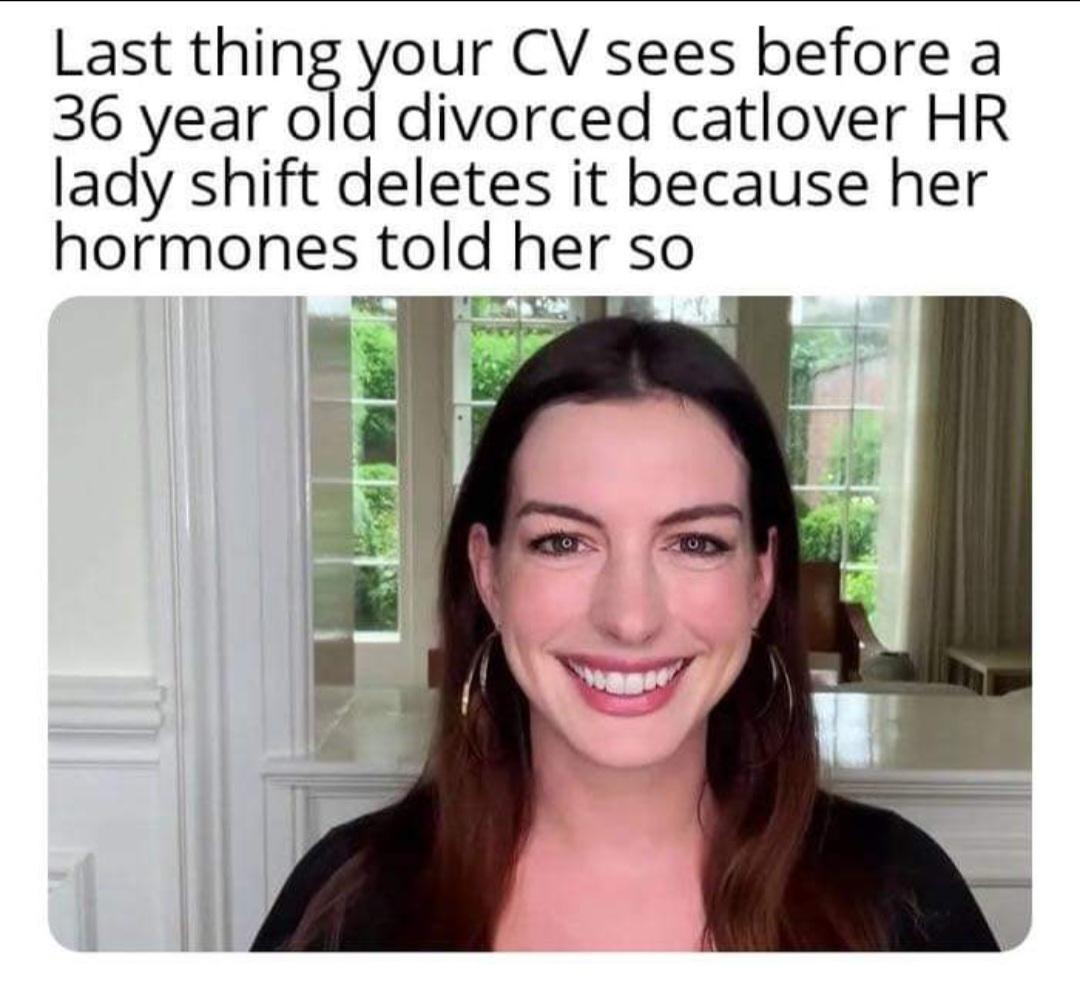
In the wake of recent revelations by The New York Times about Platner’s toxic relationship history, which include him manhandling his girlfriends against their wills, locking one in a room overnight, and otherwise behaving threateningly towards them, left-of-centre men have returned again and again to the figure of the Pan Am-smiling “HR Lady” as the face of the forces trying to destroy Platner by dredging up such ancient history from a mere five years ago.
It’s a very old story, just rewritten in the tropes of modern bureaucracy and given, for some reason, Anne Hathaway’s face. The castrating mother figure who severs (male) autonomy; the censorious, no-fun nanny; Nurse Ratched with a Slack workspace and a bad attitude. She is the eldritch goddess writhing away at the heart of leftist and centrist anxieties alike about the professional managerial class (PMC) and the lanyards that mark them as either castrator or castrated.
American society, like many Western societies, abounds with the uncontrolled fission of class resentments, but this particular species of anxiety about the PMC is entirely internal. Look at the people who espouse it most loudly and find multiply-Ivy League educated men who’ve never known employment outside academia, the press, nonprofits and think tanks, or simply Substack.
If hegemonic masculinity is defined by anything, it is anxiety. From that quivering, flabby mass radiates all the other things we’re likelier to associate with it—violence, status games, domination, overt misogyny. For such men, life is a wilderness of insecurities. Men comparing themselves to other men, threatened by women, and needing to prove that they belong here. For these PMC men, class treason means expiating their anxiety by building up and elevating offensive caricatures of manhood as exemplars that we all must follow; through their own forelock-tugging displays of obeisance, they hope to prove that they, too, know what a Real Man is and can therefore be forgiven for knowing how to eat with chopsticks, having opinions about Microsoft Excel, and enjoying the odd microbrew.
These people are apt to offgas a smokescreen of argot that only a member of the PMC would know, employed like incantations: managerialism, neoliberalism, the tyranny of the wokescold. They name real phenomena and then, as if by sheer coincidence, give them a feminine face and conjure its opposite, in turn: a musclebound workingman. Some dispatches on what Democrats need to do to “win again” (as if that has not already been happening in abundance, with women and POC at the helm, no less) wax grandiloquent about “a big guy, mid- to late-30s, in jeans, a T-shirt and a ballcap – a country boy used to hard work.”
For centrists, the solution is something like “making the forgotten man feel heard,” to prove that the government won’t neuter him and rob him of autonomy with such girly things like welfare, but instead “invest in [their] communities” (how this is different from government support is unclear), “so that they can solve their own problems.” For the leftists, it’s something-something socialism, democratic or otherwise, that respects men’s invaluable contributions to the working class (of which they form the lion's share or even sole part). In every case, it’s women and feminisation that are the enemies, telling these noble creatures what they can and cannot say, shaming them for a rude gesture or a little bro’ing down. They don’t want to be called bigots; that hurts their feelings and makes them not want to vote for you. They owe nothing to no one. They’re autonomous. They deserve respect.
Fanciful as such descriptions seem, they waft from the ceaseless confessions of angry men online who seem to view social responsibility as an unforgivable assault on their liberty and individuality, on a hegemonic manhood defined not by valour, but by virulence. Not just the right to make mistakes, but to never have to say you’re sorry. To say Graham Platner might not be worthy of office because of words and deeds flies in the face of the Rule of Cool that imbues him with a halo of impunity. He’s a rad oysterman who sharpens his axes while watching the big game, and he can win for ‘our side.’ We should grant him absolution he hasn’t even asked for because he’s manly enough to not need it, and any attempt to judge him makes you like the evil HR Lady who’s going to snatch away your 401k because you used the wrong pronouns for one of your coworkers.
In all of this is a knot of highly gendered frustrations where certain men cast their enemy as an avenging feminine spirit; making them feel bad, making them feel feelings other than righteous fury, making them feel like they have to behave according to feminized politesse that isn’t cut right for their manly bodies.
Once again, this isn’t my overheated prose. It’s professional poster Ken Klippenstein talking about how Democratic men who challenge Platner are “smoothgroins.” If I seem, at times, to be paging Dr. Freud here it is only because these men are screaming his name.
The HR Lady is the embodiment of a 21st-century monstrous feminine, all vagina dentata and maternal malevolence. The slayer of men’s jobs and the queen who condemns Real Men to exile and shame. Real Men, manly men, who save us from other, Worse Men. Women and femininity are not meant to rule, but we are meant to be protected (those of us worthy enough, anyway; trans women need not apply, nor any cis woman of colour not currently being fetishized by Real Men). In any case, Graham Platner, a man broadminded enough to love a right-wing activist and bold enough to lock her in a bedroom, is our saviour. We should be grateful, and how dare we question him. Ever.
But let’s descend from the heavens of these Freudian visions. Above all, the HR Lady represents a woman’s ability to tell a man “no.” And to judge him for refusing. Those twin sins supersede all others.
If this sounds like the seedbed of Trumpism and the reactionary right, you’re starting to see why this behaviour from lefty men is such a staggering problem. They are refusing to confront the hard problem of patriarchy. Platner offers the promise of libidinal pleasure, in having a (one presumes) lumpy, virile groin. “Alive from the waist down,” in the words of one Slate podcast.
The reason feminist psychoanalysis converges so much on the symbolism of the penis is not because of biological essentialism per se, but because it added what Freud deliberately forgot: that in patriarchy, men must atavistically rebel against any hint of women’s power. To grow up is to break free of the smother-mother; autonomy is defined by not needing to do what she tells you anymore.
“Men’s Rights Activist” unthought-leader Paul Elam rather infamously cited his political awakening as the moment his mother forced him to take medicine for his diarrhea. Once again, I am not the one introducing the literal strangest shit to this discussion. Still, the manner in which she did this was, indeed, cruel and abusive—he was held down by his brothers while she yelled at him and struck him with a wooden spoon. But of all the possible political futures that such a harrowing moment could have awoken—opposing the tyranny of the nuclear family, becoming an activist against child abuse (his father was even more violent), fighting for better mental healthcare and social services—he chose the path of the deadbeat dad who blamed his trauma on women having too much power. Circa 1970. In the end, he hit and abandoned his own children. But it’s alright. He was the dad. Not some castrating female.
I’ve known many people, including some of my dearest loved ones, who had abusive mothers. My own was not cruel, but she was certainly troubled and, as she loved to lament, I never came with an instruction manual. It’s taken years for us to untangle our own issues, and our mutual unweaving remains an unfinished project. But in every case, not one of us grew up to despise all women or treat the feminine as monstrous. Instead, we learned a lot—perhaps too early—about the world and its structural cruelties. We never told ourselves that a woman did not have the right to say no, even if she was a problematic authority figure. Flawed, you might say. Or, in James Carville’s redolent phrase, “fucked up.”
“No,” is the shortest sentence in the English language and as propulsive and powerful as that fact implies. It is a weapon that these men do not want women to have, which is why the spectre they always invoke is so relentlessly feminine; maternal and dominant, the figure that so many men can most relate to as the first woman who did them wrong because she had power.
As we noted earlier, there are those duelling visions of the pseudo-socialist and centrist alike. Both stories are the same tale in different clothes, one dressed as an ideal socialist worker, the other as a grinning Everyman who wins at retail politics. There’s something for everyone here, so long as you accept men’s natural place at the top of the hierarchy and take what you can get if you’re not so blessed.
There is much to be said for the failures of Extremely Online leftism and progressivism, defined as it was by crowdsourcing thousands of scolds ready to hand out ideological speeding tickets to every nanoaggressive person they could find. This they called ‘politics,’ and it has, indeed, done much to rob the left of its power by dissipating its energy into the vast circuitboards of corporate-owned social media.
If a politics of mere online cancellation and ad hoc online mobs ready to dole out two-minutes-hate at a second’s notice were sufficient to stop fascism, we wouldn’t be in this mess. Yet it’s worth noting that most of Platner’s loudest supporters would likely have a rather different theory of this case. Instead, they might say that this era (call it Woke 1) was altogether too effective, and we are living as much beneath its tyranny as we are Trump’s. They regard it as a triumph of feminist managerialism, which, to them, manifests as emasculating policing of decorum, neutering the stalwart men we need to finally win the fight against conservatism, capitalism, or both.
It is the difference between those of us who believe that the Extremely Online excesses of Twitter slacktivism came to nothing beyond the destruction of its participants, and those who believe that it actually succeeded in instantiating a parodic feminist dystopia. Platner’s boosters want desperately to believe that he is not only the man of the hour, but that his flaws make him such—and that the failures of 2010s online progressivism have, in fact, conditioned this.
This pessimistic credo has a constituency beyond the ‘antiwoke’ brocialist set and preemptively capitulating centrists, however.
Shay Stewart-Bouley described the latest revelations about Platner as “muckraking and gossip,” and with characteristic softpedalling, the man’s alleged deeds as “maybe abusive though not in an extreme manner.” Even as Stewart-Bouley acknowledged he was “a misogynistic mess of a man” on the strength of the reporting, she nevertheless argued, “as flawed as Platner is…I think he can still be the perfect ‘imperfect tool’ for pushing back against the administration.” She adds, “given our current political climate, his baggage isn’t the crisis it might have been years ago. These are not normal times and I am not looking to date the man.”
I quote her at length because she presents, perhaps, the most sensible and pragmatic case for Platner, and even this relies on downplaying, dismissal, and, to use her term, magical thinking. She argues that the exigencies of the moment are so severe we need to use whichever candidate we can, whoever seems remotely popular, as a battering ram against Trumpism before it’s too late.
I am not unsympathetic to this view; the Senate is one of the critical logjams in our democracy. Our most hopeful futures require us to control the Senate—the dreams of every member of our coalition depend on it. The brutal reality is that so long as Platner votes more or less the right way, there is much virtue that may flow from his election. The anxiety I and others have is whether he will do so, or whether he’ll be another willful solipsist in the mold of Manchin, Fetterman, or Sinema. But what choice will we have? What risks might we take in service of that ultimate end?
The risks are enormous, and taking them corrodes the soul; perhaps that’s worth it, but it is equally worth noting how cynical the whole exercise ultimately is, and the hastily-lashed raft of hope it all rests upon. So much of Stewart-Bouley’s recent writing on Platner feels like a hopeless cri de coeur from the ashes of the 2010s, drawn from her own experiences as a member of the Portland Charter Commission in the early 2020s:
People speak of wanting more women and BIPOC folks in office, but have we really built the conditions to support such candidates without tearing them apart? Marginalized folks have gone through enough already even before the rise of this nasty regime; are we going to uplift and support them or dig through their garbage looking for every piece of dirt so that we can ruin them even before the opposition does.
What she describes is as bitingly real as a blizzard, and it’s not unknown to me, personally.
But note here that she’s arguing, specifically, that Platner is being purity-policed by activists in a manner that would destroy (more vulnerable, ostensibly more fragile) non-white and female candidates. There is some validity to the idea that we are, indeed, more likely to be left twisting in the wind because we lack the structural support and benefit of the doubt ordinarily given to white men; Stewart-Bouley’s solution to this problem is to make herself part of that support and to argue “the conditions we have create the candidates we get.” This does little to explain how we managed to get Alexandra Ocasio-Cortez, Zohran Mamdani, Raphael Warnock, Michelle Wu, Nithya Raman, and so on. Notably, none of them have Nazi tattoos; Pete Buttigieg also served in the military and did not walk away an abuser who flirted with bigotry and fascist iconography.
Stewart-Bouley would argue that it is precisely Platner’s imperfection that leads ordinary people to empathise with him; to offer him grace is to, implicitly, offer it to the masses of us flawed, traumatized publics (nearly none of whom, it must be remembered, are running for U.S. Senate). The solution to implicit bias tanking women and POC candidates, however, is not to double down on the inverse of that bias, to further normalize and reify the idea that boys will be boys and even vile behaviour is no bar to high office.
After all, many on the right thought that Brett Kavanaugh too deserved grace.
So, after all this, where do the likes of Stewart-Bouley fall on the spectrum of all the lefty men who are loudly calling Sigmund Freud’s name in the dark? Naturally, she doesn’t. Instead, this is something altogether different: call it heteropessimism, or perhaps a left-wing variant of the savvy cynicism Andrea Dworkin identified in "Right-Wing Women": women who believe that patriarchal power is now (and perhaps forever) unbreakable, and the best we can do is compromise with it unto death, hoping that this time for sure the big strong men we support will actually keep their promise and protect us from the worse men.
Maybe this time they’ll really do it. And it’ll have all been worth it.
But, dear reader, you may well ask: what, then, is to be done? In Platner’s case, alea iacta est. For all the hopes that had alighted on Andrea LaFlamme’s write-in campaign, a sense of doom pervaded the primaries, which was called for Platner within minutes of polls closing.
If a near-inevitable further scandal does not sink the remainder of Platner’s campaign, he will almost certainly be the only alternative on the ballot in the fall, the only choice against the perfidious Susan Collins who—as so many, including Stewart-Bouley rightly point out—is one of the authors of our current misery. She might not wear a totenkopf, but she voted for the concentration camps.
At that point, the agonizing choice will be painfully clear, barring some miracle (and let us still nurture faith in miracles and healing wells, even in times like these). But we shouldn’t lie to ourselves about what stones were used to pave Platner’s road, what compromises were made, and what lies were told. We should not pretend that this whole thing does not, in fact, reek of gender.
We should not lie to ourselves that this man represents the future we are trying to build, nor should we pretend that he will model a way forward for anyone not immediately like him. His success will not trickle down to anyone but a similar class of chuds. We deserve better from democracy than wielding such fundamentally weak people against one another like drunk Pokémon. This will not blaze a trail for flawed women or people of colour with chequered pasts to run for office, simply because it fails to address the underlying problem and instead entrenches it.
The purist clamours of Extremely Online lefties have done us few favours over the years. But the answer was never to abandon standards entirely. If Platner’s earnest supporters find themselves vindicated, it will be by a combination of pure luck and a sincere, open pursuit of redemption on Platner’s part. But if that were to somehow happen, the would-be machos like Stoller, Robinson, Klippenstein, Hasan, Uygur, and others, will not actually feel contentment.
For if Platner were to truly redeem himself and become everything that Democrats hope for, it will come from him rejecting the anxiously preening masculinity that such men as his Extremely Online boosters embody—for, in their immense privilege, they nearly all come from the same place: preppy wealth and power. Through their tryhard embrace of hegemonic manhood in working class cosplay, they can at last banish their mothers, the hated HR Lady who’s telling you to stop saying ‘retard’ on main, and expiate the anxiety they experience for their own masculinities; nerdier, Ivy League, professional, the hated lanyard class. They have seen the PMC and it is them.
They need chud-dom to succeed, and for the hated feminine to forever fail; it would bless them with the sense of vicarious impunity that powers such ‘insurgencies,’ giving the bros the sense that they too can live a life free of responsibility to women or anyone else.
But if Platner becomes a good man, they will never know peace.
Featured image is "Steaming Oysters," CC BY-SA 4.0 Dinkun Chen 2023.

The white male supremacists of the Texas GOP embody what the national party has become.

Get a copy of The Reconstruction Papers while inventory lasts, and reserve a copy of next year’s issue.

Liberalism's problem isn't structural. Liberalism's problem is that we got out-hustled.

Anton Jäger’s "Hyperpolitics" is, at its best, late marginalia for "The End of History and the Last Man." At its worst, Jäger, like Fukuyama, is a prisoner of his political pieties.
Sign up for the newsletter and get our latest stories delivered straight to your inbox.

.jpg?ref=liberalcurrents.com)