
The Fall of MAGA and the Future of Conservatism
Books from Joseph J. Ellis, H. S. Jones, William G. Howell and Terry M. Moe, Donald F. Kettl, and Anthony T. Kronman.
Books from Joseph J. Ellis, H. S. Jones, William G. Howell and Terry M. Moe, Donald F. Kettl, and Anthony T. Kronman.

Welcome back to Breakwaters, the Liberal Currents weekly books newsletter. Please subscribe for exclusive access to our book reviews, author interviews, news analysis, and deep dives into the world of ideas. Grab a coffee mug and a tote bag for more comfortable reading.
The strong Democratic Party performance in the midterm elections has allowed some political analysts to speculate about the end of the MAGA movement and the future of American political conservatism more broadly. When asked during the Atlantic’s Election Night Live coverage whether there is a vision beyond the current Republican Party, David Frum, President Bush’s former speechwriter, responded: ‘‘Freedom! Markets! The rule of law!’’ You take a ‘‘dusty bottle of Chateau de Ronald Reagan 1983, and blow off the dust…and it is as delicious as ever.’’ This may be the case for a man of his vintage, but it is not obvious that voters under the age of 30 have any appetite for that kind of politics. Any memory of an intellectually and morally serious conservative politics has been overwhelmed by the incessant scandals and embarrassments of a dysfunctional GOP, and the shockingly bigoted ravings of its online affiliates.
This month's shellacking at the polls presents a real opportunity to bring this disgraceful political episode to an end, and to crush what remains of the legacy of slavery and Jim Crow. Could a sober-minded and intellectually serious conservative party join such a patriotic effort? Only a full assessment of the trajectory of American conservatism since the founding can begin to diagnose what went wrong with the party of Lincoln, and offer any real prospect of moral revitalization within the world of political conservatism. The following five books offer a well-rounded exploration of the history, influences, personalities, and philosophical perspectives of American conservatism, starting with the all-important issue of slavery.
With Democrat Scott Colom’s victory in Mississippi, the U.S. Senate now has the highest number of black senators in American history. There will also be five black governors serving simultaneously, including former Atlanta mayor Keisha Lance Bottoms, whose great-great-grandfather, Sheppard Peek, was listed in 1860 at the standard market price of $1400 as the property of William Peek. Slavery remains America’s greatest contradiction. A nation conceived in liberty, and yet committed to the maintenance of a slave caste. Historian Joseph J. Ellis has written a neat little book explaining the logic behind this tension. In The Great Contradiction: The Tragic Side of the American Founding, he takes aim at modern critics who too easily dismiss the predicament which even the most humanitarian revolutionaries had to face. To abolish slavery from the outset was to risk destroying the emerging republic before it even had a chance to reach its globally beneficial potential. Faced with this risk, Ellis argues, the founders accepted slavery as a painful, and frankly deeply embarrassing self-evident contradiction that had to be tolerated until the political order could withstand the mature and, no doubt, feisty deliberations that needed to be undertaken to bring about such a historic change.
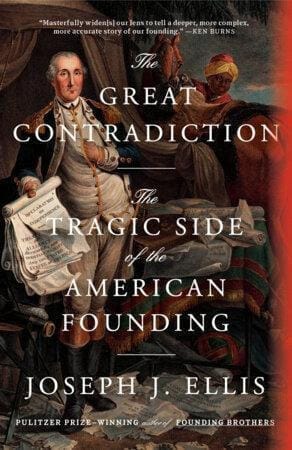
‘‘Those enamored with the idea that justice delayed is justice denied might consider the alternative scenario provided by the French and Russian revolutions, where justice imposed led to justice destroyed’’ (The Great Contradiction, p. 20). Part of the wisdom of the founders, we are told, was their ability to defer debate to ensure political survival and safeguard the hope of victory at a later date. Practical men such as George Washington agreed based on their own life experiences that slow was better than fast. While on the battlefield during the Revolutionary War, Washington noticed that the French soldiers gulped down their hot soup and burned their throats, while the Americans blew on their soup until it cooled down. The American constitutional system was designed to slow down political deliberation to ensure that cities (and people) are not habitually burned down (The Cause, p. 320). Ellis concludes that if ‘‘the founders had done what some of my colleagues have denounced them for not doing, the American republic we currently and proudly inhabit would never have come into existence’’ (The Great Contradiction, p. 20).
The thesis is provocative, and easily subject to criticism given the difficulty of establishing the probabilities of such a counterfactual. It also leaves out the unquantifiable inner experience of millions of people who suffered (and arguably continue to suffer today) because of this political calculation. It is only when one remembers that the tactic of deferment, specifically the attempt to place slavery on the legislative path to extinction, ultimately failed to avoid severe bloodshed, and that the time it took to come to this realization was enough to mark Africans and their descendants as an inferior caste for the foreseeable future, that one realizes the tremendous cost of this delay. Ellis understands the feeling of appalling shame. Slavery was an enormous tragedy with horrific consequences. Ellis invites readers to understand the enormity of this sin from the historian’s perspective (The Great Contradiction, p. 14). This book will be of interest to anyone curious to explore the historical intricacies of this early compromise from the viewpoint of the politicians and ordinary farmers who were swept by the fears and prejudices of the moment.
And yet, behind this sad story of human tragedy also lies a story of victory and overcoming. 250 years after the founding of the United States, and 165 years after the outbreak of the Civil War, the female descendant of an obscure slave is now the first black governor-elect of the state of Georgia. This remarkable transformation in the fortunes of one black family speaks to the rapid moral, social, and political progress happening in modern America. It also casts a critical light on the calamitous predictions of those nervous political thinkers who perceived in the Emancipation Proclamation and the prospect of black suffrage the undoing of American civilization. This includes Viscount James Bryce, an Oxford-educated Germanophile and Member of Parliament, whose master political work, The American Commonwealth (1888), is often cited alongside Alexis de Tocqueville’s Democracy in America as a seminal study of the political institutions of American society.

Congress should impeach Donald Trump not for reason of political strategy, but because law and principle demand it.


Richard Blumenthal, Aaron Reitz, Ilhan Omar, JD Vance, and gerrymandering, getting worse.

Sign up for the newsletter and get our latest stories delivered straight to your inbox.