
How Chile Recovered Its Democracy
A leader operating beyond the margins of the law can yet eventually be defeated in a free and fair election.
A leader operating beyond the margins of the law can yet eventually be defeated in a free and fair election.

A leader operating beyond the margins of the law and even common decency can yet eventually be defeated in a free and fair election. This was proven on April 12, 2026, when fifteen years of "competitive autocracy" in Hungary under Prime Minister Viktor Orbán came to an end when 55% of the voters supported the opposition Tisza Party ticket, making the center-right Péter Magyar the new leader of the country.
The stories of illiberalism defeated fair-and-square at the ballot box are always interesting examples for countries worried about their future under an unsavory leader. But in the case of Chile, it was not an elected strongman that pulled the existing system's levers to consolidate his power. Rather, it suffered an archetypical military coup on a day that Chileans of all generations would remember: Tuesday, September 11, 1973.
After a brief skirmish at the Moneda presidential palace that ended with President Salvador Allende taking his own life, Chile’s government was seized by a junta made of the Commanders in Chief from each of the armed services. They were led by Army General Augusto Pinochet, who had been named to the post by Allende only a few weeks prior, believing that his government would still have supporters among the generals. The Constitution and Congress were suspended overnight, with military decrees (“bandos”) announced on the radio.
Whilst the generals had seized control to quell the social and economic crisis of Allende's final days, their first actions were a violent purge of the former President's supporters. The National Intelligence Directorate (DINA) was organized for this mission, conducting raids on social cadres across Chile's length and shipping them to secret detention sites. Some of these detention sites were additions to military bases or commandeered stadiums, but a few were developed explicitly as torture centers. The most accurate figures available claim that due to these actions, approximately 1,500 were killed or forcibly disappeared, while another 27,000 were tortured by state officials.
The most brutal days of the dictatorship were its first three months in power. Human rights abuses in those days included the infamous Caravan of Death, a helicopter detachment going from one detention center to another to conduct executions of detainees, some of whom were allegedly thrown into the Pacific Ocean. Although the coup is often labeled as “US-sponsored” in foreign media, foreign powers had little involvement in its execution. Both Chile’s crimes and victims were almost entirely its own.
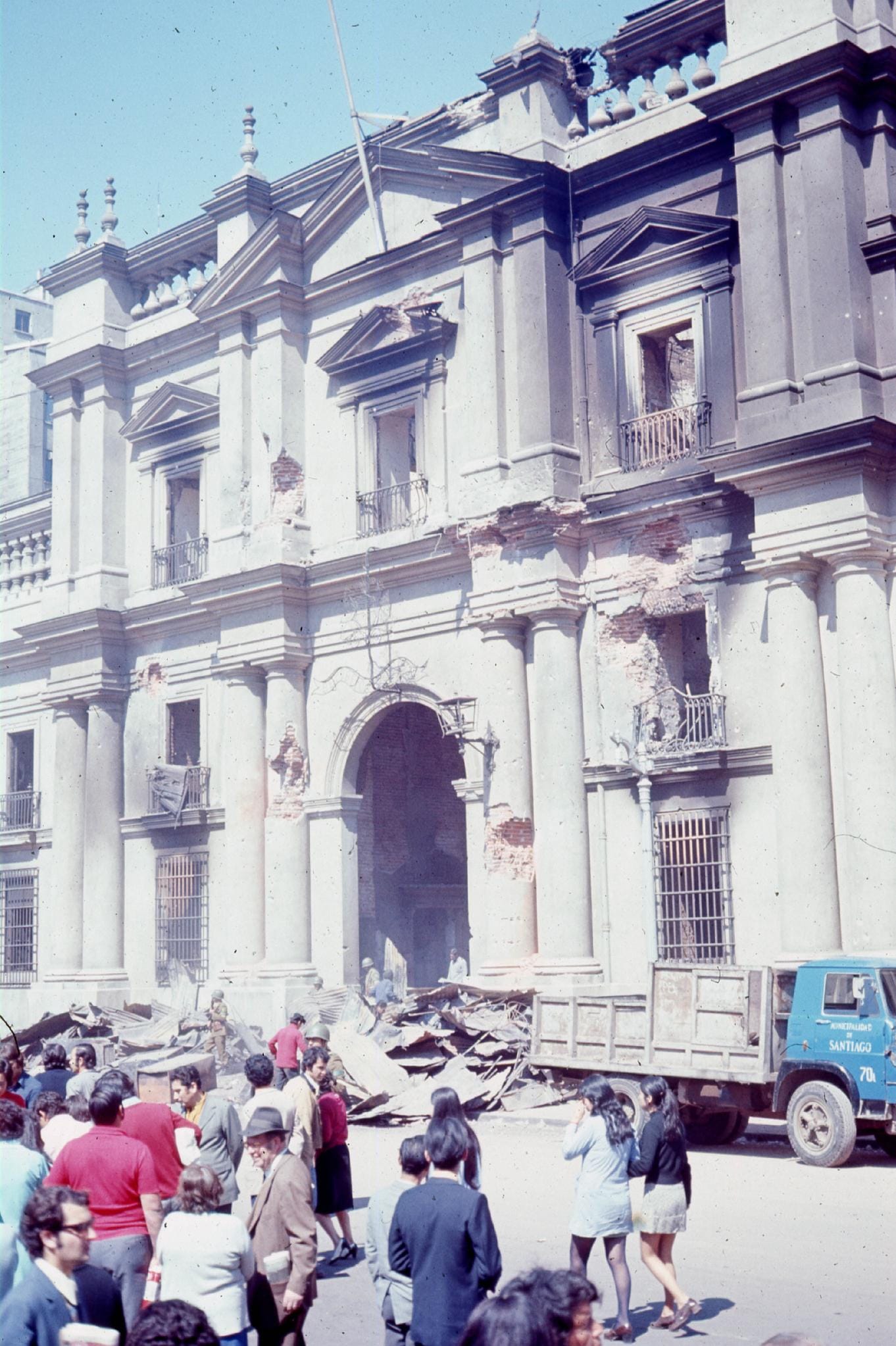
“Do whatever you want with this!” —Chile Air Force Commander in Chief Fernando Matthei to the junta, refusing any changes to the electoral law, 1985
Before the coup, Chileans prided themselves on their tradition of democracy. In a single late winter day, this idea collapsed in on itself.
In its early days, the junta was perceived as an interim government. Most people were convinced that the new military regime would call for open elections before 1975 at the latest, and Chile would again have an elected President and Congress. The dictatorship never argued that they would hold power in perpetuity. Instead, their rule extended indefinitely.
Years passed and a new Constitution was approved in 1980 by a referendum many still consider illegitimate. In its aftermath, Pinochet became Chile’s constitutional President, going so far as to move official operations back to the presidential palace, with the junta relegated to an ersatz Congress.
But unlike other dictators, Pinochet’s explicit rejection of “politics” prevented a long-lasting cult of personality consolidating around his figure. While his admirers “Were Millions” (as claimed by the propaganda slogan), the personal loyalty towards the man was a world apart from the quasi-religious devotion dedicated to, for example, Argentina’s Perón, Nicaragua’s Ortega, or the Castro family in Cuba.
After 1983 and a decade of near-total silence and repression, protests calling for the dictatorship’s end became a common occurrence. The Constitution called for Pinochet to rule for a “transitional” period of eight years, after which an election on his continuity would be called. In the meantime, parties were still outlawed under the official “political recess”. The opposition was forced to operate within parameters set by the military government. While being left with little choice than to follow the dictatorship’s schedule, the opposition was also fearful to repeat the days of bloody strife that preceded the 1973 coup. Chile and its citizens would be better served by a constructive opposition than aiming for revolution. Even in the darkest days of the dictatorship, Chileans saw themselves as citizens of a republic.
With the exception of the Communist Party, none of the marginalized political voices would entertain fantasies of armed revolution. The costs of an open civil conflict would outweigh the eventual outcome of ousting Pinochet. Chilean history still remembered the brief yet brutal civil war of 1891, in which the army and navy fought on opposite sides after President Balmaceda proclaimed that he could rule without Congressional oversight.
The opposition would support an election if the dictatorship guaranteed free and fair voting, with legitimate registries and international oversight. Just as the Constitution and election laws bound the opposition, the junta was also constrained by its own framework.
The Socialists and the Christian Democrats, bitter and often bloody rivals during Allende’s government, joined forces as a single anti-Pinochet bloc: the “Concertación of Parties for the No.” (Concertación is a term with no clean translation to English, cognate with “concert,” as in the 19th century’s “Concert of Europe.”) The Catholic Church also provided indirect support through its non-partisan “Crusade for Citizen Participation”, which actively encouraged people to register to vote. Eventually, more than 91% of eligible citizens were enrolled before the deadline.
“Without hatred, without violence, without fear. No more. Vote No.” —Television ad for the No campaign, 1988.
In a country emptied of cultural expression after the coup, the free market provided new avenues for creatives. Film directors moved to the very lucrative world of television advertising, some amassing small fortunes hawking headache medication and boxed wine. Still, they felt that they owed to themselves to put their talents to work in the campaign against Pinochet.
The No campaign was a marvel of social communication. Using the same language as commercial advertising, they sold a message of happiness and hope. Many on the political side would have preferred a more aggressive approach, rather than using their allotted 15 daily minutes in frivolities such as humorous gags and rock music. Nevertheless, the ad strategy was a resounding success with voters, scoring a record 65% of television viewers.
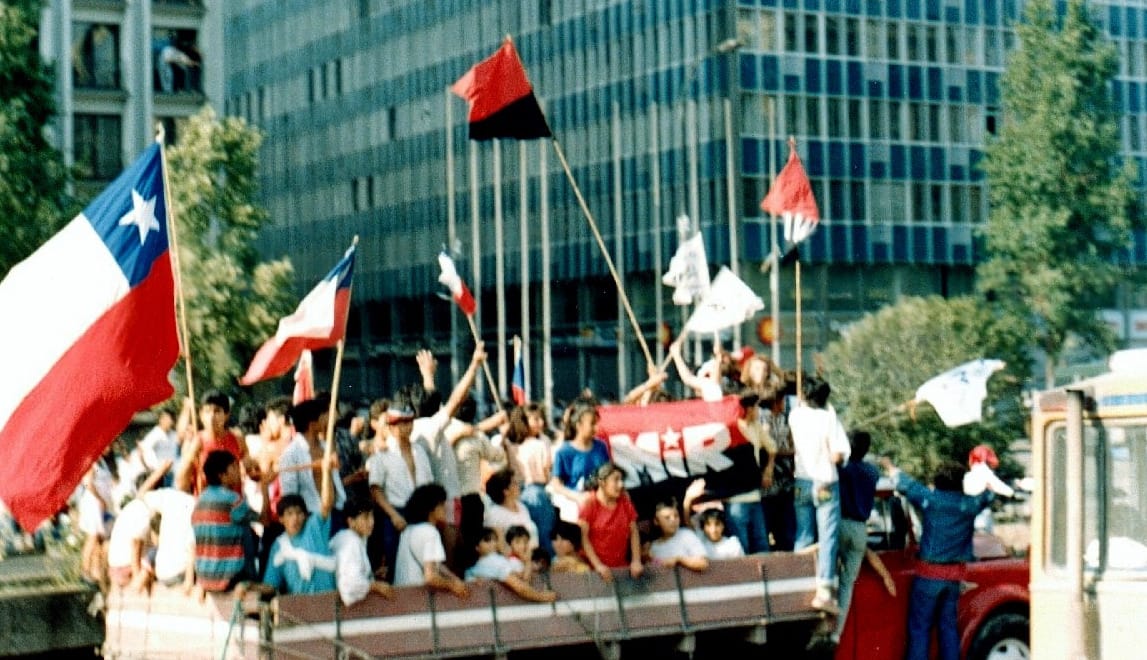
In contrast, the Sí’s bloc was not interested in competing with ideas beyond anodyne export numbers and stoking fears of a second Allende, leaving its campaign behind even in the minds of its own supporters. A late-in-the-day effort tried to parody and imitate No’s message in tone, to little effect.
Another very important, yet overlooked, element of the No campaign was its relentless commitment to patriotism. Rather than cede the national symbols to the dictatorship, the Concertación’s supporters made the wise choice to proudly fly the national flag at every opportunity.
An eager population went to the polls on October 5, 1988. The process, conducted using paper ballots (a system still in use today), was remarkable for its normality. Counting began at 6 pm, with votes read before the campaigns’ supervisors and sent to the Electoral Service in sealed envelopes. The No advantage was clear to everyone, even if the government initially refused to acknowledge it. After the junta’s generals refused to go along with Pinochet’s ploy for “emergency measures” (a naked attempt at an autogolpe), he had no recourse other than to make the results official. At 2:05 am, the government’s spokesman announced the night’s final tally: 53.31% for No.
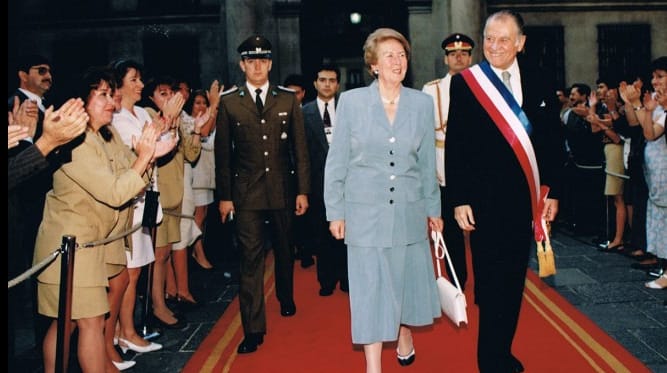
“Yes, fellow citizens! Civilians and military! Chile is only one!” —President Patricio Aylwin on his inaugural act, 1990
On March 11, 1990, Patricio Aylwin was inaugurated as Chile’s first democratically elected president in seventeen years. One of his first acts in office was to establish a committee to investigate human rights abuses committed during the dictatorship, gather a list of victims, and compensate them or their families where possible.
The Truth and Reconciliation Commission (the first in the world with that name; the better-known example in South Africa would follow Chile’s two years later) came short of true justice for the victims. In contrast to the junta trials in Raúl Alfonsin’s Argentina, the Commission had no prosecutorial powers. While some of the most egregious human rights abusers were eventually convicted in the years since, none of the junta’s generals were put on trial, apart from Pinochet’s abortive 1998 house arrest in London.
“With everything, or what for?” —Common protest graffiti, 2019
In late 2019, a youth-led protest movement turned into a “social outburst” that threatened the country’s institutional foundations.
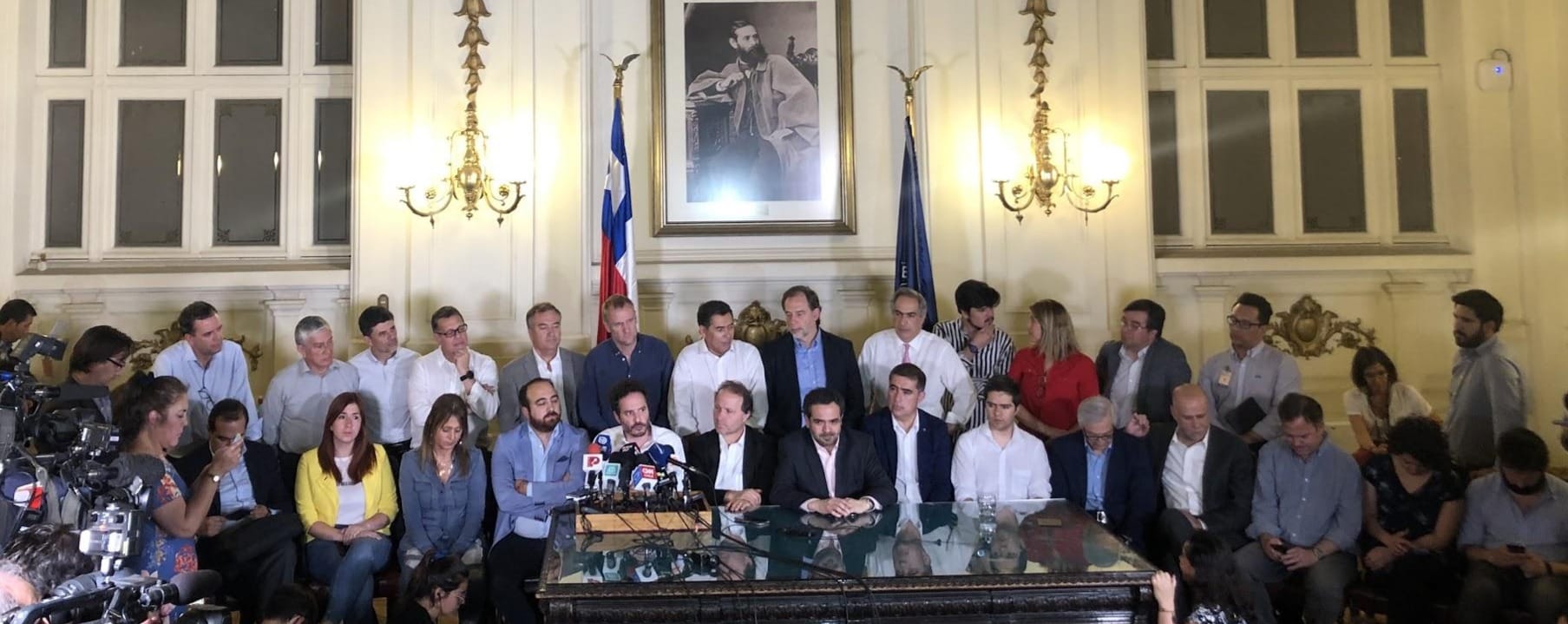
Starting in October, episodes of police brutality, political violence, and looting became a daily occurrence. While some held their hopes for revolutionary changes, most people were terrified of what could come about for Chile. In the early hours of November 15, the political forces signed an agreement to write a new constitution. Pictures of that night are not glamorous portraits of boldness. Visibly tired men and women were flocked around the gathered press microphones, grasping the hope to avoid a bigger crisis.
Ultimately, the experiment of an “inclusive” constitution failed. In 2022, voters rejected the proposal by a two-digit margin. Some have argued that the Constitutional Convention was a victim of its own hubris. Convinced they had a mandate for refoundation, their project radically changed many of the institutions and traditions of Chile’s sociopolitical landscape. The promise of more rights was not enough to convince a majority of voters that this new document would represent their idea of what Chile ought to be. A second attempt at a new constitution, this time dominated by the right wing, did not persuade voters either and was defeated by a similar share a year later.
Chile’s institutions are still organized under the 1980 Constitution. Although heavily amended out of its most authoritarian elements in the years since, with a population exhausted from the political turmoil that coincided with the COVID-19 pandemic, it is likely that it will remain in force for the foreseeable future.
With both new constitutional proposals dominated by a single political camp, Chile missed an opportunity to create a Constitution of true national agreement. While democracy and the rule of law are not in immediate jeopardy, Chile has not exempted itself from the process of deep political polarization seen across the world. The most recent presidential election in 2025 was a choice between arch-conservative José Antonio Kast and Communist Jeanette Jara. The former’s campaign on tough-on-crime policies gave him a narrow victory over the left.
No society is guaranteed perpetual peace and prosperity. New generations—effectively new societies—bring new challenges with them. Historical events and processes ought to serve as lessons for the present, rather than monoliths to be worshipped or derided. Lasting accords will not be made by entrenched oppositions, but by a nation united.
Barros, Robert. Constitutionalism and Dictatorship: Pinochet, the Junta, and the 1980 Constitution. Cambridge, 2002.
Bawden, John R. The Pinochet Generation: The Chilean Military in the Twentieth Century. The University of Alabama Press, 2016.
Cavallo, Ascanio; Salazar, Manuel & Sepúlveda, Óscar. La historia oculta del régimen militar: Memoria de una época, 1973-1988 (The Hidden Story of the Military Regime: Memoir of an Era, 1973-1988). Grijalbo, 1990.
Collier, Simon & Sater, William F. A History of Chile: 1808-2018. Cambridge, 2022.
Contardo, Óscar & García González, Macarena. La era ochentera: TV, pop y under en dictadura (The 80s: TV, Pop and the Underground Under the Dictatorship). Planeta, 2015.
Correa, Sofía; Figueroa, Consuelo; Jocelyn-Holt, Alfredo; Rolle, Claudio & Vicuña, Manuel. Historia del siglo XX chileno (History of the Chilean 20th Century). Universitaria, 2001.
Government of the Republic of Chile. Report of the National Commission for Truth and Reconciliation. Translated by the United States Institute of Peace, 1991.
Rangel, Carlos. The Latin Americans: Their Love-Hate Relationship With the United States. Routledge, 1987.
Sigismund, Paul E. The United States and Democracy in Chile. The Johns Hopkins University Press, 1993.

We know what to do with Trump and his stooges. The harder question is what to do with the ordinary Americans we will have to live alongside afterwards.


We must channel our anger at current injustices into productive direct action.

Social media has been a boon to autocratic regimes and their allied movements in democracies.
Sign up for the newsletter and get our latest stories delivered straight to your inbox.


.jpg?ref=liberalcurrents.com)